Dr. Samhitha Reddy
Consultant Proctologist & Laparoscopic Surgeon
MBBS, MS, FMAS, FISCP, DMAS
- 8 Yrs
- ASCRS Member
Blepharoplasty removes excess skin and repositions fat around the eyes, correcting the hooding, heaviness and under-eye bags that make people look tired regardless of how well they have slept.
It is frequently functional rather than purely cosmetic: heavy upper lids can genuinely obstruct the upper field of vision. Our plastic surgeon at Lux Hospitals, HITEC CITY distinguishes true eyelid excess from a drooping brow, because operating on the wrong one makes things worse.
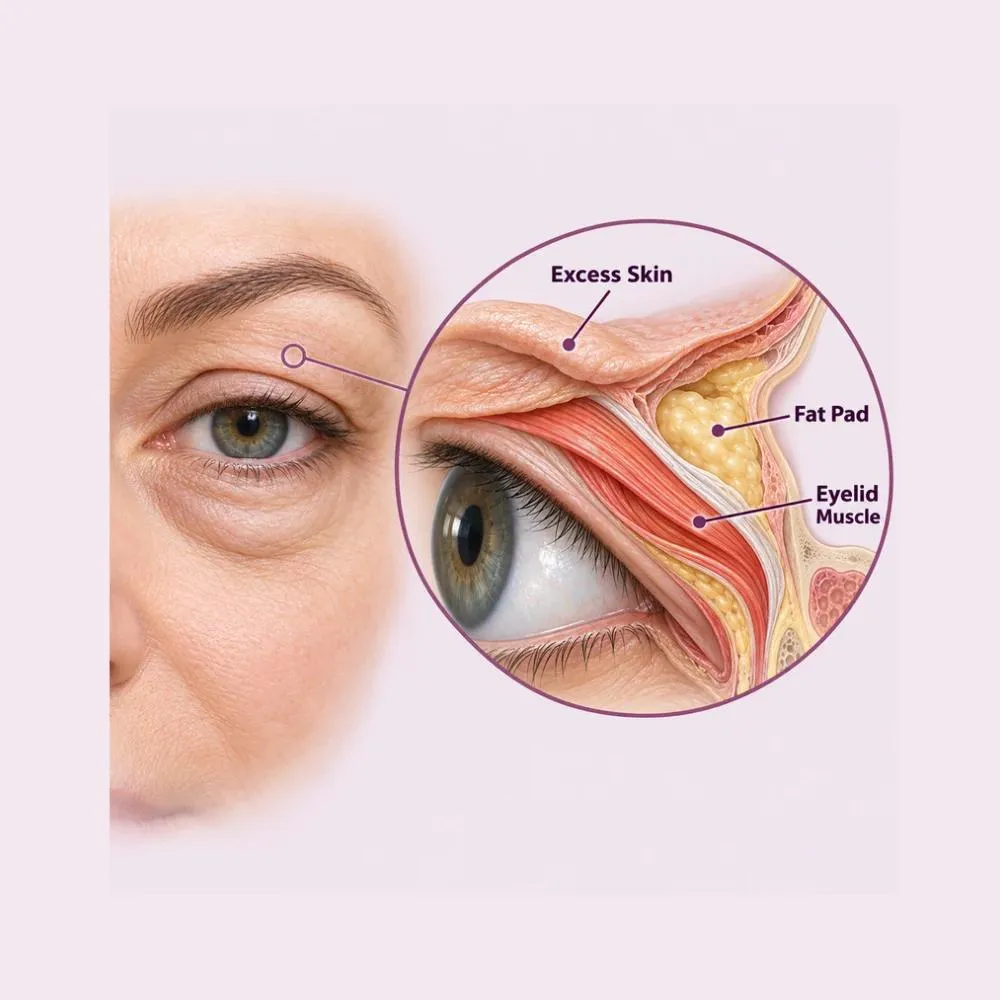
Blepharoplasty is surgery of the eyelids to remove excess skin, reduce or reposition orbital fat, and where necessary tighten supporting structures. Upper blepharoplasty addresses hooding and heaviness of the upper lid; lower blepharoplasty addresses under-eye bags and, sometimes, excess skin below the lash line. They are separate operations and are often done together.
It is one of the few cosmetic procedures that is frequently functional. As upper lid skin descends it can encroach on the upper visual field, and people compensate by raising their brows constantly, which causes forehead ache and deepens forehead lines. Where the obstruction is measurable on visual field testing, the operation is corrective rather than purely aesthetic.
The distinction that governs everything is between eyelid excess and brow descent. When the brow drops, it pushes eyelid skin downward and produces identical-looking hooding. Removing eyelid skin in that situation drags the brow lower still, worsening the appearance and sometimes making the eyes difficult to close. Establishing which is present is the single most important part of the assessment.
Several separate processes converge on a similar appearance around the eyes.
Eyelid skin is the thinnest on the body and shows collagen loss earliest. It stretches and no longer retracts.
The membrane holding orbital fat in place thins, allowing fat to bulge forward as under-eye bags.
The brow drops with age, pushing eyelid skin down and mimicking eyelid excess. This is the crucial distinction to make.
Under-eye bags frequently run in families and appear in people in their twenties, entirely independent of ageing.
Loss of cheek volume creates a hollow beneath the bag, which makes the bag itself look far more prominent.
Salt, alcohol, poor sleep and allergy cause puffiness that fluctuates. This is not fat and no surgery is needed for it.
Weakening of the muscle that lifts the lid, causing genuine drooping of the lid margin over the pupil. A different problem needing different surgery.
True ptosis, where the lid margin itself sits low over the pupil, is not corrected by removing skin. It needs the levator muscle tightened, which is a different operation and easily missed if not specifically tested for.
Upper and lower lid problems present quite differently and are assessed separately.
Upper eyelid symptoms
Lower eyelid and functional symptoms
Constantly raising your eyebrows to see clearly, or forehead ache by the afternoon, both suggest the hooding is genuinely obstructing vision rather than just looking heavy. That is worth mentioning at the consultation.
The assessment separates eyelid excess from brow descent and from true ptosis, and checks the eye itself is healthy.
Holding the brow at its natural position to see how much hooding remains. This distinguishes eyelid excess from brow descent.
Measuring where the lid margin sits relative to the pupil, and levator muscle function, to identify ptosis needing separate correction.
Where hooding appears to obstruct vision, formal testing documents it, which matters both clinically and for insurance.
Tear film testing, since blepharoplasty can worsen pre-existing dry eye. Significant dryness changes how much skin can safely be removed.
Assessing lid tone with snap-back and distraction tests. A lax lower lid needs tightening or it can pull downward after surgery.
Thyroid disease, dry eye, previous laser eye surgery and blood thinners all reviewed, with standardised photographs taken.
Removing too much upper eyelid skin causes lagophthalmos, an inability to close the eyes fully, which leads to corneal exposure and chronic dryness. It is far harder to correct than to prevent.
What works depends on whether the problem is skin, fat, brow position or lid muscle function.
Reducing salt and alcohol, treating allergy and improving sleep, all of which reduce puffiness that fluctuates rather than persists.
Filling the hollow beneath the bag so the bag itself is less obvious. Effective for mild cases, and reversible.
Softens crow’s feet and can produce a modest brow lift. It does nothing for skin excess or fat bulging.
For very mild lower lid crepiness, with subtle results. Not a substitute for surgery where skin excess is significant.
Excess skin and a small amount of muscle removed through an incision hidden in the natural eyelid crease. Day care, quick recovery.
Fat removed or repositioned through an incision inside the lower lid, leaving no external scar. Best where the problem is fat without skin excess.
Through an incision just below the lash line, allowing skin removal as well as fat adjustment. Used where both are present.
Rather than removing fat, moving it into the hollow below to fill the tear trough. Gives a smoother, less hollowed result.
Tightening the outer corner of the lower lid, done alongside lower blepharoplasty where the lid is lax to prevent it pulling downward.
Tightening the levator muscle where the lid margin itself droops. A different operation from skin removal, sometimes done together.
Where the brow has descended, a brow lift is the correct operation and blepharoplasty alone will disappoint. The two are frequently combined, and getting the sequence right is what produces a natural result.
Upper blepharoplasty takes forty-five to sixty minutes; combined upper and lower, up to two hours.
Day-care surgery under local anaesthesia with sedation
Stopping blood thinners and supplements that increase bruising, with fasting where sedation is planned.
The skin to be removed marked with you sitting upright and eyes open. This measurement is the whole operation: too much cannot be undone.
Local anaesthesia with light sedation is standard and comfortable. General anaesthesia is available where preferred.
An incision placed precisely in the natural eyelid crease, where the resulting scar becomes essentially invisible once healed.
The marked skin excised, a strip of muscle sometimes removed, and bulging fat trimmed conservatively: over-removal hollows the eye.
Fat removed or repositioned through the conjunctiva or a subciliary incision, with the outer corner tightened where the lid is lax.
Fine sutures placed, removed at five to seven days. Cold compresses started immediately in recovery.
The marking is the operation. Once skin is removed it cannot be replaced, and the difference between a rested look and an inability to close the eyes is a couple of millimetres.
Eyelid surgery is measured in millimetres and unforgiving of over-correction. Here is why patients trust us:
Eyelid excess distinguished from brow descent and from true ptosis, so the right operation is done rather than the obvious one.
Tear film and lower lid tone tested beforehand, because both determine how much skin can safely be removed.
From the first consultation through to post-treatment follow-up, with one team throughout.
Our hospital is in HITEC CITY, near IKEA: easily reachable from across Hyderabad.
Most people are presentable within ten to fourteen days. Bruising around the eyes is the main limitation.
Swelling and bruising peak. Cold compresses constantly, head elevated. Vision may be blurred from ointment and swelling.
Sutures removed at five to seven days. Bruising begins fading, often moving downward onto the cheeks.
Most bruising resolves and makeup can be worn from around ten days. Most people return to work at one to two weeks.
Residual swelling settles. Scars are pink but flattening. Exercise resumes at two to three weeks.
Scars fade into the eyelid crease and become essentially invisible. Final result established.
This does more to limit bruising and swelling than anything else. Twenty minutes on, twenty off, throughout the first two days.
On two or three pillows for the first week. Lying flat markedly increases periorbital swelling overnight.
Temporary dryness is common for several weeks. Preservative-free drops during the day and ointment at night keep the cornea protected.
They protect healing scars from sun, which prevents darkening, and shield sensitive eyes from wind and dust.
For two weeks. Straining raises pressure around the eye and risks bleeding into the eyelid, which is the one urgent complication.
Severe pain with rapidly increasing swelling and reduced vision suggests a retrobulbar haematoma: a rare emergency needing treatment within hours.
Upper blepharoplasty results last ten to fifteen years and often longer. Lower lid results are generally longer-lasting still, since removed fat does not return.
A consultation is worthwhile if any of the following apply.
Upper and lower blepharoplasty are costed separately, and many patients have both.
| Procedure | Estimated Cost |
|---|---|
| Consultation Includes assessment and photographs | ₹800 – ₹1,500 |
| Visual field testing Where vision is obstructed | ₹1,500 – ₹4,000 |
| Upper blepharoplasty Both eyes, day care | ₹85,000 – ₹1,60,000 |
| Lower blepharoplasty Both eyes, day care | ₹1,10,000 – ₹2,00,000 |
| Combined upper and lower All four lids in one sitting | ₹1,70,000 – ₹3,00,000 |
| Fat repositioning Rather than fat removal | ₹1,40,000 – ₹2,40,000 |
| Ptosis correction Levator tightening; often combined | ₹1,10,000 – ₹2,00,000 |
| With lateral canthopexy Added where the lower lid is lax | ₹30,000 – ₹60,000 |
Upper blepharoplasty is the shorter and less expensive procedure. Lower lid surgery is technically more demanding and costs more.
Ptosis correction, canthopexy or a brow lift performed at the same time each add to the total but avoid a second operation.
Where visual field testing documents genuine obstruction, upper blepharoplasty may be considered functional: worth checking with your insurer.
A shared ward, a twin-sharing room or a private suite: the largest single swing in most estimates.
We are empanelled with most major insurers, and our team files the pre-authorisation for you.
Every figure above is an indicative range, not a quote. After your consultation you are given a written, fixed-cost estimate, and that is the number you pay, with no additions once treatment begins.
The plastic surgeon who performs blepharoplasty at our HITEC CITY hospital.

Consultant Plastic & Cosmetic Surgeon
MBBS, MS, MCh (Plastic Surgery)
16 years experience
Reviews from patients treated for cosmetic and plastic surgery at Lux Hospitals, Hyderabad.
Written by Dr. M. Ram Prabhu on plastic and cosmetic surgery.

Dr. M. Ram Prabhu

Dr. M. Ram Prabhu

Dr. M. Ram Prabhu

Dr. M. Ram Prabhu
Dr. M. Ram Prabhu

Dr. M. Ram Prabhu
Common questions about eyelid surgery, recovery and what blepharoplasty costs at Lux Hospitals.
Still have questions? Call us at 079 6908 4422
Still have questions? Message us on WhatsApp at 079 6908 4444
Eyelid excess, brow position and lid function assessed properly, with costs shared upfront.
Plot No.116, Lumbini Avenue, HITEC CITY, Near IKEA, Hyderabad – 500032