



Dr. Samhitha Reddy
Consultant Proctologist & Laparoscopic Surgeon
MBBS, MS, FMAS, FISCP, DMAS
- 8 Yrs
- ASCRS Member
A spinal cord injury can affect movement, sensation, breathing and bladder or bowel control. It may occur following a road accident, fall, sports injury or another condition that damages the spinal cord. Some injuries cause temporary neurological changes, while others result in lasting weakness or paralysis. The outcome depends on the injury’s location, severity and the medical care received.
Spinal cord injury requires urgent medical assessment, appropriate spinal protection and access to specialist treatment. At Lux Hospitals, Hyderabad, patients and families can enquire about spine specialist consultations and available rehabilitation or referral services.
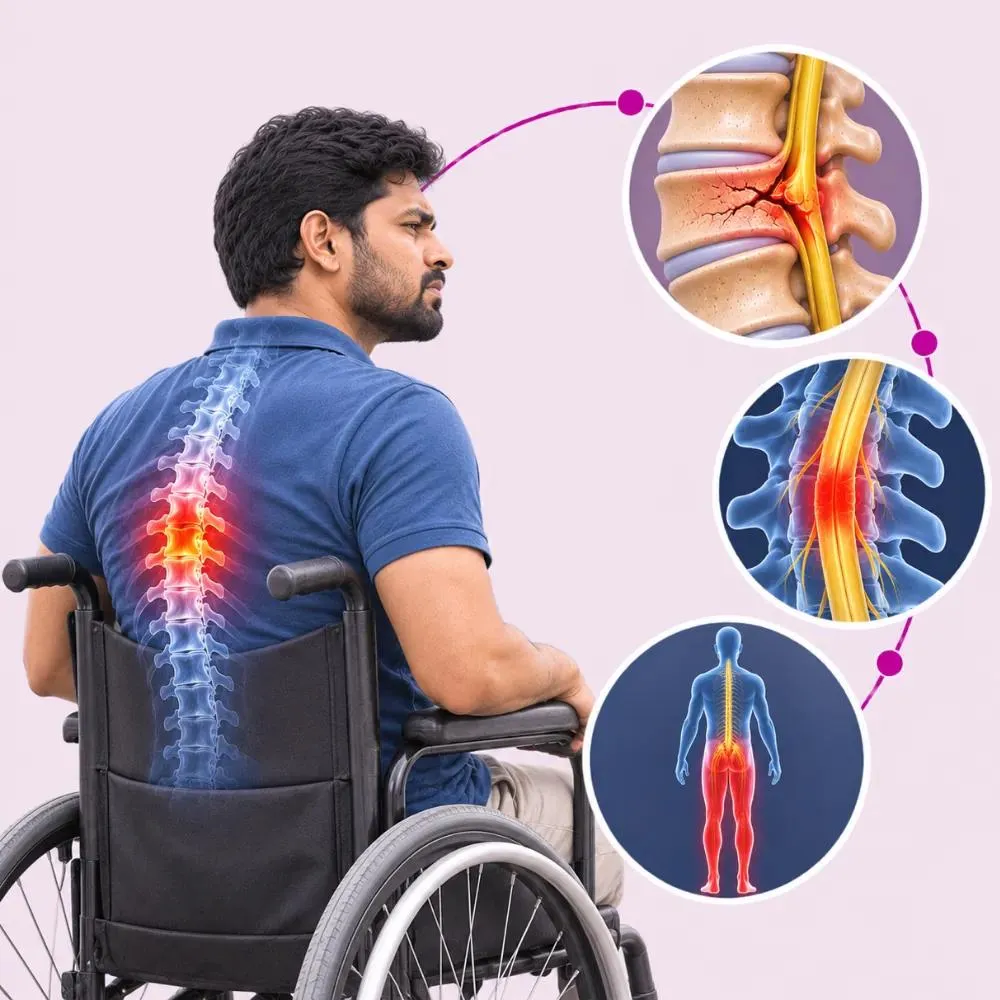
A spinal cord injury (SCI) occurs when the spinal cord becomes damaged, disrupting nerve signals between the brain and the body. When the spinal cord is injured, these signals may be partially or completely interrupted.
Depending on the injury, patients may experience loss of movement or muscle strength, reduced or absent sensation, difficulty walking, changes in bladder or bowel control and sexual dysfunction. The severity of these effects depends on the spinal level and extent of damage.
A spinal cord injury differs from a spinal fracture. A patient may sustain a vertebral fracture without spinal cord injury, or spinal cord injury without an obvious fracture on initial imaging.
Spinal cord injuries are commonly described by neurological level and whether the injury is complete or incomplete. A neurologically complete injury means there is no preserved motor or sensory function in the lowest sacral segments on formal neurological examination; it does not necessarily mean the spinal cord has been physically severed. An incomplete injury involves preserved sensory or motor function below the neurological level of injury, including sacral sparing, and functional recovery varies considerably.
A cervical spinal cord injury can affect both arms and legs, sometimes resulting in tetraplegia, and higher cervical injuries may also affect breathing. Thoracic injuries may affect trunk control, leg movement and functions below the injury level. Injuries involving the lower spinal cord or associated nerve roots may affect the legs, bladder, bowel and pelvic functions; some lower spine injuries primarily damage the cauda equina nerve roots rather than the spinal cord itself.
Spinal cord injury can occur through traumatic and non-traumatic mechanisms.
Vehicle collisions can cause fractures, dislocations or direct injury affecting the spinal cord.
Falls from height or serious falls in older adults may result in spinal fractures and neurological damage.
Contact sports, diving accidents and high-impact activities can occasionally cause cervical or other spinal cord injuries.
Falls and heavy impacts in occupational settings may lead to serious spinal trauma.
Certain violent injuries may directly damage spinal structures or the spinal cord.
Tumours within or near the spinal canal may compress the spinal cord and cause neurological dysfunction.
Conditions such as spinal epidural abscess can compress or damage neurological structures.
Severe cervical spinal stenosis or other degenerative conditions may cause spinal cord dysfunction.
Reduced blood flow or bleeding affecting the spinal cord can occasionally cause spinal cord injury.
The underlying cause determines whether emergency decompression, stabilisation, infection treatment or another approach is required.
Symptoms can begin immediately after trauma or develop as neurological function deteriorates.
Common symptoms
Emergency warning signs: seek immediate emergency care
Not every patient experiences significant neck or back pain. A cervical spinal cord injury may cause weakness in the arms and legs, difficulty gripping objects, reduced hand coordination, walking problems, altered sensation and, in higher cervical injuries, breathing difficulty. A thoracic injury may cause weakness or paralysis in the legs, altered sensation below the chest or abdomen, reduced trunk stability and bladder or bowel dysfunction. A patient with suspected spinal cord injury should not be encouraged to walk or move the neck to test whether everything is normal.
Emergency assessment focuses on identifying neurological injury, protecting the spine and detecting associated trauma.
The trauma team evaluates breathing, circulation, consciousness and other immediate threats to life. Spinal movement is restricted when indicated.
Clinicians review the injury mechanism, symptom onset and changes in movement or sensation.
Clinicians assess motor strength, sensation and sacral neurological function when the patient’s condition permits.
Clinicians can use the International Standards for Neurological Classification of Spinal Cord Injury (ISNCSCI), published by the American Spinal Injury Association (ASIA), to document the neurological level and completeness of the injury.
CT is commonly used to identify spinal fractures, dislocations and bony instability in adults with significant trauma.
MRI helps evaluate spinal cord injury, compression, ligaments, discs and other soft tissues. For adults with neurological abnormalities suggesting spinal cord injury, NICE recommends MRI after CT even when CT does not reveal an obvious cause.
Additional investigations may be necessary to assess associated injuries and medical complications.
Treatment depends on the injury mechanism, neurological findings, spinal stability and overall medical condition. The immediate goal is to prevent avoidable secondary injury while addressing life-threatening problems.
During emergency evaluation and transport, patients with suspected traumatic spinal injuries may need their spinal movement appropriately restricted. Immobilisation must be directed by trained staff.
Severe injury may affect the breathing muscles or blood pressure regulation. Some patients need oxygen, ventilator support or continuous circulatory monitoring.
Repeated neurological examinations help assess changes in strength, sensation and other functions.
Hospital care may include measures to reduce the risk of blood clots, pressure injuries, respiratory complications and other problems.
Patients may have additional fractures, head injuries, bleeding or other conditions requiring urgent management.
Decompression removes or relieves structures placing pressure on the spinal cord. These may include displaced bone, disc material, haematoma or other compressive tissue.
Screws, rods or other implants may be used to stabilise certain fractures or dislocations.
Fusion may be necessary when long-term mechanical stability is required.
Certain cervical injuries require anterior or posterior decompression and stabilisation.
Selected thoracic or lumbar injuries may require fixation, decompression or reconstruction.
Current AO Spine/Praxis guidance recommends offering early decompressive surgery within 24 hours of acute traumatic spinal cord injury when medically feasible and clinically appropriate. This is a treatment-planning recommendation, not a reason to wait for 24 hours: emergency assessment, imaging and surgical referral should occur without avoidable delay.
Some patients do not have an injury that would benefit from decompression or surgical stabilisation. Management may involve appropriate spinal protection, medical treatment, rehabilitation and close follow-up. The treating specialist should select non-surgical care on its merits, not use it to delay assessment of a potentially unstable or compressive injury.
Rehabilitation is an important part of spinal cord injury care. It may include physiotherapy, occupational therapy, mobility training, and wheelchair and assistive-device assessment.
Surgery may be recommended when spinal cord compression, instability or another surgically treatable lesion is present. Not every spinal cord injury requires an operation; the decision depends on the specific injury and medical circumstances.
The exact operation depends on the spinal level, fracture pattern and cause of spinal cord compression.
Spinal decompression and stabilisation
The surgeon reviews neurological findings, imaging and the patient’s medical stability.
The operation is generally performed under general anaesthesia. Special precautions may be necessary for airway management and blood pressure support.
The patient is carefully positioned while the surgical team protects the injured spinal region.
The surgeon approaches the affected area using an appropriate anterior, posterior or combined technique.
Disc material, bone or other compressive structures may be removed when indicated.
Implants or fusion techniques may be used if spinal instability is present.
Following surgery, the patient is monitored for neurological function, breathing, circulation, wound complications and other concerns.
Potential surgical risks include infection, bleeding, nerve injury, cerebrospinal fluid leakage, implant complications, blood clots and anaesthesia-related complications. Surgery can relieve compression or stabilise the spine, but it cannot guarantee restoration of lost neurological function.
Spinal cord injury care requires access to appropriate emergency assessment, imaging, neurological expertise and rehabilitation.
The level and severity of neurological impairment should be assessed using appropriate methods.
CT and MRI may be necessary to determine the cause and extent of injury.
Patients with instability or spinal cord compression require timely specialist evaluation.
Recovery may involve physiotherapy, functional training and management of neurological complications.
Patients can contact Lux Hospitals to enquire about available spine consultations, recovery support and referral arrangements.
Recovery from spinal cord injury differs substantially from recovery after an uncomplicated spine fracture or disc operation. Some patients regain considerable function, while others experience permanent neurological impairment.
Acute care focuses on medical stabilisation, neurological assessment and treatment of spinal injuries. Respiratory and cardiovascular monitoring may be necessary.
Once medically stable, patients may begin appropriate rehabilitation. Early goals may include positioning, maintaining joint movement, preventing pressure injuries and assessing mobility.
Rehabilitation may involve strengthening unaffected muscles, transfers, wheelchair skills and daily living activities.
Patients may continue to develop mobility, balance and functional independence. Rehabilitation may also address bladder, bowel, pain and spasticity management.
Some neurological improvement may continue. Rehabilitation goals are adjusted according to function and treatment response.
Neurological recovery may continue for months or longer, but the degree of recovery is unpredictable.
Regular pressure relief, skin inspection and appropriate positioning can reduce the risk of pressure ulcers.
Some patients require intermittent catheterisation or other bladder-management strategies.
Individualised bowel programmes may help manage constipation or incontinence.
Muscle stiffness and involuntary spasms may require therapy, medication or specialist interventions.
Patients with higher-level injuries may need breathing exercises, airway-clearance support or ongoing respiratory monitoring.
Adjusting to spinal cord injury may involve emotional and psychological challenges.
Physical and occupational rehabilitation can support independence and help prevent secondary complications.
Long-term follow-up helps prevent complications and supports participation in everyday life.
Seek urgent medical assessment if you experience:
The cost of spinal cord injury care depends on injury severity, emergency investigations, surgical treatment, hospitalisation and rehabilitation. Costs may include initial trauma assessment, stabilisation and emergency investigations.
| Procedure | Estimated Cost |
|---|---|
| Spine Fracture Surgery (Fixation) Stabilises fractured vertebrae using implants to protect the spinal cord. | ₹2,50,000 onward |
| Early Decompression (Spinal Cord Injury) Relieves pressure on the spinal cord to reduce further neurological damage. | ₹2,30,000 onward |
The level and extent of the spinal cord injury, and any associated injuries, influence the care required.
Initial trauma assessment, stabilisation, CT, MRI and other investigations depend on the injury and the patient’s condition.
Decompression, fixation and fusion involve different implants, equipment and clinical requirements.
Some patients require prolonged treatment and multidisciplinary support, including rehabilitation.
Every figure above is an indicative starting price, not a final quotation. After clinical assessment, the hospital can provide a personalised estimate based on the treatment recommended, including applicable procedure and hospital charges.

Consultant Endoscopic Spine Surgeon
MBBS, MS (Orthopaedics), Fellowship in Spine Surgery (RGUHS)
7 years experience
Common questions about spinal cord injury, emergency assessment, surgery and rehabilitation.
Still have questions? Call us at 079 6908 4422
Still have questions? Message us on WhatsApp at 079 6908 4444
Spine specialist consultations, rehabilitation and follow-up at Lux Hospitals, HITEC CITY. For a suspected acute spinal cord injury, seek immediate emergency medical care.
Plot No.116, Lumbini Avenue, HITEC CITY, Near IKEA, Hyderabad – 500032













