



Dr. Samhitha Reddy
Consultant Proctologist & Laparoscopic Surgeon
MBBS, MS, FMAS, FISCP, DMAS
- 8 Yrs
- ASCRS Member
Erectile dysfunction is common, treatable, and almost never talked about. Most men manage it silently for years, and a good proportion never seek help at all.
It is also frequently the first warning of something else. ED often precedes heart disease by three to five years, because the arteries supplying the penis are smaller and narrow earlier. Our urologists at Lux Hospitals, HITEC CITY treat the problem and check for what may be underlying it.
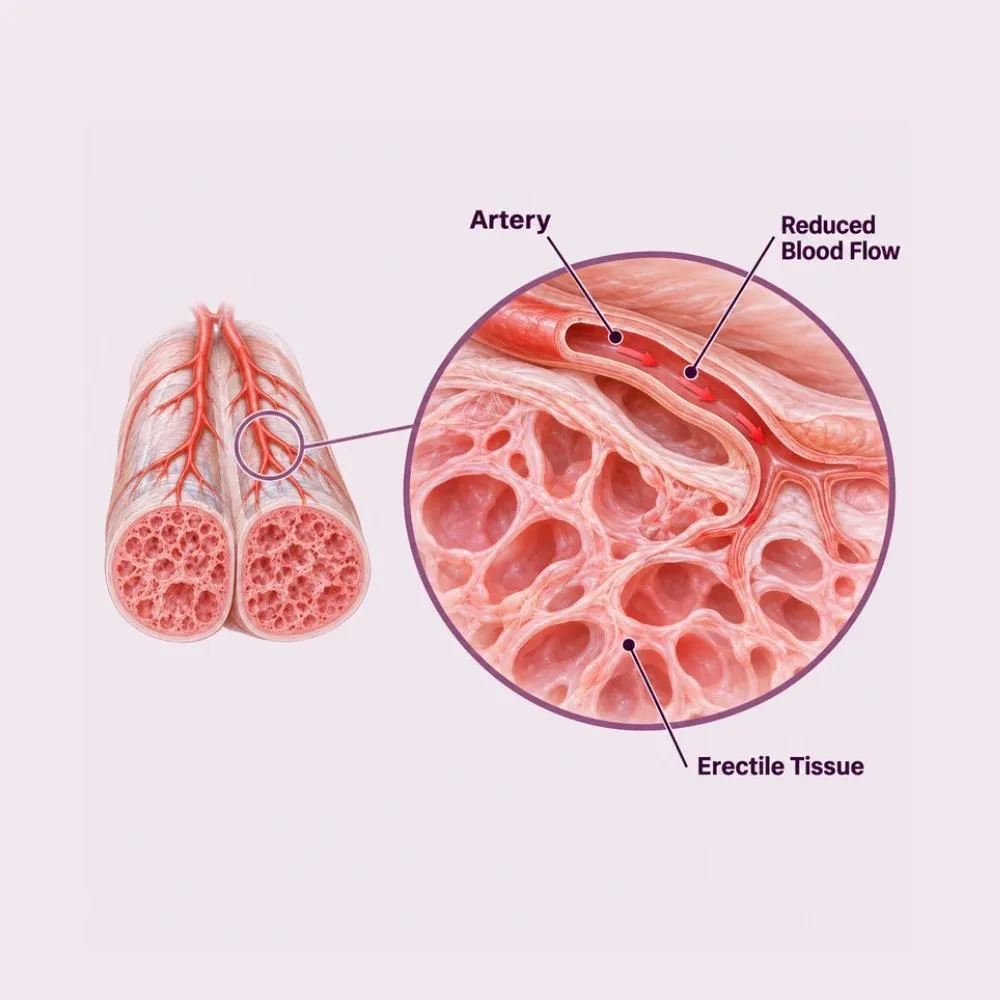
Erectile dysfunction is the persistent inability to achieve or maintain an erection sufficient for satisfactory sexual activity. The word persistent matters: occasional difficulty is normal and universal, and is not a medical condition.
An erection is a vascular event. Arteries dilate to fill the erectile tissue with blood while veins compress to hold it there, coordinated by nerves and hormones. Anything that impairs those arteries, nerves or hormones can cause ED, which is why it so often reflects a wider health problem rather than an isolated one.
The most clinically important fact about ED is what it predicts. The arteries supplying the penis are considerably narrower than the coronary arteries, so they become symptomatic first. ED frequently precedes a cardiac event by three to five years, which makes it a genuine early warning worth acting on rather than a purely quality-of-life issue.
Most cases in men over forty have a physical basis, often with a psychological component layered on top.
Narrowed arteries reduce blood flow to the penis. The commonest physical cause, and the reason ED is treated as a cardiac warning sign.
Damages both the small blood vessels and the nerves controlling erection. ED is considerably commoner and often more severe in diabetic men.
Both damage the arterial lining, and several of the medications used to treat them contribute independently.
Directly damages the arteries supplying the penis. One of the most significant and most reversible causes.
Associated with lower testosterone, worse vascular function and higher rates of ED. Weight loss and exercise measurably improve it.
Reduces desire and contributes to ED. Worth measuring, since it is straightforward to treat where genuinely low.
Beta blockers, thiazide diuretics, antidepressants (particularly SSRIs) and some prostate medications all commonly contribute.
Stress, anxiety, depression and relationship difficulties. Often the primary cause in younger men, and a secondary layer in older ones.
Performance anxiety frequently develops on top of a physical cause, creating a cycle where the worry itself becomes part of the problem. Treating the physical side often breaks that cycle on its own.
The pattern of the problem is more informative than its severity, because it distinguishes physical from psychological causes.
Common symptoms
Patterns that suggest the cause
Whether you still get morning erections is one of the most useful questions in the whole consultation. Their presence suggests the machinery works and the problem is elsewhere.
The assessment establishes the cause and (importantly) screens for the cardiovascular and metabolic disease that frequently underlies it.
The pattern, onset, morning erections, medications and relationship context, with a standard questionnaire to quantify severity.
Blood pressure, body habitus, genital examination for Peyronie’s plaques or testicular abnormality, and peripheral pulses.
Fasting glucose, HbA1c, lipid profile, morning testosterone, thyroid and kidney function: screening for the common underlying causes.
ED is an arterial marker. Assessing cardiac risk is a genuine part of this consultation rather than an aside, and may prompt cardiology referral.
Measures arterial inflow and venous leak after an injection. Used where the cause is unclear or where implant surgery is being considered.
Confirms whether erections occur during sleep, which distinguishes physical from psychological causes objectively.
A man presenting with ED and undiagnosed diabetes or hypertension has had something genuinely valuable found. That is not an incidental finding: it is often the more important half of the consultation.
Treatment is highly effective. Most men respond to oral medication, and there are reliable options for those who do not.
Stopping smoking, losing weight, regular exercise and controlling diabetes and blood pressure. These genuinely improve erectile function, not just general health.
Sildenafil, tadalafil and similar drugs. Effective in around seventy per cent of men, and the first-line treatment. Tadalafil can be taken daily at low dose.
Switching a beta blocker or antidepressant that is contributing, in discussion with the prescribing doctor.
Where testosterone is genuinely low on morning testing. It restores desire and improves the response to PDE5 inhibitors.
A pump drawing blood into the penis with a constriction ring to maintain it. Effective, drug-free, and useful where medication is contraindicated.
For performance anxiety and relationship factors. Frequently combined with medical treatment rather than used alone.
Alprostadil injected into the penis before intercourse. Highly effective even where tablets have failed, and easily self-administered once taught.
Medication placed into the urethra, an alternative for men who prefer to avoid injections.
Acoustic waves applied to the penis to promote new blood vessel formation. Non-invasive, with encouraging results in mild vascular ED.
An inflatable or malleable prosthesis surgically placed inside the penis. The definitive treatment for severe ED, with very high satisfaction rates.
Reconstruction of arterial supply in selected younger men with a discrete post-traumatic arterial injury. Rarely applicable.
Penile implant surgery is the last step and consistently reports among the highest satisfaction rates of any urological procedure (over ninety per cent) because it reliably works when nothing else has.
Treatment is a sequence rather than a single procedure, and most men do not need to progress far along it.
Stepped treatment programme
A private discussion of the pattern, duration and context, with a genital examination and blood pressure check.
Glucose, HbA1c, lipids and morning testosterone. This is where undiagnosed diabetes or a treatable hormone problem is frequently found.
Stopping smoking, adjusting contributing medications, controlling diabetes and blood pressure, and starting exercise.
A PDE5 inhibitor, with clear instruction on how to take it: timing, food effects and the need for sexual stimulation. Most apparent failures are actually incorrect use.
Trying the maximum dose on at least four to six separate occasions before concluding it does not work, and considering a daily low dose instead.
Injections, vacuum device or shockwave therapy where tablets are insufficient, with training in technique.
Discussed where nothing else has worked, with a full explanation of what is involved and its permanence.
A great many men conclude the tablets do not work when they have taken them incorrectly: too soon after a heavy meal, without stimulation, or only once. Getting the technique right rescues a substantial proportion.
ED deserves a proper medical assessment rather than a prescription handed over a counter. Here is why patients trust us:
Private consultations with urologists for whom this is an everyday conversation, not an awkward one.
Screening for diabetes, cardiovascular disease and low testosterone, because ED is frequently the first sign of one of them.
From the first consultation through to post-treatment follow-up, with one team throughout.
Our hospital is in HITEC CITY, near IKEA: easily reachable from across Hyderabad.
Most men see improvement within weeks. The lifestyle changes take longer but produce the most durable benefit.
Assessment complete and first-line medication started. Contributing drugs reviewed and lifestyle changes begun.
Medication trialled properly across several occasions at optimal dose. Most men who will respond have done so by this point.
Where tablets have not worked, second-line options are introduced. Lifestyle changes begin showing measurable effect.
Weight loss, exercise and better diabetic control produce genuine improvement in erectile function independent of medication.
Ongoing management of the underlying cardiovascular and metabolic risk, which matters well beyond the sexual symptom.
Sildenafil on an empty stomach an hour before; tadalafil lasts far longer and is less food-dependent. Sexual stimulation is still required: they do not work by themselves.
Aerobic exercise improves erectile function measurably. It is one of the few interventions that treats the cause rather than the symptom.
Directly damages the arteries supplying the penis. Stopping produces improvement, and it is among the most effective single changes.
ED often precedes heart disease by three to five years. If cardiac assessment is advised, it is worth having.
PDE5 inhibitors with nitrate heart medication can cause a dangerous drop in blood pressure. Always disclose your full medication list.
Relationship factors and performance anxiety respond considerably better when addressed together than alone.
Beware of unregulated clinics and online products promising instant cures. ED is straightforward to assess and treat properly, and the assessment frequently uncovers something more important than the symptom itself.
Book a consultation if any of the following apply.
Assessment and first-line treatment are inexpensive. Costs rise only for the advanced options a minority need.
| Procedure | Estimated Cost |
|---|---|
| Consultation Private and confidential | ₹800 – ₹1,500 |
| Screening blood tests Glucose, lipids, testosterone and thyroid | ₹2,500 – ₹6,000 |
| PDE5 inhibitor medication Per month, depending on the drug and frequency | ₹400 – ₹2,000 |
| Penile Doppler ultrasound Where the cause is unclear | ₹4,000 – ₹9,000 |
| Intracavernosal injection therapy Per month, including training | ₹1,500 – ₹5,000 |
| Shockwave therapy course Six to twelve sessions | ₹35,000 – ₹80,000 |
| Inflatable penile implant Includes the device; two nights’ stay | ₹4,50,000 – ₹8,00,000 |
Most men are treated with tablets at a few hundred rupees monthly. Only a small minority progress to implant surgery.
Where diabetes or heart disease is diagnosed, treating that is a separate but genuinely more important cost.
A penile implant is dominated by the price of the prosthesis, and inflatable devices cost considerably more than malleable ones.
A shared ward, a twin-sharing room or a private suite: the largest single swing in most estimates.
We are empanelled with most major insurers, and our team files the pre-authorisation for you.
Every figure above is an indicative range, not a quote. After your consultation you are given a written, fixed-cost estimate, and that is the number you pay, with no additions once treatment begins.
The urologists who treat erectile dysfunction at our HITEC CITY hospital.

Consultant Urologist & Andrologist
MBBS, MS, DrNB (Urology)
10 years experience

Consultant Urologist & Andrologist
MBBS, MS, MCh (Urology)
9 years experience
Reviews from patients treated for urological and men’s health conditions at Lux Hospitals, Hyderabad.
Written by Dr. Vipin Reddy B on men’s health and urological care.
Dr. Vipin Reddy B
Dr. Vipin Reddy B
Dr. Vipin Reddy B
Dr. Vipin Reddy B

Dr. Vipin Reddy B

Dr. Vipin Reddy B
Common questions about erectile dysfunction, its treatment, and what care costs at Lux Hospitals.
Still have questions? Call us at 079 6908 4422
Still have questions? Message us on WhatsApp at 079 6908 4444
Private assessment of erectile dysfunction including screening for the causes behind it, with costs shared upfront.
Plot No.116, Lumbini Avenue, HITEC CITY, Near IKEA, Hyderabad – 500032













