



Dr. Samhitha Reddy
Consultant Proctologist & Laparoscopic Surgeon
MBBS, MS, FMAS, FISCP, DMAS
- 8 Yrs
- ASCRS Member
Rectal prolapse is when the rectum loses its attachments and slides down through the anus. It is distressing, it worsens over time, and unlike many bowel complaints it does not settle with diet alone.
Surgery is what corrects it, and modern surgery does so through keyhole incisions. Our colorectal surgeons at Lux Hospitals, HITEC CITY perform laparoscopic rectopexy and perineal procedures, choosing the approach that fits your age, fitness and the degree of prolapse.
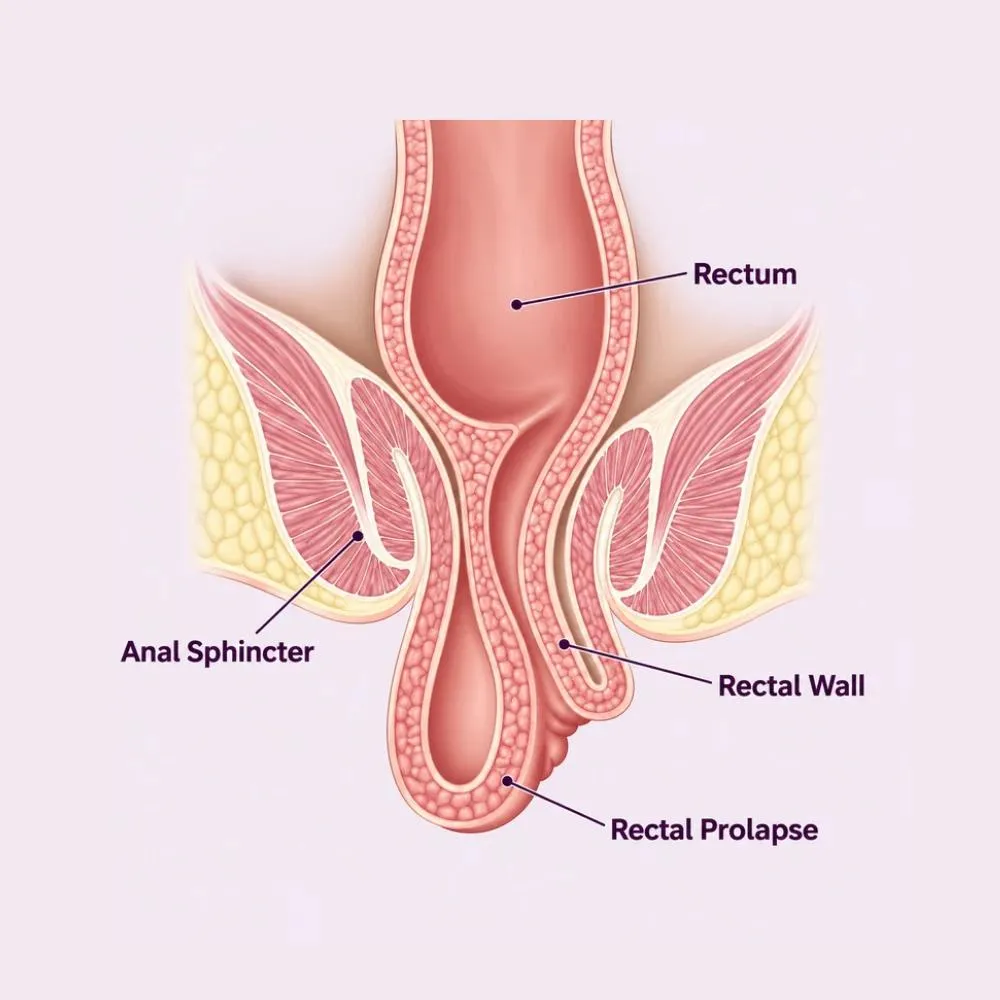
Rectal prolapse occurs when the rectum, the last part of the large intestine, loses the support that holds it in place and telescopes down and out through the anus. What appears outside is a red, moist tube of bowel with concentric rings on its surface.
It comes in three degrees. An internal prolapse, or intussusception, stays inside and causes a blocked, incomplete feeling rather than a visible lump. A partial prolapse involves only the lining. A complete prolapse, or procidentia, is the full thickness of the rectum coming through, and is the one that needs surgical repair.
Rectal prolapse is often confused with piles, and the distinction matters because the treatments are entirely different. Prolapsed piles appear as separate lobes with grooves between them; a rectal prolapse is a single continuous tube with rings running around it.
Prolapse is a failure of support. The ligaments that anchor the rectum stretch, the pelvic floor weakens, and sustained downward pressure does the rest.
Years of pushing hard against a closed pelvic floor stretches the rectal attachments until they no longer hold.
The muscular sling that supports the pelvic organs weakens, and the rectum descends through the gap it leaves.
Vaginal delivery, especially prolonged or instrumental, stretches and can damage the pelvic floor and its nerves.
Ligaments loosen and sphincter tone falls with age, which is why prolapse is commonest in women over fifty.
Injury to the nerves supplying the pelvic floor (from surgery, spinal disease, diabetes or a difficult delivery) weakens the whole support system.
Operations in the pelvis can divide or scar the tissues that would otherwise anchor the rectum.
Anything that repeatedly raises abdominal pressure pushes the rectum downward day after day.
A deep pouch of Douglas, a redundant sigmoid colon, or a naturally loose rectal attachment all make prolapse more likely.
Almost all of these come back to the same thing: sustained downward pressure meeting weakened support. That is why surgery restores the anchor, and why the diet advice afterwards is not optional.
The early stages come and go with bowel movements. Left untreated, the prolapse comes down more easily and stays out longer, until eventually it does not go back at all.
What you notice
As it progresses
A prolapse that cannot be pushed back and has turned dusky or very painful may be strangulated. That is an emergency and needs attention immediately, not an appointment.
A full-thickness prolapse is obvious once it is visible: the difficulty is that it often will not appear on demand in a consulting room. Confirming it sometimes takes a little ingenuity.
Inspection of the anus, and asking you to strain as if passing stool, often while squatting or seated, to bring the prolapse down where it can be seen.
Assesses sphincter tone and squeeze pressure, which predicts how much continence is likely to recover after repair.
Views the rectal lining directly, looking for a solitary rectal ulcer and ruling out a tumour as the lead point.
An X-ray or MRI study taken while you empty the bowel. It is the test that shows an internal prolapse, which no examination can see.
Measures sphincter pressures and rectal sensation, guiding whether pelvic floor rehabilitation should accompany surgery.
Advised in older patients and where there is bleeding, to exclude a polyp or cancer acting as the lead point of the prolapse.
If the prolapse only appears at home, a clear photograph taken on your phone is genuinely useful and saves a great deal of investigation.
Conservative measures control symptoms and are worth doing, but a full-thickness prolapse in an adult does not resolve without surgery. The choice of operation turns on your fitness rather than on the prolapse alone.
More fibre and fluid to prevent constipation and eliminate straining: the pressure that caused the prolapse and that would undo any repair.
Supervised physiotherapy strengthens the muscular sling supporting the rectum. Most effective for early or internal prolapse.
Retrains the coordination between abdominal push and pelvic floor relaxation, so emptying no longer requires straining.
Make bowel movements effortless, which controls symptoms and protects the repair afterwards.
Gently pushing the prolapse back after each bowel movement. It relieves the immediate problem but treats nothing: a holding measure, not a solution.
The standard repair. Through a few keyhole incisions the rectum is mobilised, lifted back into position and fixed to the sacrum, usually with a mesh. Excellent long-term results and a quick recovery.
A refinement in which the mesh is placed only on the front of the rectum, avoiding the nerves at the back. It corrects the prolapse with far less risk of post-operative constipation.
The same operation with robotic instrumentation, giving greater precision deep in the pelvis where the working space is narrow.
Fixation combined with removal of a redundant length of sigmoid colon. Chosen where severe constipation accompanies the prolapse.
Delorme’s and Altemeier’s operations are performed entirely through the anus, with no abdominal incision. Well suited to elderly or high-risk patients who would not tolerate an abdominal operation.
Abdominal repairs have the lowest recurrence rate and are preferred for fit patients. Perineal repairs are gentler and are the right answer for those who are frail: the decision is made with you, on your overall health.
A keyhole operation taking around ninety minutes to two hours. Three or four small incisions, a one to two night stay, and a repair that holds.
Laparoscopic ventral mesh rectopexy
Bloods, an ECG, an anaesthetic review, and bowel preparation. A defecating proctogram is reviewed to confirm the pattern of prolapse.
General anaesthetic. The abdomen is inflated with carbon dioxide and three or four ports of five to twelve millimetres are placed.
The rectum is freed from its surroundings down to the pelvic floor. In a ventral repair, dissection is kept to the front so the nerves behind are left untouched.
A strip of mesh is secured to the front of the rectum and then to the sacral promontory, lifting the rectum back to its proper position and holding it there.
The peritoneum is closed over the mesh so it is not left in contact with the small bowel: the step that prevents adhesions later.
Where a redundant sigmoid colon is contributing to severe constipation, it is resected and rejoined in the same sitting.
Overnight observation, eating and walking the next morning, and home after one to two nights with a follow-up date.
Fixing the prolapse also improves continence in most patients, because the sphincter is no longer being stretched open by bowel sitting in it. That improvement continues over several months rather than arriving at once.
Prolapse surgery is pelvic floor surgery, and it rewards experience with the anatomy. Here is why patients trust us:
Specialists including Dr. Samhitha Reddy, a member of the American Society of Colon & Rectal Surgeons, with a dedicated colorectal practice.
Laparoscopic and robotic-assisted rectopexy, so the repair is done through keyhole incisions rather than an open one.
From the first consultation through to post-treatment follow-up, with one team throughout.
Our hospital is in HITEC CITY, near IKEA: easily reachable from across Hyderabad.
Keyhole surgery means you are up and walking the next day. The internal repair, however, takes about three months to become fully strong, and that is what the lifting restrictions are for.
Overnight in the ward. Sips of fluid the same evening, walking and light diet the next morning.
Home once you are eating, walking and comfortable on oral painkillers. Bowels usually open by day two or three.
Gentle walking daily. Stool softeners continue so nothing is strained against. First follow-up review.
Desk work resumes and most normal activity returns. Driving from around two weeks, once you can brake without hesitating.
Full activity, gym and heavy work resume progressively. Continence continues improving over this period and beyond.
This is the whole point. Straining is what stretched the attachments the first time, and it will stretch a repair just as effectively.
Keep stools soft and regular for the long term, not just for the first few weeks. Take the softeners for as long as advised.
Nothing above five kilos for six weeks, and build back gradually after that. The mesh needs time to integrate.
Restart once your surgeon clears you. They are what consolidate the improvement in continence after the anatomy is fixed.
Fever, worsening abdominal pain, vomiting, no bowel movement with a distended abdomen, or the prolapse reappearing.
Reviews at six weeks, three months and a year. Recurrence, when it happens, is usually late, which is what late reviews are for.
Recurrence rates after laparoscopic rectopexy are low, in the region of five to ten per cent over the long term, and are lowest in patients who genuinely stop straining.
Book a consultation if any of the following apply.
Cost tracks the operation performed and the length of stay. These are the ranges our patients fall into.
| Procedure | Estimated Cost |
|---|---|
| Consultation & conservative management Out-patient, including biofeedback sessions | ₹2,000 – ₹15,000 |
| Perineal procedure (Delorme’s) One to two nights’ stay | ₹65,000 – ₹1,00,000 |
| Laparoscopic rectopexy Two nights’ stay, mesh included | ₹1,20,000 – ₹1,90,000 |
| Robotic-assisted rectopexy Two to three nights’ stay | ₹1,80,000 – ₹2,80,000 |
| Resection rectopexy Three to five nights’ stay | ₹1,60,000 – ₹2,50,000 |
A keyhole abdominal repair and a perineal repair differ substantially in theatre time, consumables and stay.
Adding a sigmoid resection means a stapler, a longer operation and a longer stay.
Biological and synthetic meshes differ considerably in price, and the choice is made on your tissue and history.
A shared ward, a twin-sharing room or a private suite: the largest single swing in most estimates.
We are empanelled with most major insurers, and our team files the pre-authorisation for you.
Every figure above is an indicative range, not a quote. After your consultation you are given a written, fixed-cost estimate, and that is the number you pay, with no additions once treatment begins.
What patients treated here can expect:
Keyhole surgery with a one to two night stay and a fast return to routine.
The prolapse, the discomfort and the mucus discharge resolve together.
Continence improves in most patients over the months after repair.
The colorectal and pelvic floor surgeons who treat rectal prolapse at our HITEC CITY hospital.

Consultant Proctologist & Laparoscopic Surgeon
MBBS, MS, FMAS, FISCP, DMAS
8 years experience

Consultant General & Advanced Laparoscopic Surgeon
MBBS, MS, FMAS
17 years experience
Reviews from patients treated for prolapse, piles and colorectal conditions at Lux Hospitals, Hyderabad.
Written by Dr. Samhitha Reddy on prolapse, piles and colorectal health.

Dr. Samhitha Reddy


Dr. Samhitha Reddy

Dr. Samhitha Reddy

Dr. Samhitha Reddy

Dr. Samhitha Reddy
Common questions about rectal prolapse, its surgery, and what treatment costs at Lux Hospitals.
Still have questions? Call us at 079 6908 4422
Still have questions? Message us on WhatsApp at 079 6908 4444
Laparoscopic and robotic rectopexy by experienced colorectal surgeons, with a fixed-cost estimate shared before treatment begins.
Plot No.116, Lumbini Avenue, HITEC CITY, Near IKEA, Hyderabad – 500032













