Dr. Samhitha Reddy
Consultant Proctologist & Laparoscopic Surgeon
MBBS, MS, FMAS, FISCP, DMAS
- 8 Yrs
- ASCRS Member
Knee replacement is one of the most reliably successful operations in surgery. It is done for pain rather than for X-ray appearance: the question is not how bad the knee looks, but how much it is limiting your life.
Not everyone with knee arthritis needs a replacement, and not every replacement needs to be a total one. Our orthopaedic surgeons at Lux Hospitals, HITEC CITY offer partial, total and robotic-assisted knee replacement, and will tell you honestly which (if any) you actually need.
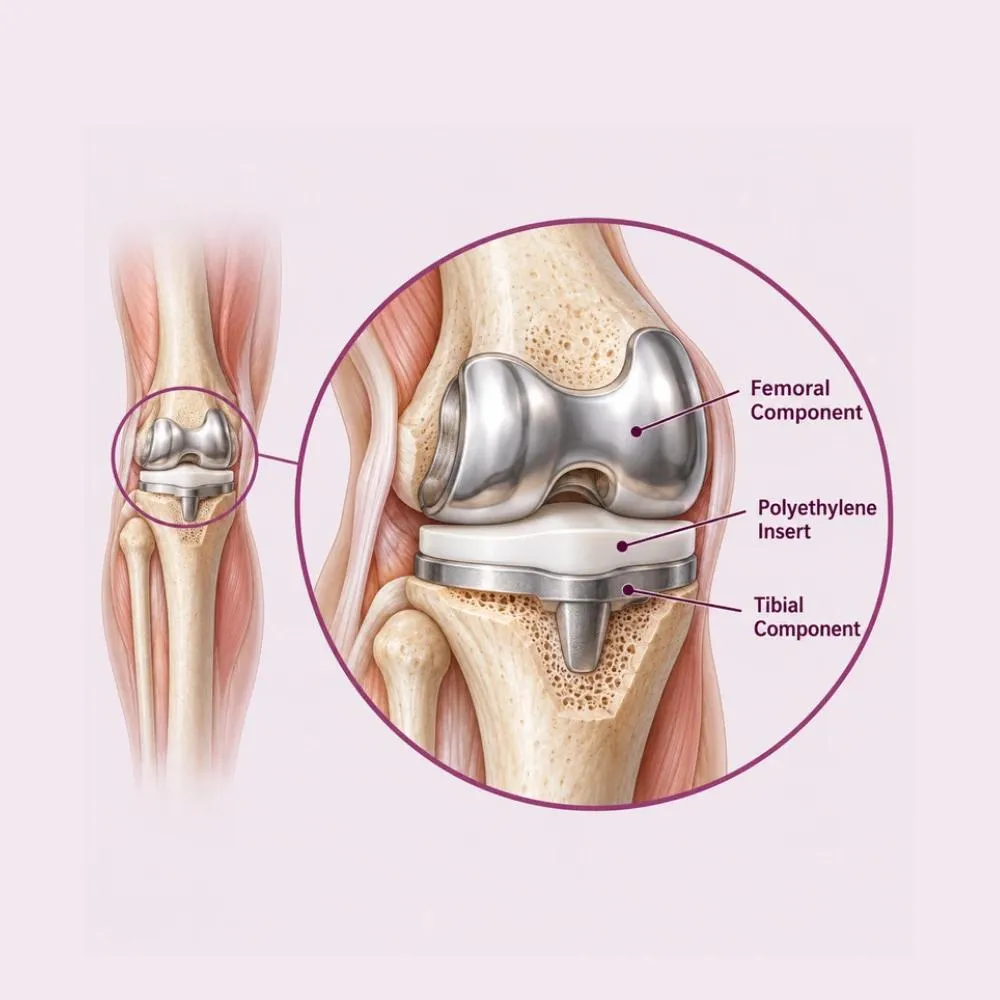
Knee replacement surgery removes the worn-out surfaces of the knee joint and resurfaces them with metal and plastic components. The name is slightly misleading: the whole knee is not removed and replaced. What is taken is a few millimetres of damaged bone and cartilage from the ends of the femur and tibia, and the ligaments that stabilise the knee are largely preserved.
It is done almost entirely for pain. The decision does not rest on how severe the arthritis looks on an X-ray, because appearance and symptoms correlate poorly: some people with dramatic-looking X-rays manage comfortably, and others with modest changes are in genuine difficulty. What matters is whether pain is limiting your walking, your sleep and your independence despite proper non-surgical treatment.
There are three main types. A total knee replacement resurfaces all three compartments. A partial replacement resurfaces only the damaged compartment, preserving healthy bone and ligaments: it gives a more natural-feeling knee but suits only around a quarter of patients. Robotic-assisted replacement uses navigation to place the components more precisely, which is particularly useful in unusual anatomy.
Most knee replacements are done for osteoarthritis, but several conditions produce the same end result of a worn-out joint.
By far the commonest reason. The cartilage covering the joint surfaces wears away over years, leaving bone rubbing on bone.
Inflammatory arthritis that attacks the joint lining, destroying cartilage and bone more rapidly and often at a younger age.
Arthritis developing years after a fracture involving the joint surface, or after a significant ligament or meniscal injury.
Every kilogram of body weight puts several kilograms of force through the knee when walking. It is the single most modifiable factor.
Removing a large part of the meniscus increases load on the cartilage and accelerates arthritis over the following decades.
Bow legs or knock knees concentrate load on one compartment, wearing it out much faster than the rest.
Loss of blood supply to a portion of bone, which collapses and destroys the overlying joint surface.
Osteoarthritis runs in families, and prevalence rises steeply after fifty regardless of activity.
Weight is the factor most worth acting on before surgery. Losing excess weight reduces pain in its own right, makes the operation safer, and materially extends how long the implant lasts.
These are the problems that lead people to a replacement, and the point is that they must have persisted despite genuine non-surgical treatment first.
Symptoms that suggest it may be time
Reasons to wait or reconsider
Night pain is often the symptom that tips the balance. Pain on walking can be worked around; pain that wakes you regularly generally cannot, and it is a reasonable point at which to consider surgery.
The assessment establishes whether a replacement is the right answer, which type suits your knee, and whether you are fit for it.
Assessment of range of motion, stability, ligament integrity, alignment and gait, plus examination of the hip and spine, which can refer pain to the knee.
Taken standing, since the joint space narrowing that matters only shows under load. Long-leg films assess overall alignment.
Used where soft tissue damage needs assessing, where the diagnosis is unclear, or for planning in robotic-assisted surgery.
Screening for anaemia, infection and diabetes control, with review of blood thinners and other medication that must be paused.
Discussion of spinal versus general anaesthesia, and cardiac assessment where age or history calls for it.
Strengthening the quadriceps before surgery measurably improves recovery afterwards. It is worth the weeks it takes.
Pain from the hip or the lower back frequently refers to the knee, and replacing a knee that was not the source is a poor outcome. Examining those is a routine part of the assessment.
Replacement is the last step, not the first. Non-surgical treatment should be genuinely exhausted first, and for many patients it is sufficient for years.
Strengthening the quadriceps and improving flexibility reduces pain substantially. The most consistently effective non-surgical treatment there is.
Losing excess weight reduces load through the knee severalfold and often produces meaningful pain relief on its own.
Paracetamol and topical or oral anti-inflammatories, used judiciously and with awareness of their long-term risks.
Relieve pain for weeks to months. Useful for flares, though repeated injections are limited because they can damage cartilage.
Viscosupplementation to improve lubrication in the joint. Evidence is mixed, but some patients report worthwhile relief.
A stick used in the opposite hand offloads the knee significantly, and an offloading brace helps in single-compartment arthritis.
Resurfacing all three compartments. The most common and most predictable operation, with over ninety per cent of implants lasting fifteen to twenty years.
Resurfacing only the damaged compartment. Smaller operation, quicker recovery, more natural-feeling knee, but it suits only around a quarter of patients.
Navigation guides implant positioning to within a degree. Particularly valuable in unusual anatomy or significant deformity.
Realigning the shin bone to shift load away from the worn compartment. An option for younger active patients with single-compartment arthritis.
Of no benefit for established arthritis, despite being widely performed in the past. Reserved for mechanical symptoms from a torn meniscus.
Replacing a worn, loose or infected implant. More complex than the original operation and best done by a surgeon who does them regularly.
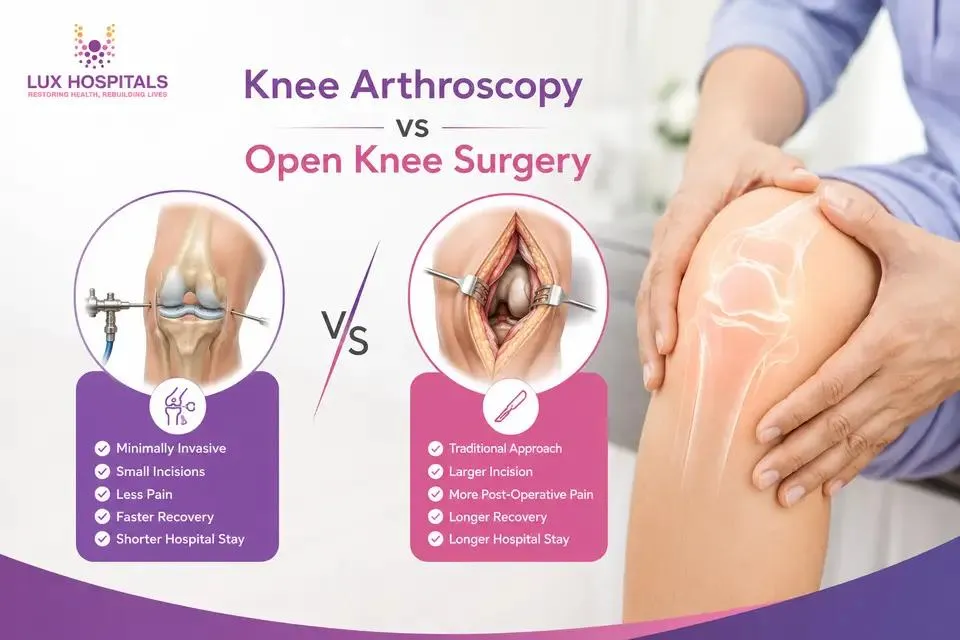
Arthroscopy for arthritis is worth mentioning explicitly because it was performed so often for so long. The evidence is now clear that it does not help, and offering it would be doing you a disservice.
A sixty to ninety minute operation through a single incision at the front of the knee, with a two to three night stay and physiotherapy starting the same day.
Total knee replacement
Bloods, imaging, anaesthetic review and pre-operative physiotherapy. Blood thinners are paused and any infection treated first.
Usually spinal anaesthesia with sedation, often with a nerve block for post-operative pain. Spinal anaesthesia is associated with less blood loss and fewer complications.
A single incision at the front of the knee, typically fifteen to twenty centimetres, giving access to the joint.
A few millimetres of worn bone and cartilage are removed from the femur and tibia using precise cutting guides, or robotic navigation where used.
Metal components are fitted to the femur and tibia with a plastic bearing between them, and the kneecap is resurfaced where indicated.
The knee is put through its full range of movement and tested for stability and alignment before anything is finalised. Balance is what determines how the knee feels afterwards.
The wound is closed in layers and you are stood up and walking with a physiotherapist the same day or the next morning.
Getting the soft tissue balance right matters more to how the knee feels than the implant brand does. A well-balanced knee feels natural; a poorly balanced one aches regardless of what was implanted.
Knee replacement outcomes depend on selection, on implant positioning and on rehabilitation. Here is why patients trust us:
A dedicated orthopaedic team performing knee replacement regularly, including partial and robotic-assisted procedures.
Structured physiotherapy from the day of surgery through to twelve weeks, because the operation alone does not produce the result.
From the first consultation through to post-treatment follow-up, with one team throughout.
Our hospital is in HITEC CITY, near IKEA: easily reachable from across Hyderabad.
Recovery from knee replacement is more demanding than most patients expect, and the physiotherapy is not optional: it is what determines the result.
Standing and walking with a frame within hours of surgery. Pain controlled with a nerve block and oral medication.
Walking further each day, climbing a few stairs, and bending the knee progressively. Home once safe on stairs and managing independently.
Intensive physiotherapy. The goal is full straightening and at least ninety degrees of bend by six weeks. This period is hard work and it is the period that matters most.
Walking without aids, driving from around six weeks, and returning to desk work. Swelling gradually subsides.
Continued improvement in strength and comfort. Most patients feel the knee is genuinely theirs by six to twelve months.
This determines your outcome more than anything else. A knee that is not moved in the first six weeks stiffens, and regaining that movement later is much harder.
Getting the knee completely straight is more important than how far it bends. A knee that will not straighten causes a limp and ongoing pain.
Regular icing and elevation for the first few weeks genuinely reduces swelling and makes the exercises easier.
Blood thinners as prescribed, and regular ankle exercises and walking. Clots are the main early risk after joint replacement.
Fever, spreading redness or discharge from the wound, calf pain and swelling, breathlessness, or sudden severe knee pain.
Maintain a healthy weight, stay active with low-impact exercise, and tell dentists and doctors you have a joint replacement.
Over ninety per cent of knee replacements are still working well at fifteen to twenty years. They last longest in people who keep their weight down and stay active without high-impact loading.
Book a consultation if any of the following apply.
The implant is the largest single component of the cost. These are the ranges our patients fall into.
| Procedure | Estimated Cost |
|---|---|
| Consultation & assessment Per visit | ₹800 – ₹1,500 |
| X-rays & pre-operative workup Imaging, bloods and anaesthetic review | ₹8,000 – ₹18,000 |
| Total knee replacement: one knee Three nights’ stay, standard implant | ₹1,80,000 – ₹3,20,000 |
| Partial knee replacement Two nights’ stay | ₹1,60,000 – ₹2,80,000 |
| Robotic-assisted knee replacement Three nights’ stay | ₹2,80,000 – ₹4,50,000 |
| Bilateral knee replacement Both knees in one sitting, four to five nights | ₹3,20,000 – ₹5,50,000 |
| Post-operative physiotherapy Six to twelve weeks of structured rehabilitation | ₹15,000 – ₹35,000 |
Standard cobalt-chrome, oxidised zirconium and high-flexion implants differ considerably in price, and the choice depends on your age and activity level.
Doing both in one sitting costs less than two separate admissions, though it is a bigger physiological insult and is not right for everyone.
Adds meaningfully to the cost. It improves the precision of component placement, most valuably in significant deformity.
A shared ward, a twin-sharing room or a private suite: the largest single swing in most estimates.
We are empanelled with most major insurers, and our team files the pre-authorisation for you.
Every figure above is an indicative range, not a quote. After your consultation you are given a written, fixed-cost estimate, and that is the number you pay, with no additions once treatment begins.
What patients treated here can expect:
The main reason for the operation, and the most reliable result.
Walking, stairs and independence regained.
Over ninety per cent of implants still working at fifteen to twenty years.
The orthopaedic and joint replacement surgeons who perform knee replacement at our HITEC CITY hospital.

Consultant Orthopaedic Surgeon: Joint Replacement & Arthroscopy
MS (Ortho), FIJR, FIASM (UK), FIKS (Italy), FIRJR
8 years experience

Consultant Orthopaedic Surgeon
MBBS, MS, FIJR
6 years experience
Reviews from patients treated for knee, shoulder and orthopaedic conditions at Lux Hospitals, Hyderabad.
Written by Dr. Sai Kishan Sirasala on knee replacement, arthroscopy and orthopaedic care.

Dr. Sai Kishan Sirasala

Dr. Sai Kishan Sirasala

Dr. Sai Kishan Sirasala
Dr. Sai Kishan Sirasala

Dr. Sai Kishan Sirasala
Dr. Sai Kishan Sirasala
Common questions about knee replacement, its recovery, and what surgery costs at Lux Hospitals.
Still have questions? Call us at 079 6908 4422
Still have questions? Message us on WhatsApp at 079 6908 4444
An honest assessment of whether you need a knee replacement, and which type, with a fixed-cost estimate before treatment begins.
Plot No.116, Lumbini Avenue, HITEC CITY, Near IKEA, Hyderabad – 500032