Dr. Samhitha Reddy
Consultant Proctologist & Laparoscopic Surgeon
MBBS, MS, FMAS, FISCP, DMAS
- 8 Yrs
- ASCRS Member
A lipoma is a soft, fatty lump that sits under the skin and grows very slowly. It is benign, it is not cancer and will not become cancer, but that does not mean it has to be lived with.
People come to have them removed because they are enlarging, because they press on something and ache, or simply because of where they are. Our surgeons at Lux Hospitals, HITEC CITY remove lipomas under local anaesthetic as a day-care procedure, with the incision planned to leave the smallest scar the lump allows.
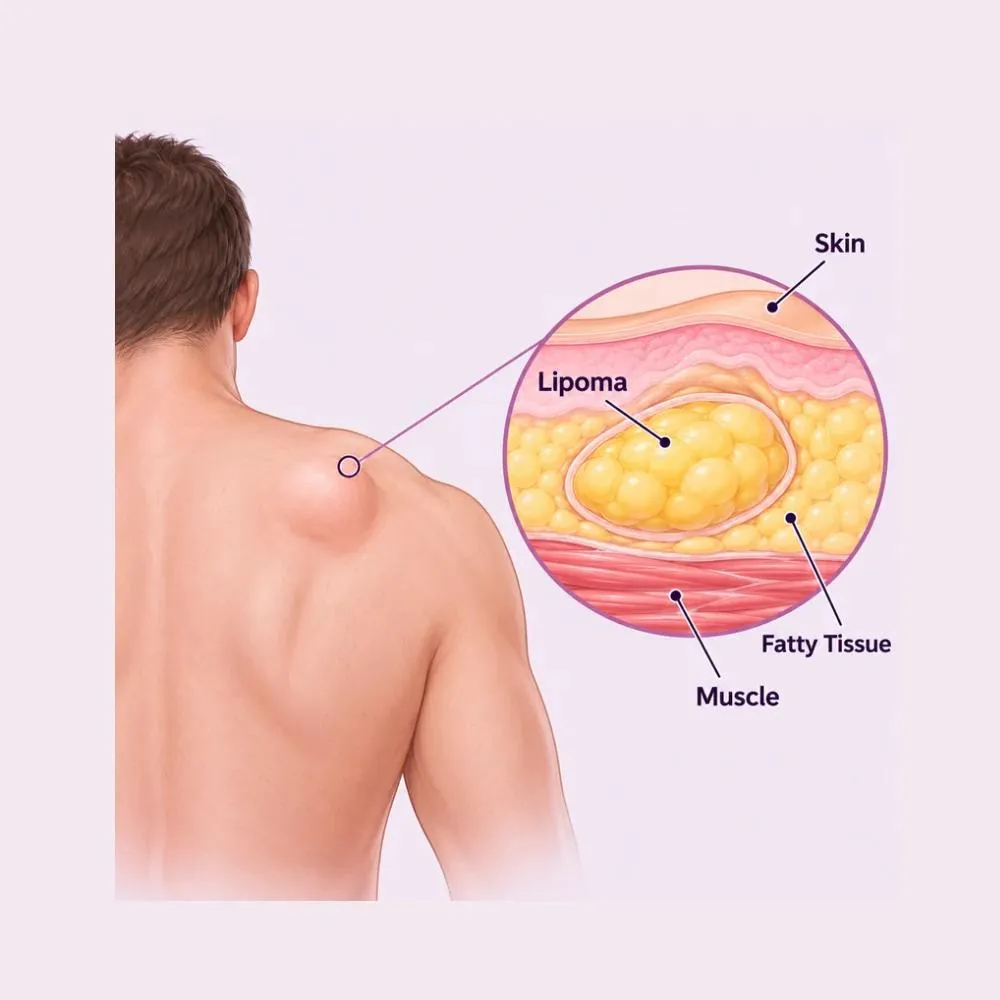
A lipoma is a benign tumour made of mature fat cells, enclosed in a thin capsule and sitting in the layer of tissue just beneath the skin. It grows slowly over years and is usually painless.
Lipomas are among the commonest soft tissue lumps there are. They typically appear on the neck, shoulders, back, abdomen, arms and thighs, and it is quite common to have several. They feel characteristically soft and rubbery, and they slide freely under the fingers when pressed: that mobility is what distinguishes them from most other lumps.
The reassuring part is that a lipoma does not turn into cancer. There is a rare malignant fatty tumour called a liposarcoma, which is a different tumour from the outset rather than a lipoma that has changed, and it behaves differently enough that a lump growing quickly, becoming hard, or sitting deep in a muscle gets imaged before anything else.
The exact cause is not known. What is clear is that genetics plays the largest part, with a few other associations recognised.
The strongest factor. Lipomas frequently run in families, and multiple lipomas in particular are usually inherited.
An inherited condition causing many lipomas across the trunk and limbs, typically appearing from early adulthood.
Some lipomas appear at the site of a past blunt injury, though whether the trauma causes them or simply draws attention to them is debated.
Most lipomas appear between the ages of forty and sixty, though they can develop at any age.
Being overweight is associated with a higher incidence, although lipomas occur just as readily in slim people.
Rare syndromes such as Gardner syndrome, Madelung disease and Dercum disease feature multiple lipomas as part of the picture.
Some patterns of multiple lipomas are associated with heavy alcohol use and liver disease.
Raised blood lipids and diabetes are seen more often in people with multiple lipomas.
Nothing you did caused a lipoma, and there is no diet or exercise that prevents one. Losing weight does not make an existing lipoma disappear: the fat inside it does not behave like the rest of your body fat.
The typical lipoma is noticed rather than felt: most people find it by accident, and it has probably been there for years.
Typical features
Features that need assessment
That second list is not a reason to assume the worst: most lumps with one of those features still turn out benign. It is a reason to get an ultrasound rather than to keep watching.
A classic lipoma is diagnosed by feel alone. Imaging is added where the lump is large, deep, fast-growing, or does not have the typical soft mobile character.
A soft, mobile, non-tender lump with normal overlying skin is characteristic. In most cases this is diagnosis enough.
Confirms the lump is fatty, measures its size and depth, and shows whether it is confined above the muscle. Quick, painless and usually all that is needed.
Used for large, deep or intramuscular lumps. It characterises fatty tissue precisely and is the test that distinguishes a lipoma from a liposarcoma.
Reserved for lumps with concerning features on imaging, to obtain a tissue diagnosis before deciding on the extent of surgery.
Every lipoma removed is sent for examination. This is what confirms the diagnosis definitively rather than presumptively.
Where several are present, a general examination and sometimes lipid and liver tests, to identify an underlying pattern.
The rule of thumb is straightforward: a soft, mobile lump under five centimetres that has been there for years needs nothing more than an examination. Anything larger, deeper or faster-growing gets a scan first.
A lipoma causing no trouble does not need treating at all. Where it does, surgical excision is the only method that removes it permanently.
A small, painless, typical lipoma can simply be left alone and watched. There is no medical need to remove it, and many people never do.
Injection into the lipoma can shrink it somewhat over time, but it rarely removes it completely and the lump usually remains palpable.
The fatty contents are suctioned out through a small cannula, leaving a much smaller scar. Useful for large lipomas in cosmetically sensitive areas, though the capsule remains and recurrence is more likely.
The definitive treatment. The lipoma is removed complete with its capsule through a small incision under local anaesthetic. Removing the capsule is what prevents it coming back.
The lipoma is squeezed out through an incision much smaller than the lump itself, leaving a shorter scar. Suitable for soft, well-defined lipomas.
For very large lipomas, those deep within muscle, or where several are being removed in one sitting.
Where imaging or biopsy raises the possibility of a liposarcoma, the lump is removed with a margin of surrounding normal tissue.
Removal is worth considering when a lipoma is enlarging, painful, pressing on a nerve, restricting movement, or in a position you would rather it were not. All of those are legitimate reasons.
A twenty to forty minute day-care procedure. You are awake, you feel nothing beyond the initial injection, and you walk out afterwards.
Excision under local anaesthetic
The lipoma is examined and its outline marked on the skin. The incision is planned along a natural skin crease or line, where the scar will fade best.
Local anaesthetic is injected around and under the lump. The initial sting lasts a few seconds, after which the area is completely numb.
A small incision is made over the lipoma: typically shorter than the lump itself, since a soft lipoma can be delivered through a smaller opening.
The lipoma is separated from the surrounding tissue by blunt dissection, staying outside its capsule so the lump comes out intact.
The whole lipoma with its capsule is delivered through the incision. Leaving capsule behind is the commonest reason a lipoma recurs.
The cavity is closed in layers to avoid a fluid collection, and the skin closed with fine dissolvable sutures for the best cosmetic result.
A dressing is applied and you go home within the hour, with painkillers and a date to return for the histopathology result.
Every lipoma removed goes for histopathology. It is nearly always exactly what was expected, and the occasion on which it is not is precisely why the test is never skipped.
Lipoma removal is a small operation whose result is judged almost entirely by the scar. Here is why patients trust us:
Consultants with extensive experience removing lipomas, including large, deep and multiple ones.
Incisions planned along natural skin lines and kept shorter than the lump, with careful layered closure.
From the first consultation through to post-treatment follow-up, with one team throughout.
Our hospital is in HITEC CITY, near IKEA: easily reachable from across Hyderabad.
Recovery after lipoma removal is quick and straightforward. Most people are back to normal within a few days, with the scar continuing to fade for months afterwards.
Home within the hour. Mild soreness as the local anaesthetic wears off, settled with simple painkillers.
Normal daily activity resumes. Desk work is usually possible the next day. Keep the dressing clean and dry.
Dressing removed and the wound checked. Some bruising and firmness around the site is normal. Showering is fine.
The wound is fully healed and any dissolvable sutures have gone. Full activity including the gym resumes. Histopathology discussed.
The scar softens, flattens and fades progressively. Firmness under the scar settles over the first few months.
Keep the dressing intact and dry for the first forty-eight hours, then follow the instructions given for changing it.
No heavy lifting or vigorous exercise for a week or two, particularly for lipomas on the back, shoulder or arm.
A firm area under the scar as the cavity heals is normal and settles over a few months. It is not the lipoma returning.
Cover it or use sunscreen for six months. Sun on a fresh scar darkens it permanently, which is easily avoided.
Fever, spreading redness, increasing pain, discharge from the wound, or a rapidly enlarging swelling suggesting a haematoma.
The wound is checked and the histopathology result discussed. It is a short appointment and it is worth keeping.
A lipoma removed completely with its capsule does not come back at that site. New lipomas can appear elsewhere, particularly in people who are prone to multiple ones: that is a new lump rather than a recurrence.
Removal is worth considering if any of the following apply.
Cost depends on the size and depth of the lipoma, how many are being removed, and whether local or general anaesthesia is needed.
| Procedure | Estimated Cost |
|---|---|
| Consultation & examination Per visit | ₹800 – ₹1,500 |
| Ultrasound assessment Where the lump is large or atypical | ₹1,500 – ₹3,500 |
| Small lipoma excision (local anaesthetic) Day care, including histopathology | ₹18,000 – ₹35,000 |
| Large or deep lipoma excision Day care, may need general anaesthesia | ₹40,000 – ₹75,000 |
| Multiple lipoma removal Single sitting, number dependent | ₹50,000 – ₹1,20,000 |
| Intramuscular lipoma excision One night’s stay, MRI beforehand | ₹70,000 – ₹1,40,000 |
A two-centimetre lipoma under the skin and a ten-centimetre one within muscle are entirely different operations.
Several lipomas removed in one sitting costs considerably less per lump than separate procedures.
Local anaesthetic is the norm and keeps costs down. Large, deep or multiple lipomas may need a general anaesthetic.
A shared ward, a twin-sharing room or a private suite: the largest single swing in most estimates.
We are empanelled with most major insurers, and our team files the pre-authorisation for you.
Every figure above is an indicative range, not a quote. After your consultation you are given a written, fixed-cost estimate, and that is the number you pay, with no additions once treatment begins.
What patients treated here can expect:
Local anaesthetic, home within the hour, back to work the next day.
The capsule taken with the lump, so it does not return at that site.
Histopathology on every lipoma removed, confirming the diagnosis.
The general surgeons who remove lipomas and soft tissue lumps at our HITEC CITY hospital.

Consultant General & Advanced Laparoscopic Surgeon
MBBS, MS, FMAS
17 years experience

Senior Consultant: Bariatric & Gastrointestinal Surgery
MBBS, MS, FRCS (UK), DLS (France)
28 years experience

Consultant Proctologist & Laparoscopic Surgeon
MBBS, MS, FMAS, FISCP, DMAS
8 years experience

Consultant Breast, Thyroid & General Surgeon
MBBS, MS (General Surgery), Fellowship in Laparoscopic Surgery
7 years experience
Reviews from patients treated for lipoma, hernia and general surgery at Lux Hospitals, Hyderabad.
Written by Dr. Abhishek Katha on lipoma removal and general surgical care.

Dr. Abhishek Katha
Dr. Abhishek Katha

Dr. Abhishek Katha
Dr. Abhishek Katha

Dr. Abhishek Katha
Dr. Abhishek Katha
Common questions about lipomas, their removal, and what surgery costs at Lux Hospitals.
Still have questions? Call us at 079 6908 4422
Still have questions? Message us on WhatsApp at 079 6908 4444
Day-care lipoma removal under local anaesthetic with minimal scarring, and a fixed-cost estimate before treatment begins.
Plot No.116, Lumbini Avenue, HITEC CITY, Near IKEA, Hyderabad – 500032