Dr. Samhitha Reddy
Consultant Proctologist & Laparoscopic Surgeon
MBBS, MS, FMAS, FISCP, DMAS
- 8 Yrs
- ASCRS Member
Appendicitis is the most common surgical emergency there is, and it is one of the few conditions where hours genuinely matter. An inflamed appendix that is left alone can perforate, and a perforated appendix is a far more serious illness than the one that preceded it.
Removing it early is straightforward, quick and safe. Our laparoscopic surgeons at Lux Hospitals, HITEC CITY operate around the clock, and most patients go home within a day or two through three keyhole incisions.
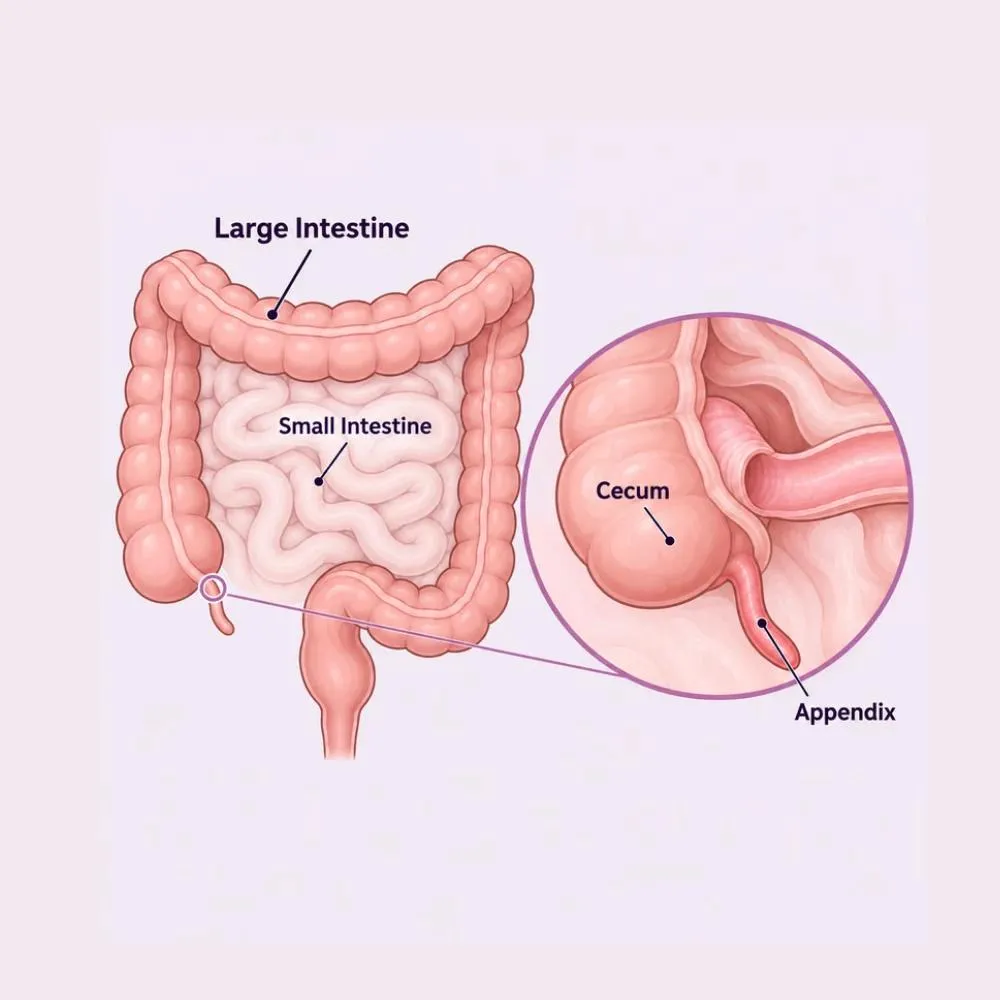
Appendicitis is inflammation of the appendix: a small, finger-shaped pouch attached to the start of the large intestine. It happens when the opening of the appendix becomes blocked, bacteria multiply behind the obstruction, and the appendix swells, becomes infected and loses its blood supply.
The natural history is what makes it urgent. Over roughly twenty-four to seventy-two hours an inflamed appendix progresses to gangrene and then perforates, spilling infected contents into the abdominal cavity. That causes peritonitis or an abscess, and turns a routine day-case operation into a serious illness with a much longer stay.
Appendicitis is described by how far it has progressed: acute inflammation needing prompt surgery, gangrenous where the tissue has begun to die, and perforated where it has ruptured. A minority of people have chronic or recurrent appendicitis, with grumbling intermittent pain over months rather than a single acute episode.
Almost every case begins with something blocking the narrow opening of the appendix, after which infection follows.
A small hardened lump of stool blocks the opening of the appendix. The single commonest cause in adults.
Lymphoid tissue in the appendix wall swells in response to a viral infection and obstructs the lumen: the usual mechanism in children and young adults.
Bacterial or viral infection of the gut causes inflammation and swelling that closes off the appendix.
Crohn’s disease affecting the region around the appendix can inflame and obstruct it.
Uncommon, but a growth at the base of the appendix or in the caecum can obstruct it, which is one reason every removed appendix is sent for examination.
Intestinal worms occasionally block the appendix, a cause still seen in parts of India.
A blunt injury to the abdomen can rarely precipitate inflammation of the appendix.
Appendicitis is somewhat commoner in people with an affected close relative, probably reflecting inherited anatomy.
None of this is preventable, and nothing you did caused it. Appendicitis is bad luck with a narrow tube, which is why the focus is entirely on recognising it early.
The classic pattern is distinctive: pain that starts vaguely around the navel and settles firmly in the lower right abdomen over several hours.
Typical symptoms
Signs of perforation: go to hospital now
Do not take painkillers and wait to see how it goes. Right-sided abdominal pain with loss of appetite that is getting worse over hours needs assessment the same day, not the next morning.
Diagnosis is largely clinical, supported by blood tests and imaging. The aim is to be confident enough to operate without waiting so long that the appendix perforates.
Tenderness and guarding at McBurney’s point in the lower right abdomen, with rebound tenderness. Still the most important part of the assessment.
The Alvarado or AIR score combines symptoms, signs and blood results into a structured estimate of how likely appendicitis is.
A raised white cell count and CRP support the diagnosis. Normal inflammatory markers in someone who has been unwell for a day make it much less likely.
First-line imaging in children and in women of childbearing age, since it involves no radiation and also assesses the ovaries.
The most accurate test. An appendix over six millimetres in diameter with surrounding inflammatory change is diagnostic, and CT also identifies an abscess or perforation.
A pregnancy test, urine testing and a gynaecological assessment where relevant: ovarian and urinary conditions imitate appendicitis closely.
An appendix over six millimetres across is abnormal, and beyond eight to ten millimetres the risk of rupture rises sharply. That measurement is often what settles the decision to operate.
Surgical removal is the standard treatment and the only one that removes the problem permanently. Antibiotics have a role in selected cases, but they treat the infection rather than the blocked appendix.
Selected patients with early, uncomplicated appendicitis can be treated with intravenous antibiotics. It works initially in most, but around one in three has a recurrence within a year.
Where a contained appendix mass or abscess has already formed, it is treated with antibiotics and drainage first, and the appendix removed electively six to eight weeks later.
An image-guided drain placed into an appendix abscess, settling the infection before any operation is attempted.
Intravenous fluids, pain relief and anti-sickness medication while the diagnosis is confirmed and surgery arranged.
The first choice for almost all patients. Three small incisions, less post-operative pain, a lower wound infection rate, a shorter stay and a faster return to work.
Performed through one incision hidden in the navel, leaving virtually no visible scar. Suitable for selected uncomplicated cases.
Through a single incision in the lower right abdomen. Still highly effective and chosen where there is extensive perforation, dense adhesions or where keyhole access is unsafe.
For perforated appendicitis with peritonitis, the abdomen is thoroughly irrigated after removal to clear infected fluid and reduce the risk of a collection forming.
Laparoscopic surgery is the first choice for the great majority. Where the appendix has perforated or the picture is advanced, open surgery may be the safer option, and that judgement is sometimes only made in theatre.
A thirty to forty-five minute emergency operation through three small incisions. Most patients are eating the next morning and home within a day or two.
Laparoscopic appendicectomy
Examination, bloods, imaging and a pregnancy test where relevant. Intravenous fluids and antibiotics are started while theatre is arranged.
General anaesthetic. The abdomen is inflated with carbon dioxide and three ports of five to ten millimetres are placed.
The appendix is identified and the surrounding organs inspected: an advantage of the keyhole approach, since it also assesses the ovaries and bowel if the diagnosis is uncertain.
The appendix is mobilised from any adhesions and its blood supply, the mesoappendix, is divided and sealed.
The base of the appendix is secured with an endoloop or stapler and divided. A secure base is what prevents a leak afterwards.
The appendix is placed in a retrieval bag and drawn out through a port so it never touches the wound. Where it had perforated, the abdomen is irrigated thoroughly.
Overnight observation, eating and walking the next morning, and home after one to two nights with antibiotics and a follow-up date.
Every appendix removed is sent for histopathology. It confirms the diagnosis and, occasionally, identifies an unsuspected tumour at the base, which is the reason it is done without exception.
Appendicitis is an emergency, and what matters is being assessed and operated on quickly by people who do this often. Here is why patients trust us:
Assessed, scanned and operated on round the clock: appendicitis does not wait for a morning list, and neither do we.
A team that performs laparoscopic appendicectomy routinely, with open surgery available where the case demands it.
From the first consultation through to post-treatment follow-up, with one team throughout.
Our hospital is in HITEC CITY, near IKEA: easily reachable from across Hyderabad.
Recovery after keyhole removal of an uncomplicated appendix is quick. A perforated appendix takes considerably longer at every stage.
Overnight in the ward. Sips of fluid the same evening, and eating and walking by the next morning.
Home once you are eating, mobile and comfortable on oral painkillers. Bowels usually open by day two or three.
Rest with light walking. Most people are off strong painkillers by day three or four. Wound check at the end of the week.
Desk work and school resume. Driving from about ten days, once you can brake hard without hesitating.
Full activity including the gym, sport and heavy lifting. Complete recovery in the great majority of patients.
Light walking from day one, but no heavy lifting or strenuous exercise for four weeks so the port sites heal properly.
A balanced diet and plenty of fluid support healing. Start light and return to normal food as your appetite comes back.
Complete the full course if one was prescribed, particularly after a perforated appendix, even once you feel entirely well.
Keep them clean and dry, shower rather than bathe for the first week, and pat rather than rub them dry.
Fever, increasing abdominal pain, a swollen tender abdomen, persistent vomiting, or redness and discharge from a wound.
A review at two weeks checks the wounds and goes through the histopathology result on the removed appendix.
Life after appendix removal is entirely normal. The appendix has no essential function, and there are no long-term dietary or activity restrictions once you have healed.
Any of the following needs assessment the same day.
Cost depends on whether the appendix had perforated by the time you reached theatre, which is largely a matter of how early you presented. These are the ranges our patients fall into.
| Procedure | Estimated Cost |
|---|---|
| Laparoscopic appendicectomy (uncomplicated) One to two nights’ stay | ₹65,000 – ₹1,10,000 |
| Single-incision appendicectomy One to two nights’ stay, near-scarless | ₹85,000 – ₹1,30,000 |
| Open appendicectomy Two to three nights’ stay | ₹55,000 – ₹95,000 |
| Perforated appendicitis with washout Four to seven nights’ stay, IV antibiotics | ₹1,20,000 – ₹2,20,000 |
| Abscess drainage & interval surgery Two admissions, six to eight weeks apart | ₹1,40,000 – ₹2,50,000 |
The single biggest factor. An uncomplicated appendix is a day or two in hospital; a perforated one can be a week with intravenous antibiotics.
Appendicitis is almost always an unplanned admission through the emergency department rather than a booked elective slot.
Endoloops and staplers differ in cost, and the choice depends on how inflamed the base of the appendix is.
A shared ward, a twin-sharing room or a private suite: the largest single swing in most estimates.
We are empanelled with most major insurers, and our team files the pre-authorisation for you.
Every figure above is an indicative range, not a quote. After your consultation you are given a written, fixed-cost estimate, and that is the number you pay, with no additions once treatment begins.
What patients treated here can expect:
Less pain and minimal scarring compared with open surgery.
Most patients return to normal activities within two to three weeks.
Smaller wounds and a retrieval bag mean fewer wound infections.
The general and laparoscopic surgeons who perform appendix surgery at our HITEC CITY hospital.

Consultant General & Advanced Laparoscopic Surgeon
MBBS, MS, FMAS
17 years experience

Senior Consultant: Bariatric & Gastrointestinal Surgery
MBBS, MS, FRCS (UK), DLS (France)
28 years experience

Consultant Proctologist & Laparoscopic Surgeon
MBBS, MS, FMAS, FISCP, DMAS
8 years experience
Reviews from patients treated for appendicitis, hernia and general surgery at Lux Hospitals, Hyderabad.
Written by Dr. Abhishek Katha on general and laparoscopic surgical care.

Dr. Abhishek Katha
Dr. Abhishek Katha

Dr. Abhishek Katha

Dr. Abhishek Katha

Dr. Abhishek Katha

Dr. Abhishek Katha
Common questions about appendicitis, appendix surgery, and what treatment costs at Lux Hospitals.
Still have questions? Call us at 079 6908 4422
Still have questions? Message us on WhatsApp at 079 6908 4444
24/7 emergency assessment and laparoscopic appendix surgery, with costs confirmed as soon as the picture is clear.
Plot No.116, Lumbini Avenue, HITEC CITY, Near IKEA, Hyderabad – 500032