



Dr. Samhitha Reddy
Consultant Proctologist & Laparoscopic Surgeon
MBBS, MS, FMAS, FISCP, DMAS
- 8 Yrs
- ASCRS Member
Peyronie’s disease is the formation of fibrous scar tissue inside the penis, producing a curve, an indentation or shortening, often with pain during erection.
Many men assume nothing can be done, or are too embarrassed to ask. Both assumptions are wrong: treatment is well established, and it works considerably better when started early in the disease. Our urologists at Lux Hospitals, HITEC CITY assess the curvature properly and treat it according to its stage.
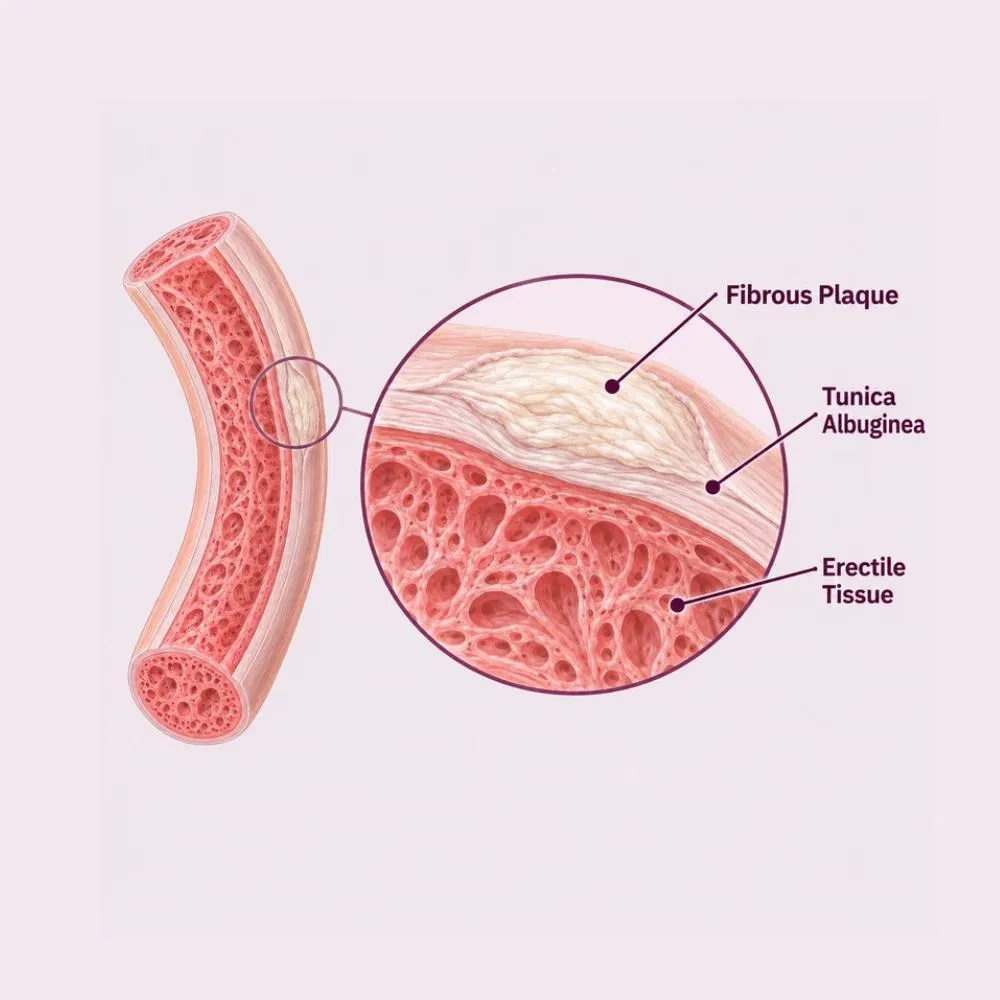
Peyronie’s disease is a wound-healing disorder of the tunica albuginea, the tough fibrous sheath surrounding the erectile tissue of the penis. Fibrous plaque forms within that sheath. Because scar tissue does not stretch, the affected side fails to lengthen during erection while the opposite side does, and the penis bends toward the plaque.
The disease has two distinct phases, and this matters enormously for treatment. The acute or inflammatory phase lasts roughly six to eighteen months: the plaque is forming, the curvature is changing, and pain during erection is common. The chronic or stable phase follows, when the plaque has matured, pain has usually resolved and the curvature stops progressing.
Medical treatment works during the acute phase, when the scar is still remodelling. Surgery is only appropriate once the disease is stable, because operating on a curvature that is still changing risks a poor result. Establishing which phase you are in is therefore the first thing the consultation does.
The prevailing explanation is abnormal healing after minor injury, in men predisposed to excessive scar formation.
Repeated minor injury to the tunica albuginea, often unnoticed at the time. The most widely accepted trigger.
Some men lay down excessive fibrous tissue in response to injury. This predisposition, rather than the injury itself, is what produces the disease.
Peyronie’s runs in families and is associated with Dupuytren’s contracture of the hand: the same abnormal fibrosis in a different site.
Most cases occur between forty and seventy. Tissue elasticity declines with age, making injury more likely and healing less complete.
Impairs healing and is associated with both a higher incidence and more severe disease.
Dupuytren’s contracture, plantar fascial fibrosis and similar conditions occur more often in men with Peyronie’s.
Prior prostate surgery or instrumentation is occasionally implicated as the initiating injury.
Peyronie’s disease is not caused by masturbation, by sexually transmitted infection, or by anything you did wrong. It is a healing disorder, and the predisposition to it is largely inherited.
The symptoms differ substantially between the two phases, which is itself a useful diagnostic clue.
Acute phase symptoms
Chronic phase symptoms
Erectile dysfunction accompanies Peyronie’s disease in a substantial proportion of men, sometimes from the disease itself and sometimes from the anxiety that comes with it. It is assessed alongside, not separately.
The assessment establishes the degree of curvature, the phase of the disease and whether erectile function is also affected.
When it started, whether it is still changing, whether erection is painful, and whether intercourse is possible. This is what distinguishes acute from chronic.
Palpating the shaft for the plaque, recording its position, size and consistency, and measuring stretched penile length.
Photographs taken at home from several angles allow the curvature to be measured objectively. Simple, and more accurate than description alone.
Performed after an injection to produce an erection. It measures curvature precisely, maps the plaque and assesses blood flow.
A standard questionnaire and Doppler flow measurement, because coexisting erectile dysfunction changes which operation is appropriate.
Stability over six months with no pain defines the chronic phase, and that is the prerequisite for considering surgery.
Objective measurement matters. Men consistently over- or under-estimate their own curvature, and the treatment decision hinges on the actual angle rather than the perceived one.
Treatment depends on the phase. Medical therapy in the acute phase, surgery only once the disease has stabilised.
Appropriate where the curve is mild, intercourse is possible and there is no pain. A proportion of cases improve spontaneously.
Pentoxifylline, vitamin E and colchicine have been used. The evidence is modest, and they are offered as an adjunct rather than a mainstay.
A device worn for several hours daily over months. It reduces curvature and helps preserve length, and works best in the acute phase.
Regular stretching of the tissue with a vacuum pump, often combined with traction.
Verapamil or interferon injected directly into the plaque over a course of sessions, to soften it and reduce curvature.
An enzyme that breaks down the collagen of the plaque. The best-evidenced non-surgical treatment where available, given as a structured course with modelling.
Effective for the pain of the acute phase. It does not reliably reduce curvature, and is offered for symptom relief.
The longer, unaffected side is shortened with sutures to straighten the penis. Simple, reliable and low-risk, but it costs some length.
The plaque is cut and the defect filled with a graft, lengthening the short side. Preserves length and suits severe curves, but carries a higher risk of erectile dysfunction.
Where Peyronie’s coexists with significant erectile dysfunction, an implant corrects both at once, often with modelling to straighten during placement.
Manual straightening against an inflated prosthesis at the time of implant surgery, correcting residual curvature.
The choice between plication and grafting is a genuine trade-off: plication is safer but shortens, grafting preserves length but risks erectile function. Which matters more to you is part of the decision.
Treatment follows the disease rather than a fixed schedule, and most men begin with non-surgical measures.
Stage-based programme, from medical therapy to surgery
History, examination of the plaque, measurement of stretched length and review of photographs of the erect penis.
Determining whether the curve is still changing and whether erection is painful. This decides whether surgery is even on the table.
An erection induced by injection, allowing precise measurement of curvature and assessment of blood flow.
Traction therapy, oral medication and intralesional injections where indicated, aimed at limiting progression and reducing pain.
Review at three to six month intervals with repeat measurement. Six months without change defines stability.
Where curvature still prevents intercourse, the operation is chosen on the angle, the length available and erectile function, with the trade-offs explained fully.
Plication, grafting or implant under general anaesthesia, generally requiring one night in hospital.
Operating during the acute phase is the classic mistake. A curvature that is still evolving will keep evolving after surgery, which is why waiting for stability is not delay but part of the treatment.
Peyronie’s is under-treated largely because men do not raise it. Here is why patients trust us with it:
Private consultations with urologists who treat this routinely and will discuss it plainly.
Objective measurement of curvature and careful determination of stability before any surgery is considered.
From the first consultation through to post-treatment follow-up, with one team throughout.
Our hospital is in HITEC CITY, near IKEA: easily reachable from across Hyderabad.
Conservative treatment is measured in months. After surgery, most men return to work within two weeks and to intercourse at six to eight.
Traction and medical therapy, with pain typically settling over this period. Curvature is remeasured at each review.
Discharge after one night. Swelling and bruising are expected and considerable. Simple painkillers and a supportive dressing.
Swelling settles substantially. Most men return to desk work within two weeks. Wound review and suture check.
Intercourse resumes at six to eight weeks after clearance. Traction may be recommended to maintain length after grafting.
Final result becomes apparent. Any residual curve is reassessed, and sensation changes settle over this period.
Traction only works with sustained daily use over months. Intermittent use does very little, and this is where most conservative treatment fails.
Straightening by shortening the longer side inevitably costs length. This is discussed and quantified beforehand rather than discovered afterwards.
The repair or graft needs time to consolidate. Early activity risks recurrence of the curve or graft failure.
Diabetes worsens both the fibrosis and the healing after surgery. Good control genuinely affects the outcome.
Peyronie’s affects confidence and relationships more than most conditions of comparable severity, and it is far easier managed together.
A curve that starts changing again, or pain returning after it had settled, suggests reactivation and needs review.
Roughly one man in eight improves spontaneously and about half remain stable, but the remainder progress. Presenting early, while the plaque is still remodelling, is what makes non-surgical treatment worth trying.
Book a consultation if any of the following apply.
Assessment and conservative treatment are modest in cost. Surgical correction is the significant expense, and most men do not need it.
| Procedure | Estimated Cost |
|---|---|
| Consultation Private and confidential | ₹800 – ₹1,500 |
| Penile Doppler ultrasound Measures curvature and blood flow | ₹4,000 – ₹9,000 |
| Traction device One-off device cost | ₹8,000 – ₹25,000 |
| Intralesional injection course Multiple sessions over months | ₹25,000 – ₹70,000 |
| Shockwave therapy course Mainly for pain relief | ₹35,000 – ₹80,000 |
| Plication surgery One night’s stay | ₹1,20,000 – ₹2,20,000 |
| Plaque incision with grafting Includes graft material | ₹1,80,000 – ₹3,20,000 |
| Penile implant with correction Dominated by the device cost | ₹4,50,000 – ₹8,00,000 |
Early acute-phase disease is managed with traction and medication at a fraction of surgical cost. Late severe curvature usually needs an operation.
Plication is the least expensive. Grafting adds the graft material, and an implant is dominated by the price of the prosthesis.
Where ED is significant, an implant addresses both problems at once but is the most expensive option.
A shared ward, a twin-sharing room or a private suite: the largest single swing in most estimates.
We are empanelled with most major insurers, and our team files the pre-authorisation for you.
Every figure above is an indicative range, not a quote. After your consultation you are given a written, fixed-cost estimate, and that is the number you pay, with no additions once treatment begins.
The urologists who treat Peyronie’s disease at our HITEC CITY hospital.

Consultant Urologist & Andrologist
MBBS, MS, DrNB (Urology)
10 years experience

Consultant Urologist & Andrologist
MBBS, MS, MCh (Urology)
9 years experience
Reviews from patients treated for urological and men’s health conditions at Lux Hospitals, Hyderabad.
Written by Dr. Vipin Reddy B on men’s health and urological care.

Dr. Vipin Reddy B
Dr. Vipin Reddy B

Dr. Vipin Reddy B
Dr. Vipin Reddy B

Dr. Vipin Reddy B

Dr. Vipin Reddy B
Common questions about Peyronie’s disease, its treatment and what care costs at Lux Hospitals.
Still have questions? Call us at 079 6908 4422
Still have questions? Message us on WhatsApp at 079 6908 4444
Objective assessment of penile curvature and stage-appropriate treatment, with costs shared upfront.
Plot No.116, Lumbini Avenue, HITEC CITY, Near IKEA, Hyderabad – 500032













