
Dr. Samhitha Reddy
Consultant Proctologist & Laparoscopic Surgeon
MBBS, MS, FMAS, FISCP, DMAS
- 8 Yrs
- ASCRS Member
The gastric balloon is the gentlest option in weight-loss medicine. There is no incision, nothing is cut or stapled, and nothing about your anatomy is permanently changed: a soft balloon simply occupies space in the stomach so you feel full sooner.
It suits people whose BMI is too low for bariatric surgery, or who want to try a reversible approach first. Our team at Lux Hospitals, HITEC CITY places it endoscopically in twenty to thirty minutes, and you go home the same day.
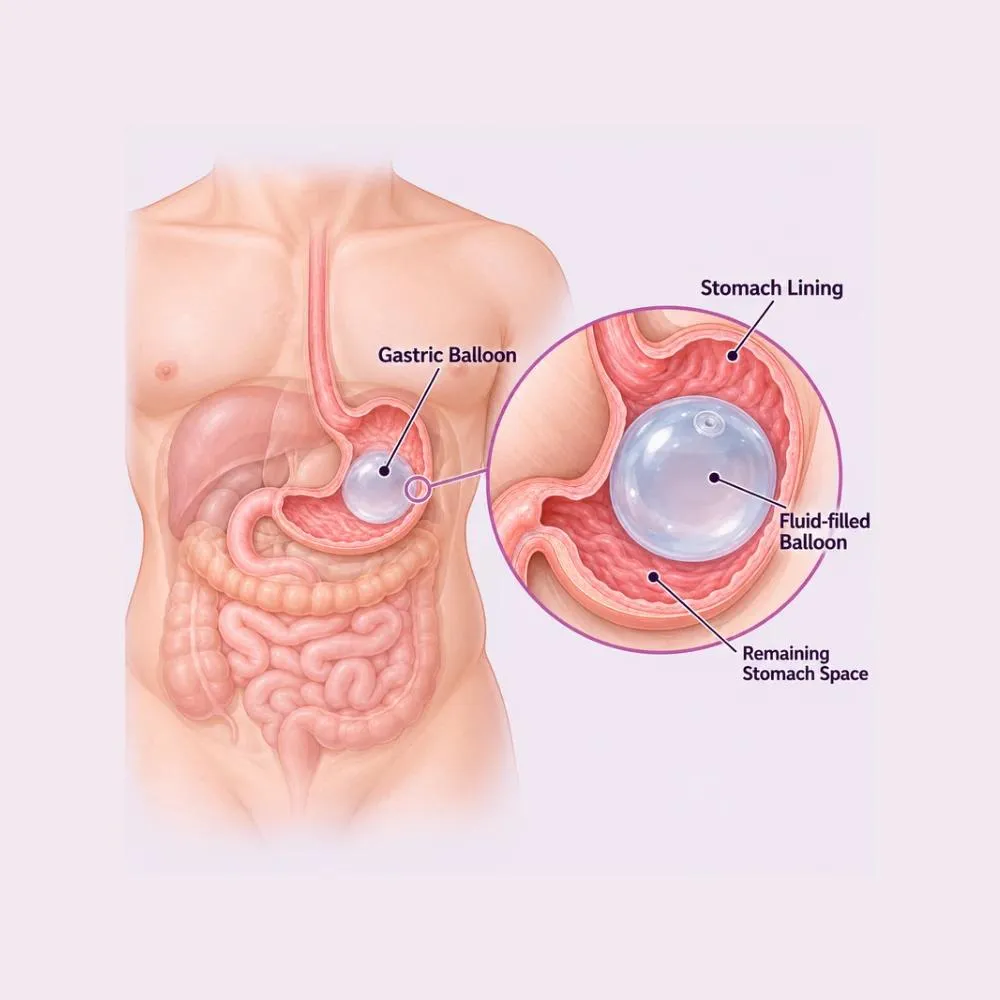
A gastric balloon is a soft, inflatable device placed inside the stomach to occupy space. With less room available, you feel full after eating considerably less, and that restriction is what drives the weight loss. It is temporary and fully reversible.
There are three main types. A swallowable balloon comes as a capsule you swallow, which is then inflated through a thin tube and needs no endoscopy at all. An endoscopic balloon is placed and inflated through an endoscope under sedation. An adjustable balloon can have its volume changed partway through the treatment period, to renew the effect as your stomach accommodates.
It is important to understand what it is and is not. The balloon buys you six to twelve months during which eating less is genuinely easier: it is a window for establishing new habits, not a permanent solution. Weight regain after removal is common in those who treat it as a device rather than as a programme.
The mechanism is mostly mechanical, with a modest hormonal contribution. It is simpler than surgical procedures, and correspondingly less powerful.
The balloon occupies 400–700ml of stomach volume, so far less food is needed before the stomach registers as full.
The balloon slows the rate at which the stomach empties, so fullness after a meal lasts longer.
Stretch receptors in the stomach wall are triggered by smaller volumes, sending fullness signals sooner.
Ghrelin levels fall somewhat, reducing hunger, though far less than after a sleeve gastrectomy.
Six to twelve months in which smaller portions feel natural, which is the real opportunity the balloon provides.
Dietitian input during the balloon period is what converts temporary restriction into lasting habit.
The balloon does the easy part. Whether the weight stays off after removal depends almost entirely on what you did with the twelve months it gave you.
The balloon fills a real gap: it serves people whose BMI is below the threshold for bariatric surgery but for whom diet alone has not worked.
You may be a candidate if
It is also used when
It is not suitable if you have had previous stomach surgery, a large hiatal hernia, significant reflux, or an untreated ulcer: the endoscopy beforehand exists to identify exactly these.
The assessment is lighter than for surgery, but the endoscopy is essential: several stomach conditions make a balloon unsafe.
Height, weight, BMI and weight history, along with a review of previous weight-loss attempts and current medication.
Examines the stomach and oesophagus for ulcers, a large hiatal hernia, significant reflux or previous surgery: each of which rules the balloon out.
Full blood count, glucose, HbA1c, lipids, thyroid, and liver and kidney function.
Assesses for fatty liver and gallstones, both common in this group.
Blood pressure, diabetes screening and cardiovascular risk, so improvement can be measured objectively.
Planning the dietary programme that will run alongside the balloon: the part that determines whether the result lasts.
Most patients are assessed and scheduled within a week or two. The workup is genuinely lighter than for surgery, because the procedure itself is.
The balloon sits between medical management and bariatric surgery. Knowing where it fits helps set realistic expectations.
Endoscopic, reversible, no incisions, and typically 10–15% total body weight loss over six to twelve months.
Dietitian-led planning and review. Effective for many, and it runs alongside the balloon rather than instead of it.
GLP-1 receptor agonists produce comparable or greater weight loss than a balloon, though weight is regained if stopped.
Graded activity with behavioural work on eating patterns: essential alongside every other approach.
Permanent, 50–70% excess weight loss, and a strong hormonal effect on hunger. Far more powerful than a balloon, and irreversible.
The most effective procedure for weight and diabetes, with correspondingly greater commitment and lifelong supplements.
Used to reduce a very high BMI so that subsequent bariatric or other surgery can be performed more safely.
The honest comparison: a balloon typically achieves 10–15% total body weight loss, against 25–30% for a sleeve. It asks far less of you, and it delivers proportionately less.
A twenty to thirty minute day-care procedure under light sedation. No incisions, no scars, and you go home the same day.
Endoscopic balloon placement
Medical tests, BMI and metabolic assessment, and the endoscopy that confirms your stomach is suitable.
Light sedation or a short general anaesthetic. Most patients remember nothing of the procedure.
An endoscope is passed through the mouth to inspect the stomach lining and confirm there is no ulcer or abnormality.
The deflated balloon is passed into the stomach through the endoscope, or, for a swallowable balloon, simply swallowed as a capsule.
It is filled with 400–700ml of sterile saline, usually with a blue dye that would colour your urine if it ever leaked. Position is confirmed visually.
Two to four hours of observation with anti-sickness and antispasmodic medication, then home the same day.
A second short endoscopy deflates and removes the balloon. Swallowable balloons deflate on their own and pass naturally.
The first three to five days are the difficult part. Nausea and cramping as the stomach adjusts to the balloon are expected, and are managed with medication that is prescribed in advance rather than in response.
The balloon is straightforward to place. Making it work is about what surrounds it. Here is why patients trust us:
Led by Dr. Tagore Mohan Grandhi, with fellowships in bariatric surgery (USA) and robotic surgery (Korea) and 28 years of experience.
Structured support throughout the balloon period, so the restriction becomes a habit rather than a phase.
From the first consultation through to post-treatment follow-up, with one team throughout.
Our hospital is in HITEC CITY, near IKEA: easily reachable from across Hyderabad.
The procedure itself needs no recovery. The first week with the balloon in place is the part that takes adjusting to.
Nausea, cramping and occasional vomiting as the stomach adjusts. This is expected. Anti-sickness medication is prescribed in advance, and liquids only.
Symptoms settle markedly. Progress from liquids to soft foods. Most patients return to work by the end of the first week.
Normal foods resume in much smaller portions. Weight loss is usually rapid in this period, and the restriction feels natural.
Steady weight loss with dietitian review. Most of the total loss happens in the first four to six months.
Weight loss slows as the stomach accommodates. Balloon removed at the end of the period, and the habits established carry it forward.
Take it regularly for the first few days rather than waiting for nausea. This is the single thing that makes the first week tolerable.
Liquids for the first few days, then soft foods, then a normal balanced diet in small portions. Avoid high-calorie foods throughout.
Regular exercise and dietitian follow-up during the balloon period. This is what determines whether the weight stays off afterwards.
A proton pump inhibitor is prescribed for the whole balloon period, to protect the stomach lining from the device.
Severe persistent vomiting, inability to keep fluids down, severe abdominal pain, or blue-green urine, which would indicate balloon leakage.
Regular dietitian and medical reviews throughout, and the scheduled removal. A balloon left beyond its intended period risks deflation and migration.
Weight regain after removal is common, and it is common because the balloon was treated as the treatment. Those who use the twelve months to build genuinely different habits do far better.
Book a consultation if any of the following apply.
The balloon is generally not covered by insurance, since it is regarded as a non-surgical weight-management procedure. These are the self-pay ranges.
| Procedure | Estimated Cost |
|---|---|
| Consultation & assessment Per visit | ₹1,000 – ₹2,000 |
| Pre-procedure workup Endoscopy, bloods and ultrasound | ₹12,000 – ₹22,000 |
| Endoscopic gastric balloon Includes placement, balloon and removal | ₹1,60,000 – ₹2,60,000 |
| Swallowable gastric balloon No endoscopy needed; passes naturally | ₹1,80,000 – ₹2,80,000 |
| Adjustable gastric balloon Twelve months, with mid-term volume adjustment | ₹2,20,000 – ₹3,20,000 |
| Dietitian programme Across the balloon period, usually included | ₹10,000 – ₹20,000 |
Swallowable and adjustable balloons cost more than a standard endoscopic one, and offer different advantages.
A six-month balloon costs less than a twelve-month adjustable device, which requires an additional adjustment procedure.
Most packages include both placement and removal. Check this: a separate removal endoscopy is a meaningful additional cost.
A shared ward, a twin-sharing room or a private suite: the largest single swing in most estimates.
We are empanelled with most major insurers, and our team files the pre-authorisation for you.
Every figure above is an indicative range, not a quote. After your consultation you are given a written, fixed-cost estimate, and that is the number you pay, with no additions once treatment begins.
What patients treated here can expect:
No incisions, no scars, and nothing permanently altered.
Placed in under thirty minutes, removed after six to twelve months.
Improvement in blood sugar, blood pressure and overall fitness.
The bariatric and gastrointestinal surgeon who places gastric balloons at our HITEC CITY hospital.

Senior Consultant: Bariatric & Gastrointestinal Surgery
MBBS, MS, FRCS (UK), DLS (France)
28 years experience
Reviews from patients treated for bariatric and gastrointestinal conditions at Lux Hospitals, Hyderabad.
Written by Dr. Tagore Mohan Grandhi on weight-loss procedures and metabolic health.

Dr. Tagore Mohan Grandhi
Dr. Tagore Mohan Grandhi
Dr. Tagore Mohan Grandhi
Dr. Tagore Mohan Grandhi
Dr. Tagore Mohan Grandhi

Dr. Tagore Mohan Grandhi
Common questions about the gastric balloon, its results, and what the procedure costs at Lux Hospitals.
Still have questions? Call us at 079 6908 4422
Still have questions? Message us on WhatsApp at 079 6908 4444
A non-surgical, reversible weight-loss procedure with dietitian-led support, and a fixed-cost estimate before treatment begins.
Plot No.116, Lumbini Avenue, HITEC CITY, Near IKEA, Hyderabad – 500032