Dr. Samhitha Reddy
Consultant Proctologist & Laparoscopic Surgeon
MBBS, MS, FMAS, FISCP, DMAS
- 8 Yrs
- ASCRS Member
Uterine prolapse is the descent of the uterus into the vagina when the ligaments and muscles supporting it give way. It causes a sensation of something coming down, worse by the end of the day, and often a bulge that can be felt.
It is common after childbirth and around the menopause, and it is one of the conditions women most often endure in silence for years. Our gynaecologists at Lux Hospitals, HITEC CITY grade it properly and offer everything from pelvic floor therapy to uterus-sparing surgery.
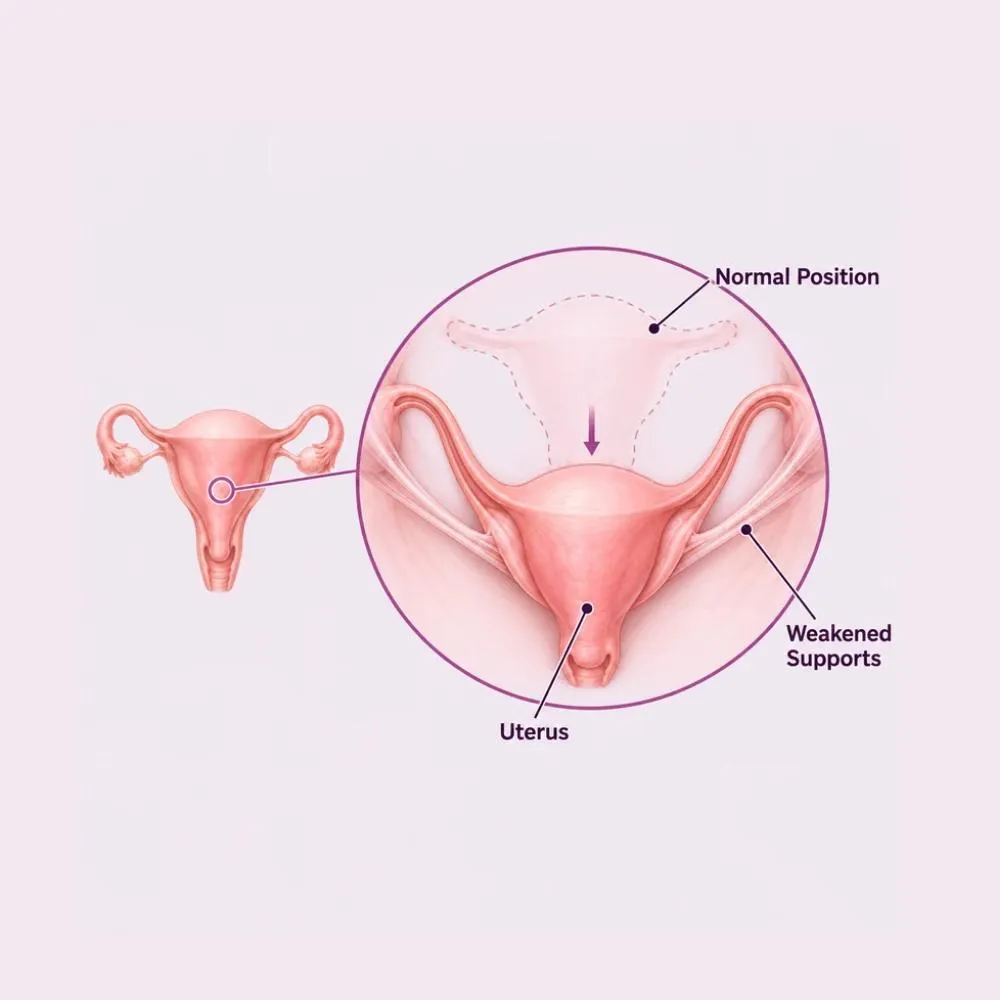
Uterine prolapse occurs when the ligaments and pelvic floor muscles that hold the uterus in position weaken, allowing it to descend into the vaginal canal. The uterosacral and cardinal ligaments do most of the suspending work, and when they stretch or tear the uterus drops under gravity and abdominal pressure.
It is graded by how far the descent has gone. Grade one is descent into the upper vagina. Grade two brings the cervix to the vaginal opening. Grade three protrudes the cervix beyond the opening. Grade four, procidentia, is complete descent of the entire uterus outside the body. The grade largely determines whether conservative treatment is realistic.
Prolapse rarely affects one compartment alone. The same weakened support frequently allows the bladder to descend into the front vaginal wall as a cystocele, and the rectum into the back wall as a rectocele. Assessing all three at once is what prevents repairing the uterus and leaving a bladder prolapse to become symptomatic six months later.
Prolapse results from cumulative damage to the pelvic support tissues over a lifetime.
The single largest factor. Prolonged labour, instrumental delivery and large babies stretch and tear the supporting structures, and risk rises with each delivery.
Falling oestrogen thins and weakens the connective tissue and pelvic floor. Many women find prolapse becomes symptomatic in the years around menopause.
Long-standing constipation, chronic cough and repeated heavy lifting steadily push the pelvic organs downward.
Sustained additional weight increases the constant load the pelvic floor carries.
Occupations involving repeated lifting are a recognised and significant contributor, particularly over years.
Conditions affecting collagen make prolapse more likely and earlier, and explain cases in women who have never given birth.
Tissue strength declines with age, and a family history of prolapse raises risk independently of childbirth.
Chronic constipation is the most modifiable factor and the most consistently ignored. Years of straining on the toilet does real damage to pelvic support, and treating it is both simple and preventive.
Symptoms characteristically worsen through the day and ease on lying down, which is a useful diagnostic clue.
Common symptoms
Bladder and bowel symptoms
Where the cervix protrudes outside the body it rubs against clothing and can ulcerate, causing discharge and bleeding. That needs treating rather than tolerating, and it is a clear indication to be seen.
Diagnosis is clinical. The assessment establishes the grade, checks the other compartments and evaluates bladder function.
Examined lying and standing, and while straining, since prolapse is often considerably more apparent upright than on the couch.
A standardised measurement of each vaginal compartment, allowing objective comparison over time and after surgery.
Checking for bladder and rectal prolapse alongside the uterus, so the repair addresses everything that has descended.
Ultrasound measurement of urine remaining after voiding, which explains recurrent infections and influences the surgical plan.
Where incontinence coexists, and specifically to detect occult stress incontinence that a large prolapse may be masking.
An up-to-date smear, and endometrial assessment where there is abnormal bleeding, before any surgery is planned.
A large prolapse can kink the urethra and hide stress incontinence entirely. Repairing it sometimes unmasks leaking that was not there before, which is why this is tested for and discussed in advance rather than discovered afterwards.
Mild prolapse is managed conservatively. Surgery is for symptoms that conservative measures have not controlled.
Supervised, correctly performed exercises. Genuinely effective for grade one and two prolapse, and considerably more so with a physiotherapist than from a leaflet.
A silicone ring or shelf fitted to support the uterus. Effective at any grade, avoids surgery entirely, and is a reasonable permanent solution.
Local oestrogen after menopause improves tissue quality and comfort. Used alone and also before surgery to improve healing.
Reducing weight lessens the constant load on the pelvic floor and measurably improves symptoms.
Fibre, fluids and stool softeners to end straining, and proper treatment of chronic cough. Both slow progression.
Avoiding heavy lifting where possible, with guidance on technique where it cannot be avoided.
The uterus removed through the vagina and the vault suspended to the uterosacral ligaments. The traditional operation where family is complete.
The vaginal vault or cervix fixed to the sacrospinous ligament through a vaginal approach, restoring support without an abdominal incision.
The uterus suspended to the sacrum laparoscopically, preserving it entirely. The uterus-sparing option for women who want to keep it.
The cervix shortened and the cardinal ligaments plicated, preserving the uterus. Suitable for prolapse with cervical elongation.
Anterior and posterior vaginal wall repairs performed alongside, addressing bladder and rectal prolapse in the same operation.
Closure of the vaginal canal: a short, very effective operation for frail elderly women no longer sexually active.
Sacrohysteropexy is worth knowing about. Hysterectomy is not the only surgical answer to uterine prolapse, and a woman who wants to keep her uterus has a genuine and durable alternative.
Repair takes sixty minutes to two and a half hours depending on how many compartments are involved.
Vaginal or laparoscopic surgery under spinal or general anaesthesia
Any urinary infection treated, vaginal oestrogen used for several weeks beforehand to improve tissue quality, and bloods and anaesthetic review completed.
Spinal or general anaesthesia, positioned in lithotomy. A catheter is placed for the duration of the operation.
The full extent of prolapse in every compartment reassessed once the muscles are relaxed, which often reveals more than examination in clinic.
Either vaginal hysterectomy with vault suspension, or uterus-sparing suspension to the sacrospinous ligament or sacrum.
Apical support is the step that determines durability. A repair that fixes the walls but not the apex is the commonest reason prolapse recurs.
Anterior and posterior vaginal wall repairs as needed, with conservative trimming of vaginal skin to avoid narrowing.
The vaginal wall closed with absorbable sutures and a pack placed for a few hours, removed with the catheter the following day.
Apical support is what makes a prolapse repair last. Repairing the vaginal walls without suspending the top is the classic reason a woman is back with recurrent prolapse within a couple of years.
Prolapse is best treated by starting with the least invasive option that works. Here is why patients trust us:
Sacrohysteropexy and Manchester repair available, so hysterectomy is a choice rather than the only route.
Bladder and rectal prolapse checked alongside the uterus, and occult incontinence specifically tested for before surgery is planned.
From the first consultation through to post-treatment follow-up, with one team throughout.
Our hospital is in HITEC CITY, near IKEA: easily reachable from across Hyderabad.
Most women go home within two to three days and return to desk work at three to four weeks.
Pack and catheter removed the day after surgery, bladder emptying checked, and discharge once you are passing urine comfortably.
Vaginal discharge and light bleeding are expected. Walking encouraged; lifting and straining strictly avoided.
Most women return to desk work. Discharge settles. Driving once you can perform an emergency stop comfortably.
Follow-up examination confirms the repair is holding. Light exercise resumes gradually.
Intercourse resumes after clearance at six weeks. Full activity, with permanent care over heavy lifting.
Nothing over five kilograms. The repair depends on healing under no load, and early lifting is the commonest cause of early failure.
Fibre, fluids and a stool softener from day one. Straining on the toilet after a prolapse repair directly threatens it.
Restarted once healing allows and continued permanently. They protect the repair and reduce prolapse elsewhere.
If you are managing with a pessary instead of surgery, it needs removing, cleaning and checking every three to six months to prevent erosion.
The vaginal wall and the suspension need full healing time. Resume only after your follow-up confirms it.
Fever, offensive discharge, heavy bleeding, or an inability to pass urine after discharge all need review rather than waiting.
Prolapse can recur, particularly where the underlying causes persist. Treating constipation, avoiding heavy lifting and keeping up pelvic floor exercises is what makes the difference between a repair that lasts and one that does not.
Book a consultation if any of the following apply.
Conservative treatment costs very little, and for many women it is all that is needed.
| Procedure | Estimated Cost |
|---|---|
| Consultation Includes pelvic examination | ₹800 – ₹1,500 |
| Assessment and urine tests Culture, residual volume, ultrasound | ₹2,000 – ₹5,000 |
| Urodynamic study Where incontinence coexists | ₹8,000 – ₹16,000 |
| Pessary fitting Includes the device and fitting | ₹5,000 – ₹12,000 |
| Pelvic floor physiotherapy Per session; eight to twelve sessions | ₹800 – ₹2,000 |
| Vaginal hysterectomy with repair Two to three nights | ₹1,50,000 – ₹2,60,000 |
| Sacrospinous fixation Uterus-sparing; vaginal approach | ₹1,40,000 – ₹2,40,000 |
| Laparoscopic sacrohysteropexy Uterus preserved; includes mesh | ₹2,20,000 – ₹3,60,000 |
A pessary at ₹5,000–₹12,000 resolves symptoms for many women indefinitely, without any operation at all.
Repairing uterus, bladder and rectum together costs more than one alone, but far less than separate operations later.
Uterus-sparing suspension is technically more demanding than hysterectomy and, laparoscopically, uses mesh: both adding to the cost.
A shared ward, a twin-sharing room or a private suite: the largest single swing in most estimates.
We are empanelled with most major insurers, and our team files the pre-authorisation for you.
Every figure above is an indicative range, not a quote. After your consultation you are given a written, fixed-cost estimate, and that is the number you pay, with no additions once treatment begins.
The gynaecologists who treat uterine prolapse at our HITEC CITY hospital.

Consultant Gynaecologist & Advanced Laparoscopic Surgeon
MBBS, MS, FMAS
16 years experience

Consultant Obstetrician, Gynecologist & Laparoscopic Surgeon
MBBS, MS (Obstetrics & Gynaecology)
11 years experience
Reviews from women treated for gynaecological conditions at Lux Hospitals, Hyderabad.
Written by Dr. Harshita Kakarla on women’s health and gynaecological care.
Dr. Harshita Kakarla

Dr. Harshita Kakarla

Dr. Harshita Kakarla

Dr. Harshita Kakarla

Dr. Harshita Kakarla

Dr. Harshita Kakarla
Common questions about uterine prolapse, pessaries, surgery and costs at Lux Hospitals.
Still have questions? Call us at 079 6908 4422
Still have questions? Message us on WhatsApp at 079 6908 4444
Assessment of pelvic organ prolapse with non-surgical options and uterus-sparing repair, and costs shared upfront.
Plot No.116, Lumbini Avenue, HITEC CITY, Near IKEA, Hyderabad – 500032