



Dr. Samhitha Reddy
Consultant Proctologist & Laparoscopic Surgeon
MBBS, MS, FMAS, FISCP, DMAS
- 8 Yrs
- ASCRS Member
The Roux-en-Y gastric bypass has been the benchmark against which every other weight-loss operation is measured for over fifty years. It produces the most reliable long-term weight loss and the highest rate of diabetes remission of any bariatric procedure.
It works by both restricting intake and altering the gut hormones that govern hunger and insulin. Our bariatric team at Lux Hospitals, HITEC CITY performs it laparoscopically, with a three-night stay and lifelong nutritional follow-up.
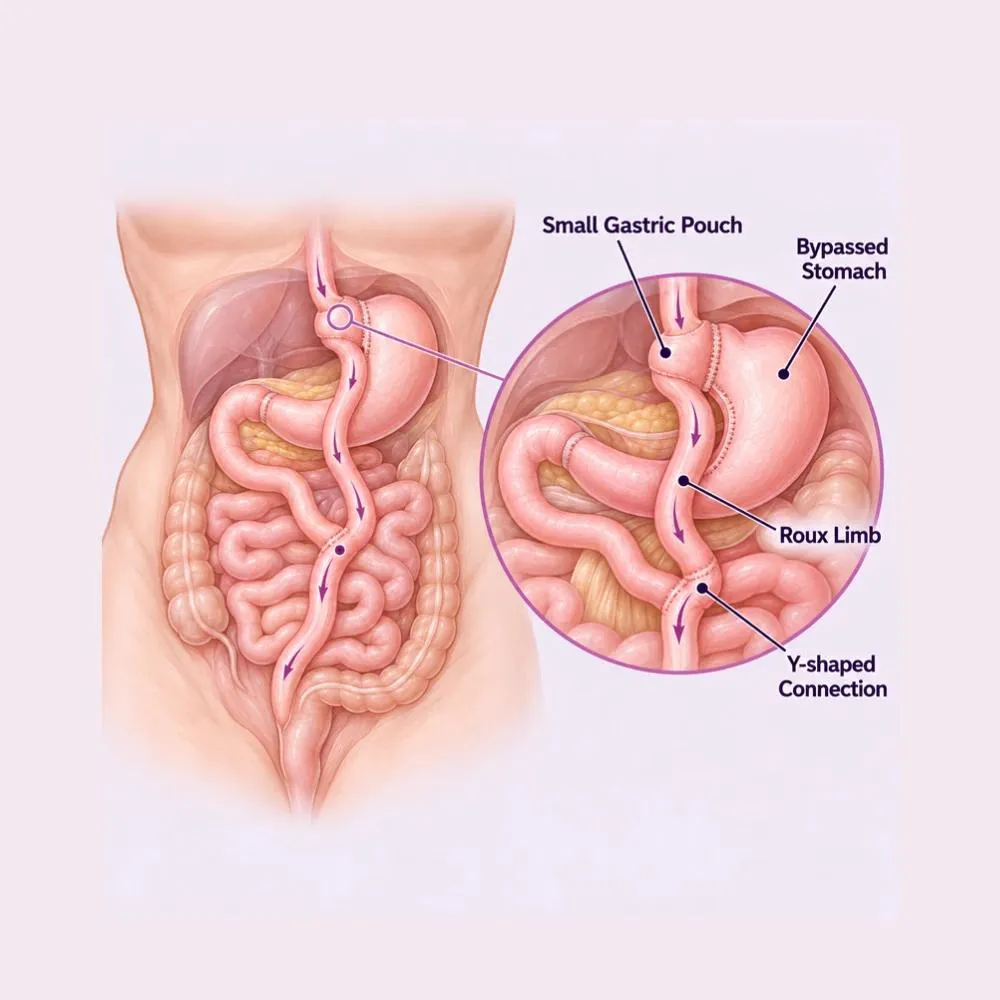
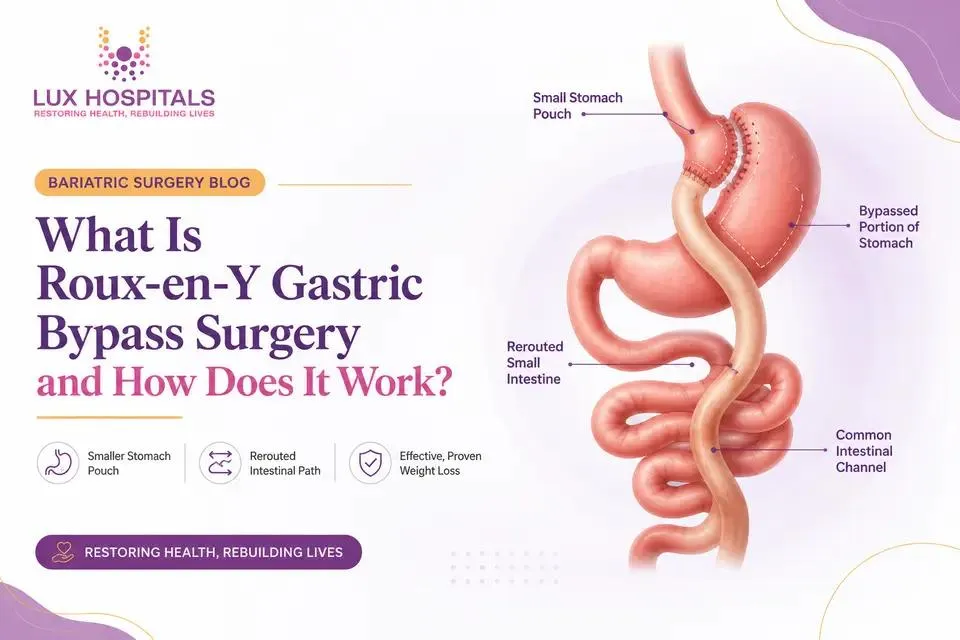
The Roux-en-Y gastric bypass does two things in one operation. A small pouch of around thirty millilitres is created at the top of the stomach, restricting how much you can eat. That pouch is then joined directly to a limb of small intestine, so food bypasses the rest of the stomach and the first part of the small bowel.
The name describes the shape. The rerouted intestine forms a Y, with one limb carrying food from the pouch and the other carrying bile and pancreatic enzymes down from the bypassed stomach and duodenum. The two meet lower down, where digestion resumes normally.
Its real advantage lies in the hormonal effect. Delivering food rapidly to the lower intestine triggers a large release of GLP-1, the hormone that stimulates insulin: the same pathway modern diabetes drugs target. This is why blood sugar improves within days, and why the bypass outperforms other procedures for type 2 diabetes.
The bypass works through several mechanisms at once, which is why it produces more weight loss and better diabetes control than restriction alone.
A thirty-millilitre pouch limits how much you can eat at one sitting, and produces fullness after very small portions.
Bypassing the duodenum and upper jejunum means fewer calories are absorbed from what you do eat.
Food arriving rapidly in the lower intestine triggers a large hormonal release that boosts insulin secretion and suppresses appetite.
Excluding the upper small intestine switches off signals that promote insulin resistance, independently of any weight loss.
The bypassed stomach produces less of the main hunger hormone, so the constant preoccupation with food subsides.
Sugary foods pass rapidly into the intestine and cause unpleasant symptoms: an unintended but genuinely effective deterrent.
Rerouted bile flow alters metabolic signalling in ways that improve glucose handling and liver fat.
The composition of gut bacteria shifts measurably after bypass, in patterns associated with improved metabolism.
Because several mechanisms act together, results are more consistent than with restriction alone, but the trade-off is permanently altered absorption, and that means lifelong supplements without exception.
The bypass is offered against the same criteria as other bariatric surgery, but it is specifically preferred in several situations where a sleeve is a poorer choice.
You may be a candidate if
Bypass is preferred over a sleeve when
A sleeve tends to worsen reflux; a bypass reliably improves it. For anyone with significant existing reflux, that alone usually settles the choice between the two.
A bypass permanently alters how you absorb nutrients, so the workup is more thorough than for restrictive procedures.
Full weight history, previous attempts at weight loss, comorbidities and medication review.
HbA1c, lipids, liver and kidney function, thyroid, and a full nutritional panel: B12, iron, folate, vitamin D, calcium and zinc.
Mandatory before a bypass. It checks for ulcers, H. pylori and Barrett’s oesophagus, since the bypassed stomach cannot be examined afterwards.
For gallstones and fatty liver. Rapid weight loss after bypass frequently causes gallstones, so removal may be planned at the same operation.
ECG, echocardiogram where indicated, and a sleep study for suspected sleep apnoea, which affects anaesthetic planning.
Assessment of eating patterns and readiness, plus detailed counselling on the lifelong supplement regime a bypass commits you to.
The endoscopy matters more here than for any other bariatric procedure. Once the stomach is bypassed it cannot easily be examined again, so anything needing attention must be found first.
Surgery is considered where non-surgical management has been genuinely tried. Among the surgical options, the choice turns on your diabetes, your reflux and your BMI.
Dietitian-led planning with regular review: the foundation of every approach, and it continues after any operation.
Graded activity with behavioural work on eating patterns and habit change.
GLP-1 receptor agonists produce meaningful weight loss and target the same hormone the bypass amplifies surgically.
A temporary endoscopic device giving six to twelve months of restriction, useful as a bridge or a trial.
The gold standard. The most reliable long-term weight loss and the highest diabetes remission rate, and it reliably improves reflux.
A single-anastomosis alternative with a shorter operating time and comparable results, though a higher rate of bile reflux.
Simpler, no rerouting, and better absorption, but slightly less weight loss and it tends to worsen reflux.
Conversion of a previous sleeve or band, most often for severe reflux or inadequate weight loss.
Adjustable and reversible, but now rarely performed because of poorer long-term weight loss and frequent reoperation.
The bypass is technically more demanding than a sleeve and carries a small risk of internal hernia years later. In exchange it offers the best results in weight, diabetes and reflux, which for many patients is the right trade.
A two to three hour keyhole operation through five small incisions, followed by a three-night stay. This is what happens.
Laparoscopic Roux-en-Y gastric bypass
A two-week liver-shrinking diet, which reduces the fatty liver overlying the stomach and makes access considerably safer.
General anaesthetic. The abdomen is inflated with carbon dioxide and five ports are placed across the upper abdomen.
A pouch of around thirty millilitres is stapled off from the top of the stomach, completely separated from the remainder.
The jejunum is divided, and the lower limb brought up to be joined to the pouch. This is the alimentary limb that carries food.
The pouch is joined to that limb with a stapled or hand-sewn connection. Its calibre determines both restriction and the risk of later narrowing.
The bypassed limb carrying bile and enzymes is rejoined further down, completing the Y. Mesenteric defects are closed to prevent internal hernia.
Both joins are tested with dye or air under water. Three nights in hospital follow, with fluids, walking and a detailed diet plan before discharge.
Closing the mesenteric defects is a small step with a large consequence. Left open, they allow bowel to herniate through months or years later: the one late complication that brings bypass patients back as emergencies.
A bypass is the most technically demanding of the common bariatric operations, and it commits you to lifelong follow-up. Here is why patients trust us:
Led by Dr. Tagore Mohan Grandhi, with fellowships in bariatric surgery (USA) and robotic surgery (Korea) and 28 years of experience.
Structured annual monitoring and dietitian support, because a bypass without follow-up leads to preventable deficiency.
From the first consultation through to post-treatment follow-up, with one team throughout.
Our hospital is in HITEC CITY, near IKEA: easily reachable from across Hyderabad.
Physical recovery takes four to six weeks. The dietary progression is staged deliberately, and the supplement regime that follows is lifelong and non-negotiable.
In hospital. Sips of water the same evening, walking within hours, clear fluids from day one. Home after three nights.
Clear liquids and sugar-free, non-carbonated drinks only. Small frequent sips, with protein supplements and close attention to hydration.
Pureed and soft foods, protein first. Desk work resumes from around week two. Supplements begin in earnest.
Gradual return to normal solid foods in small, well-chewed portions. Exercise resumes progressively. Sugary foods now cause dumping.
Most weight comes off over this period: typically 60–80% of excess body weight by eighteen to twenty-four months. Regular blood monitoring throughout.
Multivitamin, B12, iron, calcium and vitamin D indefinitely. Absorption is permanently altered: stopping them leads to anaemia and neurological damage.
60–80g daily, eaten before anything else at each meal, to protect muscle mass during rapid weight loss.
Sugary foods cause dumping: sweating, palpitations and diarrhoea. Anti-inflammatory painkillers cause pouch ulcers and must be avoided permanently.
Stop fluids thirty minutes before and after eating, so food is not washed through the small pouch.
Severe crampy abdominal pain, especially after meals, even years later. It needs urgent assessment rather than waiting.
Nutritional monitoring every year, indefinitely. Deficiencies develop silently and are far easier to correct early.
The bypass gives the best results of any bariatric operation, and it asks the most in return. The supplements and the annual blood tests are the price of that, and they are not optional.
Book a consultation with a bariatric specialist if any of the following apply.
Bariatric surgery is covered by most insurers in India where BMI criteria are met, and our team handles the pre-authorisation. These are the self-pay ranges.
| Procedure | Estimated Cost |
|---|---|
| Consultation & bariatric assessment Per visit | ₹1,000 – ₹2,000 |
| Complete pre-operative workup Bloods, endoscopy, ultrasound, cardiac and sleep review | ₹20,000 – ₹40,000 |
| Laparoscopic Roux-en-Y gastric bypass Three nights’ stay, staplers included | ₹3,50,000 – ₹5,50,000 |
| Robotic-assisted gastric bypass Three to four nights’ stay | ₹4,80,000 – ₹7,00,000 |
| Revision sleeve to bypass More complex, four nights’ stay | ₹4,20,000 – ₹6,50,000 |
| Follow-up & dietitian programme First year, with nutritional monitoring | ₹15,000 – ₹30,000 |
A bypass uses more stapler cartridges than a sleeve because it creates two anastomoses rather than one staple line.
Revising a previous sleeve or band involves dense adhesions, a longer operation and a longer stay.
A very high BMI, sleep apnoea or heart disease means longer theatre time and sometimes a night in intensive care.
A shared ward, a twin-sharing room or a private suite: the largest single swing in most estimates.
We are empanelled with most major insurers, and our team files the pre-authorisation for you.
Every figure above is an indicative range, not a quote. After your consultation you are given a written, fixed-cost estimate, and that is the number you pay, with no additions once treatment begins.
What patients treated here can expect:
60–80% of excess body weight, sustained long term.
The highest remission rate of any bariatric procedure.
Unlike a sleeve, a bypass reliably improves acid reflux.
The bariatric and gastrointestinal surgeon who performs gastric bypass at our HITEC CITY hospital.

Senior Consultant: Bariatric & Gastrointestinal Surgery
MBBS, MS, FRCS (UK), DLS (France)
28 years experience
Reviews from patients treated for bariatric and gastrointestinal conditions at Lux Hospitals, Hyderabad.
Written by Dr. Tagore Mohan Grandhi on bariatric surgery and metabolic health.

Dr. Tagore Mohan Grandhi
Dr. Tagore Mohan Grandhi
Dr. Tagore Mohan Grandhi
Dr. Tagore Mohan Grandhi
Dr. Tagore Mohan Grandhi

Dr. Tagore Mohan Grandhi
Common questions about gastric bypass, its results, and what surgery costs at Lux Hospitals.
Still have questions? Call us at 079 6908 4422
Still have questions? Message us on WhatsApp at 079 6908 4444
Laparoscopic Roux-en-Y gastric bypass with lifelong nutritional follow-up, and a fixed-cost estimate and insurance check before treatment begins.
Plot No.116, Lumbini Avenue, HITEC CITY, Near IKEA, Hyderabad – 500032













