Dr. Samhitha Reddy
Consultant Proctologist & Laparoscopic Surgeon
MBBS, MS, FMAS, FISCP, DMAS
- 8 Yrs
- ASCRS Member
Buccal fat removal takes out the pad of fat sitting in the hollow of the cheek, creating more definition beneath the cheekbone. It is performed entirely through the inside of the mouth, so there is no visible scar.
It is also permanent and irreversible, and the face continues to lose volume with age. Our plastic surgeon at Lux Hospitals, HITEC CITY is deliberately conservative with this procedure, because too much removed at thirty looks gaunt at fifty.
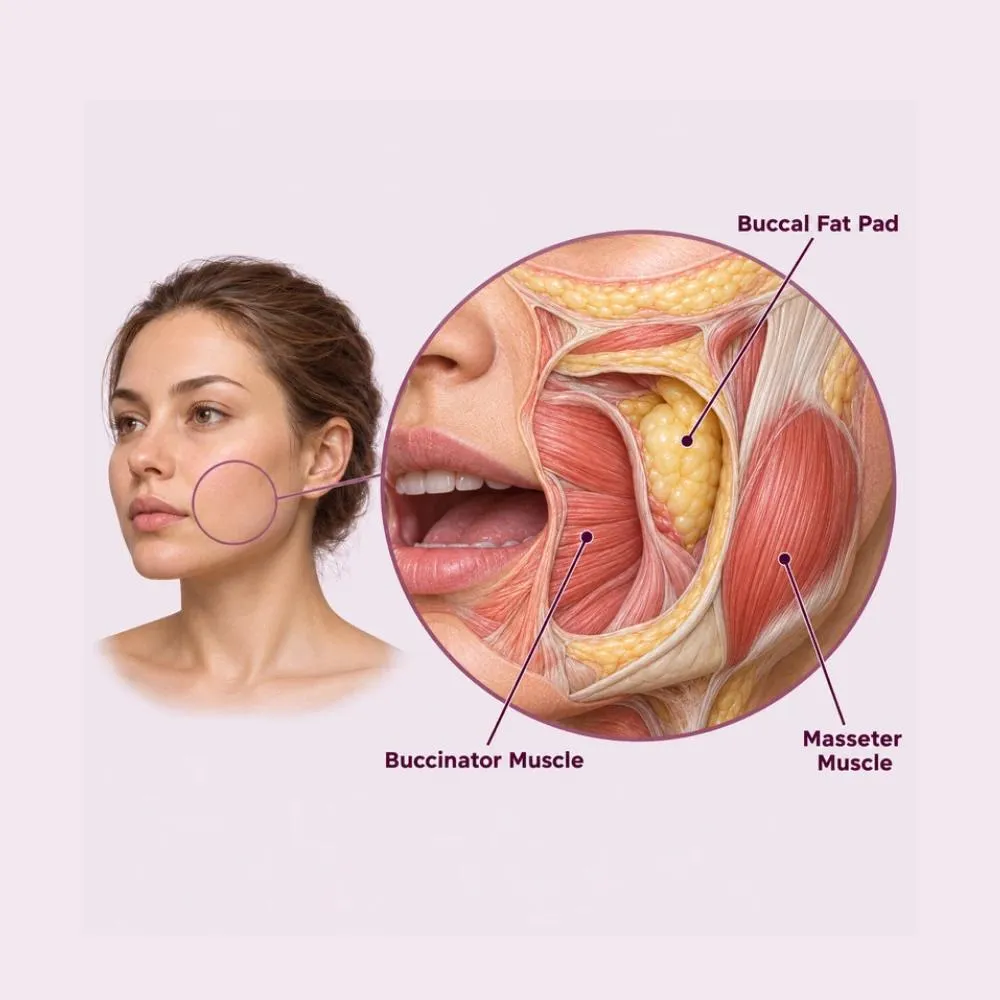
The buccal fat pad is a discrete, encapsulated body of fat sitting deep in the cheek, between the facial muscles. It is quite separate from the subcutaneous fat just beneath the skin, and its size varies considerably between individuals: largely genetically, and not in proportion to body weight. Removing part of it reduces fullness in the lower cheek and accentuates the hollow beneath the cheekbone.
The operation is performed entirely through a small incision inside the mouth, opposite the upper molars. The pad is teased out through that opening, a measured portion removed, and the incision closed with dissolving sutures. There is no external scar anywhere on the face, which is a genuine advantage of the approach.
The critical point is that this is permanent and cannot be undone. The buccal fat pad does not regenerate. Meanwhile the face naturally loses volume from the mid-face throughout adult life, so a degree of hollowing that looks sculpted at twenty-five can look drawn and aged at forty-five. This is why conservative removal matters far more here than in almost any other cosmetic procedure.
Several distinct things produce a rounded lower face, and only one of them is buccal fat.
Genetically determined and largely independent of body weight. This is the only component the operation addresses.
The layer just beneath the skin, which does respond to weight change. Removing buccal fat does nothing for this.
Enlargement of the chewing muscle from clenching or grinding, producing a square lower face. Treated with botulinum toxin, not surgery.
A wide mandibular angle produces a rounded face regardless of soft tissue. No fat removal changes the underlying skeleton.
Generalised weight gain fills the face along with everywhere else, and this component responds to weight loss.
Salt intake, alcohol, poor sleep and some medications cause facial puffiness that fluctuates and is not fat at all.
If your fullness is masseter muscle rather than fat, botulinum toxin will slim your face considerably and buccal fat removal will not. Clenching your jaw and feeling the muscle bulge is the simplest way to tell.
This procedure suits a narrow group well and a wider group badly. The difference is predictable at consultation.
Good candidates
Where it should be avoided
Being told you are not a good candidate is a valuable outcome here. This procedure has become fashionable, and the number of people asking for it far exceeds the number it will actually suit.
The consultation confirms that buccal fat is genuinely the cause, and that removing it will not age you prematurely.
Palpating the cheek to assess the buccal pad specifically, distinguishing it from subcutaneous fat and masseter bulk.
Evaluating cheekbone projection, mid-face volume and lower face width, to judge whether hollowing would improve or unbalance the face.
Anticipating natural volume loss over coming decades. This is what determines how conservative the removal should be.
Asking you to clench, which reveals whether the muscle is contributing. If it is, botulinum toxin may be the better answer.
Standardised frontal and three-quarter photographs, with a realistic account of how subtle the change will be.
A frank conversation about irreversibility, since restoring over-removed buccal fat requires fat grafting and never quite matches.
Ask yourself whether you would still want this at forty-five. The fat pad will not come back, the rest of your face will continue to lose volume, and that combination is what produces the gaunt look people regret.
Several things produce facial fullness, so several different treatments compete for the same complaint.
Where fullness came with weight gain, losing it slims the face along with everything else, and reversibly.
Where the fullness is muscle rather than fat, this slims the lower face effectively. It is reversible, which is a real advantage.
Adding volume above rather than removing it below often achieves the definition people are actually after, and it is reversible.
Lower salt intake, less alcohol and better sleep reduce facial puffiness that is frequently mistaken for fat.
A legitimate option, particularly for those under twenty-five whose facial proportions are still maturing.
The standard approach. A small incision inside the cheek, the pad partially removed, and no external scar anywhere on the face.
Removing a measured portion rather than the whole pad. This is the deliberate approach and it protects against premature hollowing.
Where subcutaneous fat also contributes, treating both layers gives a more complete result than either alone.
Rather than removing the pad, repositioning it to add volume higher in the mid-face. An option in older patients.
Buccal fat removal alongside botulinum toxin where both fat and muscle contribute to the fullness.
Cheekbone filler is worth serious consideration before surgery. It creates definition by adding above rather than removing below, it is reversible, and for many people it achieves what they were actually asking for.
The procedure takes thirty to forty-five minutes and you go home the same day.
Day-care procedure through the inside of the mouth
Antiseptic mouthwash beforehand, stopping blood thinners, and fasting where sedation or general anaesthesia is planned.
Local anaesthesia is usually sufficient, sometimes with light sedation. General anaesthesia is used only for combined procedures.
A small incision of around one centimetre inside the cheek, opposite the upper molars. Nothing on the outside of the face.
The buccinator muscle is divided carefully and the encapsulated fat pad identified beneath it, distinct from surrounding tissue.
Gentle external pressure on the cheek delivers the pad through the incision, and a measured portion is excised.
Both sides compared directly, with the volume removed matched. Asymmetry here is very visible and hard to correct afterwards.
The incision closed with dissolving sutures that disappear within one to two weeks. Nothing needs removing.
The facial nerve branches and the parotid duct run close to this dissection, which is why it is a procedure for a trained plastic surgeon rather than a quick clinic treatment.
This procedure is fashionable, permanent, and easy to overdo. Here is why patients trust us:
A measured portion removed rather than the whole pad, planned around the volume your face will naturally lose over coming decades.
Masseter bulk, subcutaneous fat and bone structure all assessed, and alternatives offered where buccal fat is not the actual cause.
From the first consultation through to post-treatment follow-up, with one team throughout.
Our hospital is in HITEC CITY, near IKEA: easily reachable from across Hyderabad.
Recovery is quick, but the final result takes three to six months to appear as swelling settles.
Cheek swelling, which paradoxically makes the face look fuller at first. Soft diet and antiseptic mouthwash after every meal.
Swelling peaks around day three then begins settling. Most people return to work at around five to seven days.
Swelling reduces substantially and normal diet resumes. Intraoral sutures dissolve on their own.
Residual swelling settles and the contour change becomes visible. Most of the result is apparent by three months.
Final result established. Any remaining firmness inside the cheek resolves.
Swelling makes the cheeks look larger for the first week or two. The change only becomes visible from around six weeks and settles by three months.
The incision is inside the mouth, so oral hygiene is what prevents infection. Rinse after eating for the first two weeks.
Avoid crunchy, spicy and very hot food while the intraoral incision heals. Nothing that requires vigorous chewing.
On two pillows for the first week, which noticeably reduces facial swelling in the early days.
The fat pad does not regenerate. If too much was taken, correcting it requires fat grafting and never quite matches the original.
Increasing rather than settling pain, fever, or swelling on one side only needs review: these suggest infection or a haematoma.
The regret associated with this procedure is almost always about over-removal rather than the surgery itself. Conservative removal that looks subtle now is what still looks good in twenty years.
A consultation is worthwhile if any of the following apply.
This is a short day-care procedure under local anaesthesia, so the cost is modest and predictable.
| Procedure | Estimated Cost |
|---|---|
| Consultation Includes assessment and photographs | ₹800 – ₹1,500 |
| Buccal fat removal Both sides, day care, local anaesthesia | ₹65,000 – ₹1,20,000 |
| Under sedation or general anaesthesia Where preferred or combined | ₹90,000 – ₹1,50,000 |
| Combined with facial liposuction Addresses both fat layers | ₹1,20,000 – ₹2,00,000 |
| Buccal fat repositioning Volume moved rather than removed | ₹1,10,000 – ₹1,90,000 |
| Botulinum toxin to the masseter Per session; lasts four to six months | ₹18,000 – ₹40,000 |
| Cheekbone filler Per session; lasts twelve to eighteen months | ₹25,000 – ₹60,000 |
Local anaesthesia is the default and costs least. Sedation or general anaesthesia adds anaesthetist and recovery charges.
Adding facial liposuction or masseter treatment increases the cost but addresses fullness that buccal fat removal alone would not.
Botulinum toxin and filler are cheaper per session but recur as ongoing costs, whereas surgery is one-off and permanent.
A shared ward, a twin-sharing room or a private suite: the largest single swing in most estimates.
We are empanelled with most major insurers, and our team files the pre-authorisation for you.
Every figure above is an indicative range, not a quote. After your consultation you are given a written, fixed-cost estimate, and that is the number you pay, with no additions once treatment begins.
The plastic surgeon who performs buccal fat removal at our HITEC CITY hospital.

Consultant Plastic & Cosmetic Surgeon
MBBS, MS, MCh (Plastic Surgery)
16 years experience
Reviews from patients treated for cosmetic and plastic surgery at Lux Hospitals, Hyderabad.
Written by Dr. M. Ram Prabhu on plastic and cosmetic surgery.
Dr. M. Ram Prabhu

Dr. M. Ram Prabhu
Dr. M. Ram Prabhu
Dr. M. Ram Prabhu
Dr. M. Ram Prabhu

Dr. M. Ram Prabhu
Common questions about buccal fat removal, its permanence and what it costs at Lux Hospitals.
Still have questions? Call us at 079 6908 4422
Still have questions? Message us on WhatsApp at 079 6908 4444
An honest assessment of whether buccal fat removal will suit your face, given that the result is permanent.
Plot No.116, Lumbini Avenue, HITEC CITY, Near IKEA, Hyderabad – 500032