Dr. Samhitha Reddy
Consultant Proctologist & Laparoscopic Surgeon
MBBS, MS, FMAS, FISCP, DMAS
- 8 Yrs
- ASCRS Member
A hydrocele is fluid collecting around the testicle, producing a painless scrotal swelling that grows slowly and eventually becomes hard to ignore.
It is not dangerous, which is why many men leave it for years. It does, however, keep enlarging, and the operation to fix it is straightforward day-care surgery. Our urologists at Lux Hospitals, HITEC CITY confirm the diagnosis on ultrasound and treat it in a single day.
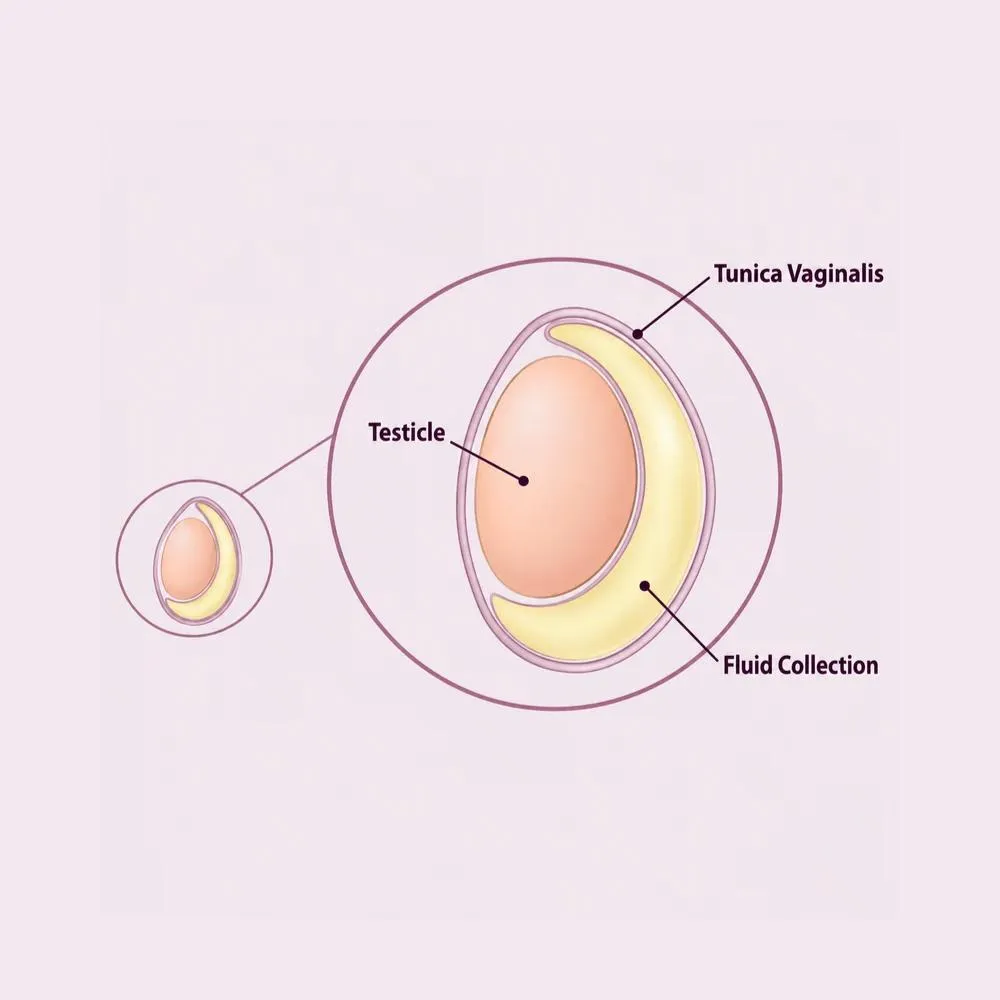
A hydrocele is an accumulation of fluid within the tunica vaginalis, the thin double-layered sac that surrounds the testicle. A small amount of fluid is normally present there and is continuously produced and reabsorbed. A hydrocele forms when that balance tips: either too much is produced or too little is absorbed.
There are two types. A communicating hydrocele occurs when the passage between the abdomen and the scrotum fails to close after birth, allowing abdominal fluid to track down. These are seen in infants and characteristically change size through the day, being smaller in the morning. A non-communicating hydrocele has no such connection and is the type seen in adults: the sac is sealed and the fluid is trapped.
Hydroceles are painless and benign. The reason to treat them is size: they enlarge steadily, and a large one becomes uncomfortable, interferes with walking and sitting, and is difficult to conceal under clothing. Some reach the size of a grapefruit before a man seeks help.
The cause differs between infants and adults, and in most adult cases no specific trigger is ever identified.
In infants, the processus vaginalis fails to seal after descent of the testis, allowing abdominal fluid into the scrotum. Most close spontaneously within the first year.
The commonest adult cause. The balance between fluid production and absorption shifts for no identifiable reason, usually with age.
Epididymo-orchitis can cause a reactive hydrocele that persists after the infection has resolved.
Trauma to the scrotum causes inflammation and fluid accumulation, sometimes weeks after the event itself.
Hydroceles occasionally develop after varicocele repair, hernia surgery or other scrotal procedures.
A parasitic infection that obstructs lymphatic drainage. Uncommon in Hyderabad but a significant cause in endemic parts of India.
A hydrocele can develop secondary to an underlying tumour, which is precisely why ultrasound is done rather than assumed unnecessary.
Most adult hydroceles have no identifiable cause and none is found on investigation. The ultrasound is nonetheless important, because the small proportion that are secondary to something else must not be missed.
The characteristic presentation is a painless, gradually enlarging swelling on one side of the scrotum.
Typical symptoms
Symptoms needing prompt review
A hydrocele that appears suddenly, hurts, or feels firm is not behaving like a hydrocele and needs urgent assessment: infection, torsion and testicular tumour all present as scrotal swelling.
Diagnosis is usually clear on examination, but ultrasound is done in every adult case to exclude an underlying testicular abnormality.
The swelling is soft and fluctuant, and the examining hand can get above it, which distinguishes it from an inguinal hernia extending into the scrotum.
A light held against the scrotum passes through clear fluid and makes it glow. Solid lumps do not transilluminate. A simple bedside test, though not sufficient on its own.
Confirms fluid, measures its volume, and (most importantly) visualises the testicle underneath. Every adult hydrocele should have one.
Assesses blood flow to the testis, distinguishing hydrocele from torsion where the presentation is acute.
Inflammatory markers where infection is suspected, and tumour markers where ultrasound raises any concern about the testis.
Routine bloods, ECG and anaesthetic review before surgery, arranged so it can be completed in a single visit.
The single reason not to skip the ultrasound is testicular tumour. It is uncommon, but a hydrocele can be the presenting sign, and a scan takes fifteen minutes.
Small, symptomless hydroceles need nothing. Surgery is the definitive treatment when size or discomfort warrants it.
Appropriate for small, painless hydroceles. In infants, most resolve spontaneously within the first year and surgery is deferred until then.
Supportive underwear reduces the dragging sensation while waiting, though it does not treat the hydrocele itself.
Drawing the fluid off with a needle. It gives immediate relief but the fluid reaccumulates in most cases within weeks to months.
Draining the fluid then injecting an agent to obliterate the sac. Better than aspiration alone, but recurrence remains commoner than after surgery. Reserved for men unfit for an operation.
The sac is opened, drained and everted behind the testis so fluid can no longer collect. The standard operation for a large, thin-walled hydrocele.
The sac is bunched with sutures rather than excised, causing less bleeding and swelling. Suited to smaller, thin-walled hydroceles.
The thickened sac is removed entirely. Used where the wall is thick or long-standing, with a slightly higher rate of post-operative swelling.
In children, the persistent communication is tied off through a small groin incision: a different operation to the adult one, addressing the connection rather than the sac.
Aspiration is tempting because it is quick and needle-only, but the fluid comes back in the great majority of cases. Surgery is done once and is definitive.
The operation takes around thirty to forty-five minutes and you go home the same day.
Day-care surgery under spinal or general anaesthesia
Fasting from midnight, with the scrotal area shaved and cleaned. A single dose of antibiotic is given before the incision.
Usually spinal anaesthesia, numbing you from the waist down while you remain awake. General anaesthesia is used where preferred or in children.
A small incision over the scrotum, or in the groin crease for children. Placed along a natural skin line so the scar settles well.
The hydrocele sac is carefully separated from surrounding tissue and brought out through the incision with the testis inside it.
The fluid is drained and the sac is everted, plicated or excised depending on its thickness and size. The testis itself is left untouched.
Meticulous control of bleeding: this is the step that determines whether a haematoma forms. The testis is returned and the layers closed with absorbable sutures.
A supportive dressing and scrotal support are applied. You are observed for a few hours, then discharged the same evening.
Careful haemostasis is what separates a smooth recovery from a difficult one. A scrotal haematoma is the commonest complication and is almost entirely a function of how carefully the operation is finished.
A hydrocele operation is straightforward, and doing it carefully is what keeps recovery uneventful. Here is why patients trust us:
Admission, surgery and discharge in a single day, with the assessment completed in one prior visit.
The testis is imaged before surgery in every adult, because a hydrocele can occasionally be secondary to something that must not be missed.
From the first consultation through to post-treatment follow-up, with one team throughout.
Our hospital is in HITEC CITY, near IKEA: easily reachable from across Hyderabad.
Most men are back to desk work within a week. Scrotal swelling settles more slowly than the wound and is expected.
Home the same evening. Some soreness and swelling, controlled with simple painkillers. Scrotal support worn continuously.
Discomfort peaks then settles. Ice packs help. Walking is encouraged; standing for long periods is not.
Dressing removed and the wound reviewed. Most men return to desk work at the end of this week.
Swelling reduces steadily. Light exercise resumes. Sexual activity can restart at around three to four weeks.
Residual firmness and swelling settle fully. The scrotum returns to normal size and the scar fades.
Snug supportive underwear for at least two to four weeks. It reduces swelling and discomfort more than anything else you can do.
Fifteen minutes at a time with a cloth between the pack and the skin. It meaningfully limits swelling in the first forty-eight hours.
Nothing over five kilograms and no strenuous exercise for four weeks. Straining raises the risk of bleeding and swelling.
Scrotal swelling can take six to twelve weeks to settle completely. This is normal and is not a sign the hydrocele has come back.
Rapidly increasing pain, a tense hard scrotum, fever or discharge from the wound needs review: these suggest haematoma or infection.
Shower after the dressing comes off, pat dry rather than rub, and avoid baths and swimming until the wound has healed.
Recurrence after proper surgery is uncommon: under five per cent. The swelling most men worry about in the first month is post-operative oedema, not fluid returning.
Book a consultation if any of the following apply.
Hydrocelectomy is a day-care procedure, so cost is predictable and there is no extended stay.
| Procedure | Estimated Cost |
|---|---|
| Consultation Includes examination | ₹800 – ₹1,500 |
| Scrotal ultrasound Confirms diagnosis and checks the testis | ₹1,500 – ₹3,500 |
| Pre-operative workup Bloods, ECG, anaesthetic review | ₹3,000 – ₹6,000 |
| Hydrocelectomy: one side Day care, all-inclusive | ₹40,000 – ₹70,000 |
| Hydrocelectomy: both sides Done in one sitting | ₹55,000 – ₹90,000 |
| Aspiration with sclerotherapy Where surgery is not suitable | ₹12,000 – ₹25,000 |
| Paediatric hydrocele surgery Groin approach, general anaesthesia | ₹35,000 – ₹60,000 |
Bilateral surgery costs more than one side but considerably less than two separate operations, since theatre and anaesthesia are shared.
A very large or long-standing hydrocele with a thickened sac takes longer and may need the sac excised rather than plicated.
Spinal anaesthesia is the default for adults and costs less than general anaesthesia, which is needed for children.
A shared ward, a twin-sharing room or a private suite: the largest single swing in most estimates.
We are empanelled with most major insurers, and our team files the pre-authorisation for you.
Every figure above is an indicative range, not a quote. After your consultation you are given a written, fixed-cost estimate, and that is the number you pay, with no additions once treatment begins.
The urologists who perform hydrocele surgery at our HITEC CITY hospital.

Consultant Urologist & Andrologist
MBBS, MS, DrNB (Urology)
10 years experience

Consultant Urologist & Andrologist
MBBS, MS, MCh (Urology)
9 years experience
Reviews from patients treated for urological and men’s health conditions at Lux Hospitals, Hyderabad.
Written by Dr. Vipin Reddy B on men’s health and urological care.

Dr. Vipin Reddy B

Dr. Vipin Reddy B

Dr. Vipin Reddy B

Dr. Vipin Reddy B

Dr. Vipin Reddy B

Dr. Vipin Reddy B
Common questions about hydrocele, its surgery, recovery and what treatment costs at Lux Hospitals.
Still have questions? Call us at 079 6908 4422
Still have questions? Message us on WhatsApp at 079 6908 4444
Ultrasound assessment and day-care hydrocele surgery with our urologists, and a written estimate before you decide.
Plot No.116, Lumbini Avenue, HITEC CITY, Near IKEA, Hyderabad – 500032