



Dr. Samhitha Reddy
Consultant Proctologist & Laparoscopic Surgeon
MBBS, MS, FMAS, FISCP, DMAS
- 8 Yrs
- ASCRS Member
An anal fissure is a small tear in the lining of the anus. It is a minor injury that causes disproportionate pain: a sharp, tearing pain during bowel movements that can go on for hours afterwards.
Most fissures heal with the right medication and diet. For the ones that do not, our proctologists at Lux Hospitals, HITEC CITY offer laser treatment and sphincter-preserving surgery that relieve the pain and let the tear finally close.
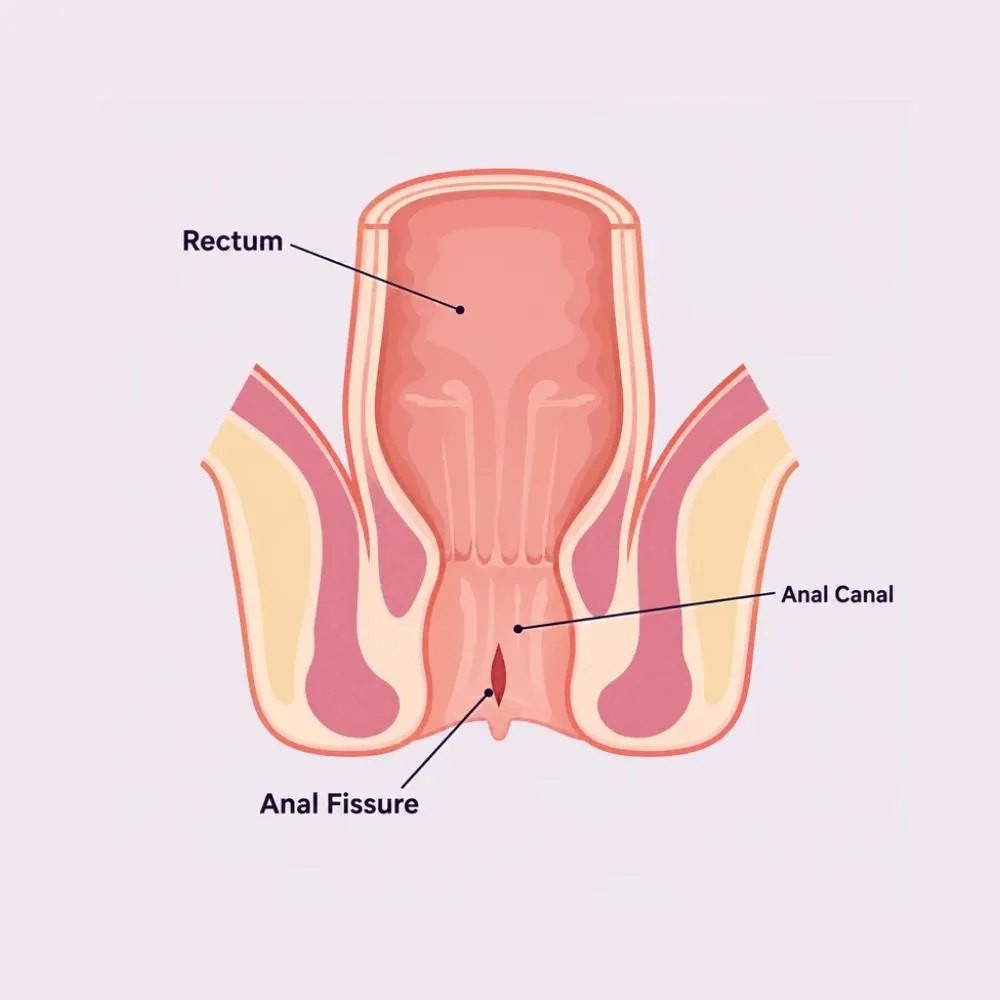
An anal fissure is a small tear or crack in the thin, moist lining of the anus. It usually happens when a hard or large stool stretches the anal canal beyond what the lining will take.
What turns a small tear into a persistent problem is a spasm. The pain makes the internal sphincter clench, the clenched muscle cuts off blood supply to the tear, and a tear without blood supply cannot heal. That cycle (pain, spasm, poor blood flow, more pain) is what every fissure treatment is designed to break.
Fissures are described as acute or chronic. An acute fissure is recent and heals within a few weeks with proper care. A chronic fissure has lasted longer than six to eight weeks, is deeper, and often has a sentinel skin tag at its outer edge and a thickened rim: signs that it has been trying and failing to heal.
Most fissures are a mechanical injury: something stretched the anal lining past its limit. A few point to an underlying condition.
The commonest cause by far. A hard, bulky stool tears the lining on its way out.
Infrequent, difficult bowel movements that leave stools dry and hard by the time they pass.
Pushing hard raises pressure in the anal canal and stretches the lining while it is already under tension.
Frequent, loose bowel movements irritate and inflame the anal lining until it breaks down.
The stretching of vaginal delivery, and the constipation that often follows it, make fissures common after childbirth.
Some people have a naturally high resting sphincter pressure, which both causes fissures and stops them healing.
Injury to the anal area, including from instrumentation or anal intercourse, can tear the lining directly.
Crohn’s disease and ulcerative colitis cause fissures that are often off the midline and slow to heal: a pattern that prompts further investigation.
A fissure in the midline, front or back, is almost always mechanical. One off to the side is the one that warrants looking for a cause beneath it.
Fissure pain is distinctive: sharp and well localised, tied to bowel movements, and out of proportion to how small the tear actually is.
During and after a bowel movement
Between bowel movements
Holding on because it hurts is the trap. The stool gets harder, the next movement tears the same spot again, and an acute fissure becomes a chronic one.
A fissure is usually diagnosed on sight, in under a minute. The examination is gentle: we do not force an instrument into a canal that is already in spasm.
Gently parting the buttocks usually reveals the tear directly. Its position and depth tell us whether it is acute or chronic.
Assesses sphincter tone and tenderness. Often deferred to a later visit if the fissure is too painful to allow it comfortably.
A sentinel skin tag, a thickened edge, or visible sphincter fibres at the base: the features that mean medication alone is unlikely to work.
Performed once the pain has settled, to see the anal canal fully and rule out coexisting piles or a fistula.
Advised for chronic, recurrent or atypically-placed fissures, to rule out Crohn’s disease and other inflammatory bowel conditions.
Measures resting sphincter pressure in selected cases, which helps decide between Botox and a sphincterotomy.
You will usually leave the first consultation with a diagnosis, a prescription, and a clear idea of whether surgery is likely to be needed at all.
The great majority of fissures heal without surgery. Everything on the first list is aimed at the same thing: softening the stool and relaxing the sphincter so blood can reach the tear.
Creams containing nitroglycerin, diltiazem or nifedipine relax the internal sphincter and increase blood flow, letting the fissure heal. The mainstay of first-line treatment.
Reduce straining and let a soft stool pass without reopening the tear. No fissure heals while hard stools keep tearing it.
Ten minutes in warm water, several times a day. It relaxes the sphincter spasm and relieves pain immediately.
Local anaesthetic gel applied before a bowel movement breaks the pain-spasm cycle at the moment it is worst.
Botulinum toxin injected into the internal sphincter relaxes it for around three months: long enough for the fissure to heal, with no permanent change to the muscle.
A small, precisely measured cut in the internal sphincter permanently lowers resting pressure so the fissure heals. The most effective treatment for chronic fissures, with cure rates above ninety per cent.
The same principle performed with laser energy rather than a blade: more controlled, less bleeding, and a faster recovery.
The chronic, scarred edges of the fissure are trimmed back to healthy tissue so it can heal as a fresh wound. Often combined with Botox.
Healthy tissue is moved to cover the fissure. Reserved for fissures that have recurred after a sphincterotomy, or where sphincter pressure is already low.
Surgery is recommended when a fissure is chronic, has not healed on medication, or is causing severe pain and bleeding. It is not the starting point, and for most patients it is never reached.
A twenty to thirty minute day-care procedure. It relieves the spasm that is preventing healing, and most patients notice the pain is gone from the very first bowel movement afterwards.
Laser lateral internal sphincterotomy
Routine bloods, an ECG where age or history calls for one, and a six-hour fasting window before your slot.
A short spinal or general anaesthetic. The sphincter must be fully relaxed for the surgeon to judge the cut accurately, which local anaesthesia alone does not achieve.
With the spasm gone, the surgeon can assess the fissure, the sphincter tone and any coexisting piles or fistula properly for the first time.
A laser fibre divides a measured portion of the internal sphincter through a small lateral opening: away from the fissure itself, which is why the wound heals cleanly.
Where the fissure is chronic, its scarred edges and sentinel tag are trimmed back so it heals as fresh tissue rather than continuing as old scar.
Two to three hours in day care, then home the same evening with stool softeners, painkillers and a follow-up date.
Only the internal sphincter is divided, and only partially: the external sphincter, which does the work of holding on, is left untouched. That is what keeps continence intact.
At Lux Hospitals we are a trusted centre for anal fissure treatment in Hyderabad, offering modern care with a patient-first approach. Here is why patients trust us:
Led by Dr. Samhitha Reddy, one of the top colorectal surgeons in Hyderabad, with Dr. Abhishek Katha, an expert laparoscopic surgeon.
Laser treatment for fissures: minimally invasive, precisely controlled, and quick to recover from.
From the first consultation through to post-treatment follow-up, with one team throughout.
Our hospital is in HITEC CITY, near IKEA: easily reachable from across Hyderabad.
The pain relief after a sphincterotomy is immediate and is what patients notice first. The wound itself takes a few weeks to heal quietly in the background.
Home the same evening. The characteristic spasm pain is usually gone straight away, replaced by mild soreness.
First bowel movement, and for most patients the first painless one in months. Sitz baths begin. Desk work from day two or three.
Minor spotting settles. Stool softeners continue. First follow-up review at the end of the week.
The fissure and the small lateral wound close. Normal activity, driving and the gym resume.
Final review. Healing is confirmed and the diet changes carry on as long-term prevention.
Ten minutes in warm water, two or three times a day for the first fortnight. Nothing relieves anal soreness better.
25–30g of fibre a day and two to three litres of water. Soft stools are what stop the fissure recurring.
Continue stool softeners for the full period advised, not just until the pain stops. The pain stops well before the tear closes.
Go when you need to. Deferring is what hardens the stool and reopens the tear: the habit that caused the fissure in the first place.
Heavy bleeding, fever, increasing pain after the first few days, or any difficulty controlling wind or stool.
Week one and week six. The second confirms the fissure has actually closed rather than merely stopped hurting.
Fissures recur when the bowel habit that caused them returns. The operation fixes the spasm; the fibre and the water are what keep it fixed.
Book a consultation if any of the following apply.
Medication and lifestyle changes are inexpensive; surgery costs more and is needed less often. These are the ranges our patients fall into.
| Procedure | Estimated Cost |
|---|---|
| Consultation & medical management Out-patient, including a course of topical medication | ₹1,500 – ₹6,000 |
| Botox injection Day care, effect lasts around three months | ₹18,000 – ₹35,000 |
| Lateral internal sphincterotomy Day care or one night’s stay | ₹30,000 – ₹55,000 |
| Laser sphincterotomy Day care, same-day discharge | ₹40,000 – ₹70,000 |
| Fissurectomy with flap One night’s stay | ₹50,000 – ₹80,000 |
An acute fissure usually needs a prescription and a diet change. A chronic one with a sentinel tag and scarring needs a procedure.
Fissures often come with piles or a fistula, and treating both in one sitting changes the theatre time and the estimate.
A shared ward, a twin-sharing room or a private suite: the largest single swing in most estimates.
We are empanelled with most major insurers, and our team files the pre-authorisation for you.
Every figure above is an indicative range, not a quote. After your consultation you are given a written, fixed-cost estimate, and that is the number you pay, with no additions once treatment begins.
What patients treated here can expect:
The spasm pain typically resolves from the first bowel movement after surgery.
Minimally invasive day-care procedures, with most patients back at work in days.
Cure rates above ninety per cent when the sphincter spasm is properly treated.
The proctologists and colorectal surgeons who treat anal fissures at our HITEC CITY hospital.

Consultant Proctologist & Laparoscopic Surgeon
MBBS, MS, FMAS, FISCP, DMAS
8 years experience

Consultant General & Advanced Laparoscopic Surgeon
MBBS, MS, FMAS
17 years experience
Reviews from patients treated for fissures, piles and fistulas at Lux Hospitals, Hyderabad.
Written by Dr. Samhitha Reddy on fissures, piles, fistulas and colorectal health.
Dr. Samhitha Reddy

Dr. Samhitha Reddy

Dr. Samhitha Reddy
Dr. Samhitha Reddy
Dr. Samhitha Reddy
Common questions about anal fissures, their treatment, and what it costs at Lux Hospitals.
Still have questions? Call us at 079 6908 4422
Still have questions? Message us on WhatsApp at 079 6908 4444
Fast relief from fissure pain with laser and non-surgical options, and a fixed-cost estimate shared before treatment begins.
Plot No.116, Lumbini Avenue, HITEC CITY, Near IKEA, Hyderabad – 500032













