



Dr. Samhitha Reddy
Consultant Proctologist & Laparoscopic Surgeon
MBBS, MS, FMAS, FISCP, DMAS
- 8 Yrs
- ASCRS Member
Do you experience deep buttock pain that becomes worse when sitting, climbing stairs or exercising? Does the discomfort sometimes travel into the back of your thigh or leg? These symptoms may be linked to piriformis syndrome, a condition that involves irritation of structures around the sciatic nerve in the buttock.
Piriformis syndrome can resemble sciatica caused by a slipped disc, making accurate assessment important. Many patients improve with suitable activity modification, physiotherapy and conservative pain management. At Lux Hospitals, Hyderabad, patients can enquire about orthopaedic consultations for persistent buttock pain, suspected piriformis syndrome and related nerve symptoms.
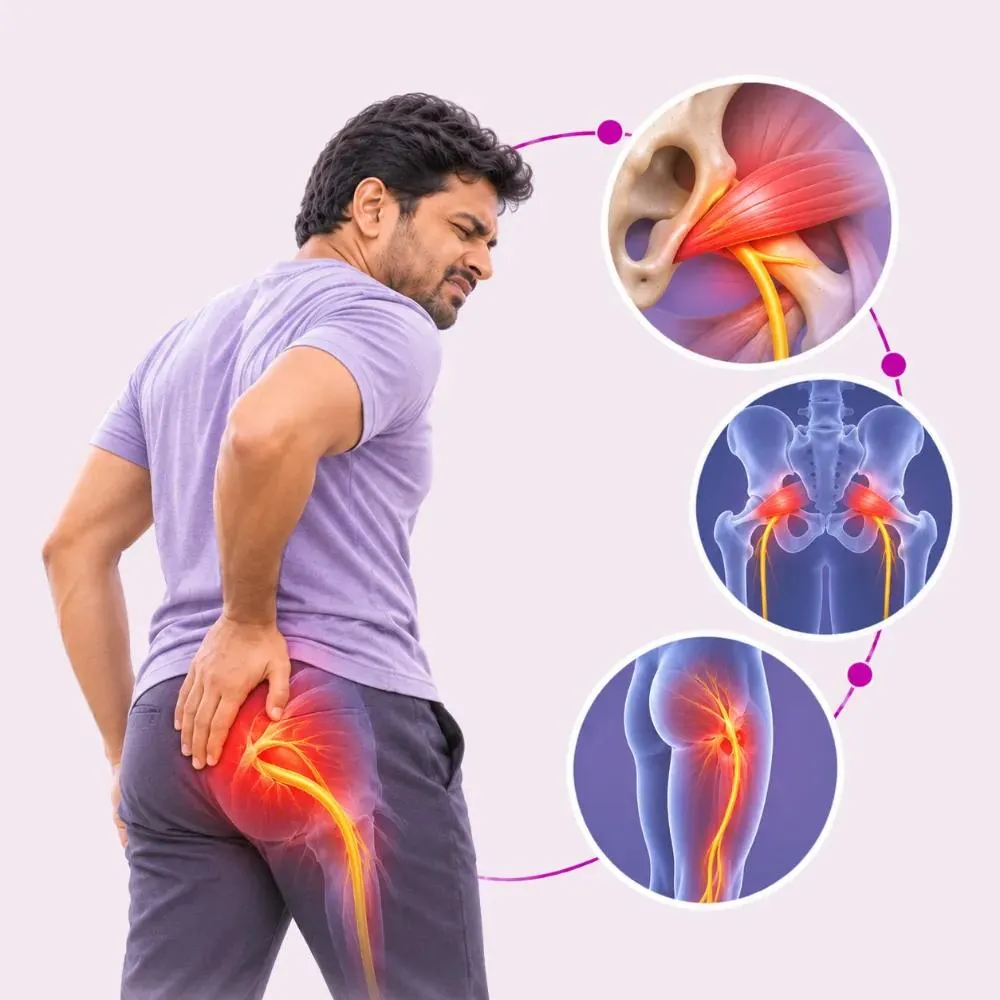
Piriformis syndrome is a condition in which the sciatic nerve becomes irritated or compressed near the piriformis muscle in the deep buttock region. The piriformis is a small muscle that extends from the sacrum to the upper thigh bone and helps rotate and stabilise the hip. Since the sciatic nerve travels close to this muscle, irritation or compression in the surrounding area may cause buttock pain that can extend into the thigh or leg.
Piriformis syndrome is sometimes considered part of deep gluteal syndrome, a broader group of conditions involving sciatic nerve irritation outside the spine. Symptoms may resemble sciatica caused by spinal problems. However, not all deep buttock pain originates from the piriformis muscle. Diagnosis involves clinical evaluation to identify possible nerve irritation and rule out other conditions with similar symptoms.
Piriformis syndrome is considered when symptoms seem to start around the deep buttock and are made worse by pressure or specific hip movements. Lumbar sciatica is most commonly caused by irritation of nerve roots in the lower spine, sometimes from a herniated disc or spinal stenosis. Both may cause radiating leg pain, and pain location alone is not enough to confirm either diagnosis.
Piriformis-related symptoms may develop from several contributing factors, although the exact mechanism is not always clear.
Repeated physical activities involving the hip may aggravate the piriformis muscle or nearby tissues.
Long hours of sitting may worsen existing symptoms by putting pressure on the deep buttock area.
In susceptible people, repetitive hip movements from running, cycling and other activities may cause discomfort.
A fall or impact involving the buttock can occasionally cause local tissue injury or irritation near the sciatic nerve.
Some people may experience discomfort due to piriformis muscle sensitivity or increased muscle tone, although tightness by itself does not prove nerve entrapment.
The relationship between the sciatic nerve and piriformis muscle differs between individuals. However, these variations also occur in people without symptoms and should not automatically be assumed to be the cause.
Scar tissue, nearby muscle or tendon problems and other structures in the deep gluteal region can produce similar symptoms.
Identifying the true pain source matters before recommending targeted injections or other procedures.
Symptoms generally involve the buttock and may extend along the path of the sciatic nerve.
Common symptoms
Emergency warning signs
Symptoms are commonly one-sided, although other pain conditions may produce discomfort on both sides. The emergency warning signs need immediate medical attention and should not be assumed to be caused by piriformis syndrome.
The diagnosis is mostly clinical and often involves ruling out more serious or more common causes of buttock and radiating leg pain.
The doctor reviews pain location, duration, physical activities, sitting tolerance and previous injuries. The clinician also considers lower back pain, neurological symptoms or previous lumbar spine problems.
The clinician evaluates the hip, buttock and lower back. Tenderness around the deep gluteal region and discomfort with selected hip movements may increase clinical suspicion.
The clinician may examine muscle strength, reflexes and sensation to identify possible lumbar nerve-root involvement or another neurological condition.
Selected examinations, including the FAIR test (flexion, adduction and internal rotation), may reproduce characteristic symptoms, and other hip rotation or resisted muscle tests may also be used. No individual manoeuvre reliably confirms piriformis syndrome in every patient.
MRI of the lumbar spine or pelvis may be considered when symptoms suggest disc herniation, hip-related conditions or other structural problems. Imaging is not routinely required for every suspected case.
In certain circumstances, nerve conduction testing and electromyography may be used to rule out other neurological disorders. A specialist may also consider an image-guided local anaesthetic injection near the piriformis region: temporary improvement may support the suspected pain source, but injection response is not a definitive diagnostic test.
Significant lower back pain with neurological deficits, progressive foot or leg weakness, symptoms involving several nerve distributions, severe hip pain or inability to bear weight, fever or systemic illness, persistent unexplained night pain and unexplained weight loss suggest another condition. These findings may require evaluation for lumbar spine, hip, neurological or other medical conditions.
Treatment usually begins with conservative care. The aim is to relieve discomfort, improve hip function and help patients return to their usual activities.
Commonly recommended for persistent piriformis-related pain. An individualised programme may include gentle hip mobility exercises, piriformis and surrounding muscle stretches, gluteal muscle strengthening, trunk and hip stabilisation exercises, movement retraining, a gradual return to activity and education about sitting and exercise tolerance. Exercises should be adapted to the patient’s symptoms rather than performed aggressively.
Temporarily cutting back on activities that cause pain may help. While symptoms are present, patients may need to adjust their participation in sports or take frequent breaks from extended sitting.
A clinician may recommend suitable pain-relieving or anti-inflammatory medication. The choice depends on other medical conditions, current medications and potential side effects.
Cold or gentle heat may provide temporary comfort around the affected buttock.
Gradually strengthening the hip and surrounding muscles may improve movement tolerance and reduce activity-related discomfort.
Specific soft-tissue techniques may be combined with exercise-based rehabilitation. Because the evidence varies, manual treatment should not replace appropriate assessment or active rehabilitation.
May be considered to provide temporary relief and help assess whether the suspected region is contributing to pain.
A corticosteroid may be combined with local anaesthetic in selected circumstances. It may temporarily reduce symptoms, although responses vary.
Botulinum toxin has been studied for persistent piriformis-related symptoms. It may reduce muscle activity for a limited period, but the evidence is still developing, and the treatment is not appropriate for every patient.
In carefully selected cases, a surgeon may release part of the piriformis muscle to relieve pressure on nearby nerve structures.
Surgeons may consider surgical decompression when fibrous bands or other structures cause nerve entrapment.
Some specialised centres use endoscopic techniques for selected causes of deep gluteal sciatic nerve entrapment.
A specialist may consider an injection around the piriformis muscle for patients whose symptoms do not improve with conservative treatment, after discussing its potential risks and expected benefits. Surgery is seldom required: it may be considered when there is enough evidence of sciatic nerve entrapment outside the spine and symptoms persist despite appropriate conservative and interventional treatment. Surgical outcomes are variable, and the diagnosis should be carefully reassessed before proceeding.
Surgery is considered only for selected patients with persistent symptoms and a carefully evaluated diagnosis. The exact procedure depends on the suspected site and cause of sciatic nerve entrapment.
Sciatic Nerve Decompression
The surgeon reviews symptoms, physical examination, imaging and response to previous treatment, and considers alternative diagnoses before surgery.
The procedure may be performed under general anaesthesia, depending on the surgical technique.
The patient is positioned so the deep gluteal region can be accessed safely.
The surgeon uses an open or endoscopic approach according to the anatomy and intended procedure.
The surgeon carefully identifies the nerve and surrounding anatomical structures.
The surgeon may release constricting structures that contribute to nerve entrapment.
The surgeon closes the surgical site and postoperative monitoring begins. Activity limitations and rehabilitation depend on the specific surgery.
Possible risks include bleeding, infection, sciatic nerve injury, chronic pain, scar tissue formation and complications from anaesthesia. Surgery does not guarantee complete or permanent symptom relief.
Persistent buttock pain requires careful assessment because several hip, spinal and neurological conditions can produce similar symptoms.
A clinical evaluation helps determine whether symptoms match piriformis-related pain or another condition.
Physiotherapy, activity modification and suitable symptom management are generally the first treatment options.
The doctor may evaluate the lumbar spine, hip and neurological findings to identify other possible causes.
Injections or surgery are considered only when there is a clear clinical indication.
Lux Hospitals is located in HITEC CITY, near IKEA, with access from Gachibowli and surrounding areas of Hyderabad.
Recovery varies depending on the underlying cause, symptom duration and treatment approach.
Patients may focus on light movement while avoiding activities that greatly worsen discomfort. Short rest intervals may help during acute symptoms, although prolonged inactivity is generally avoided.
Some patients improve with appropriate activity modification and initial physiotherapy. Comfortable hip movement and a gradual return to daily tasks are encouraged.
Rehabilitation may focus on progressive strengthening, mobility and increasing sitting or walking tolerance.
Patients with persistent symptoms may need reassessment of the diagnosis and rehabilitation programme. Further investigation or specialist treatment may be considered when appropriate.
Long-standing buttock or sciatic-type pain may require evaluation for lumbar radiculopathy, deep gluteal entrapment or other musculoskeletal conditions.
Take breaks from extended sitting if this aggravates symptoms.
Adapt stretching and strengthening to pain tolerance.
Avoid returning abruptly to high-intensity running, cycling or other provoking activities.
If pain does not improve, further evaluation may be necessary rather than continuing the same treatment indefinitely.
New or worsening weakness, numbness or other neurological symptoms require clinical reassessment.
After an injection, temporary soreness may occur around the injection site, and the degree and duration of pain relief vary. Patients undergoing deep gluteal decompression need a procedure-specific rehabilitation plan, and recovery may take several weeks or months depending on the intervention and the extent of nerve involvement.
Consider a medical consultation if:
The cost of piriformis syndrome treatment depends on the assessment required, diagnostic investigations, rehabilitation and whether any specialised interventions are recommended. Many patients improve without injections or surgery.
| Procedure | Estimated Cost |
|---|---|
| Piriformis Injection Delivers medication near the piriformis muscle to help relieve pain. | ₹5,000 onward (estimate) |
| Piriformis Release / Sciatic Nerve Decompression / Endoscopic Piriformis Release Releases structures compressing the sciatic nerve to relieve pain. | ₹75,000 onward (estimate) |
The first evaluation may include a hip, spine and neurological examination.
MRI, nerve conduction studies or a diagnostic injection are needed only in selected cases.
The physiotherapy programme is individualised to each patient’s symptoms and activity goals.
Image-guided injections or surgical release are considered only when conservative care has not helped.
Every figure above is an indicative starting price, not a final quotation. After clinical assessment, the hospital can provide a personalised estimate based on the treatment recommended.

Consultant Endoscopic Spine Surgeon
MBBS, MS (Orthopaedics), Fellowship in Spine Surgery (RGUHS)
7 years experience
Common questions about piriformis syndrome, sciatica-like pain, physiotherapy and when injections are considered.
Still have questions? Call us at 079 6908 4422
Still have questions? Message us on WhatsApp at 079 6908 4444
Buttock and leg pain assessment at Lux Hospitals, HITEC CITY: a careful diagnosis, physiotherapy and conservative care first, and injections or surgery only when clearly indicated.
Plot No.116, Lumbini Avenue, HITEC CITY, Near IKEA, Hyderabad – 500032













