



Dr. Samhitha Reddy
Consultant Proctologist & Laparoscopic Surgeon
MBBS, MS, FMAS, FISCP, DMAS
- 8 Yrs
- ASCRS Member
Neck pain that spreads into your shoulder, arm or fingers may be caused by a pinched nerve in the neck. Also known as cervical radiculopathy, this condition occurs when a nerve root in the cervical spine becomes irritated or compressed.
Symptoms may include sharp or burning arm pain, tingling, numbness and muscle weakness. Although these symptoms can affect work, sleep and everyday activities, many patients improve with appropriate non-surgical treatment. At Lux Hospitals, Hyderabad, patients can enquire about consultations for cervical nerve compression, neck pain and related spinal conditions.
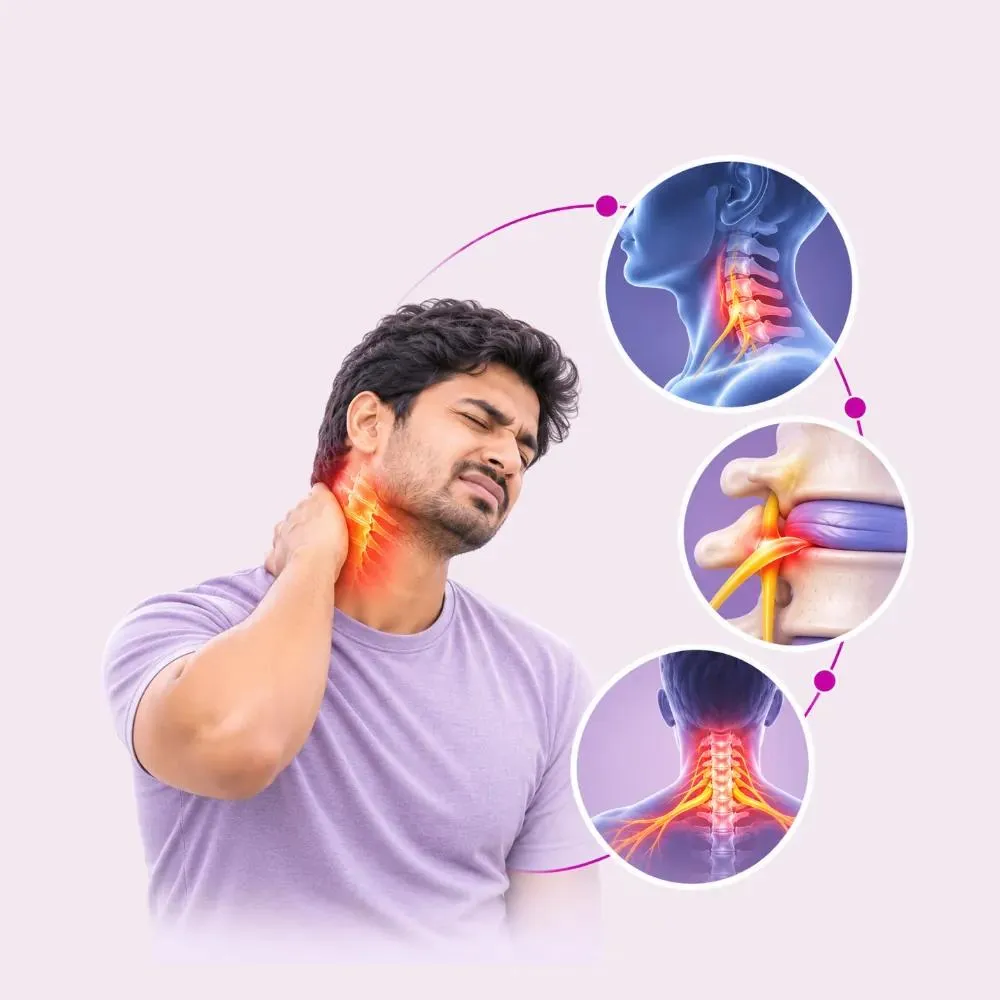
A pinched nerve in the neck, medically known as cervical radiculopathy, occurs when a nerve root leaving the cervical spine becomes compressed or irritated. The cervical spine consists of seven vertebrae (C1–C7), with intervertebral discs between most of them that cushion the bones and allow movement.
A herniated disc or age-related degenerative changes can narrow the openings through which spinal nerves exit, causing nerve compression. This may cause pain that radiates from the neck into the shoulder, arm or hand, along with tingling, numbness or muscle weakness.
The C6 and C7 nerve roots are commonly affected, although symptoms vary with the location of compression. C5 compression may cause shoulder or upper-arm pain and weakness of shoulder movement. C6 symptoms may travel towards the thumb, with weakness in certain arm movements. C7 symptoms may extend towards the middle finger, sometimes with weakness straightening the elbow. C8 compression may affect the ring and little fingers and certain hand muscles. These patterns can overlap and do not on their own confirm which nerve is involved.
Cervical myelopathy is different from cervical radiculopathy: it involves compression of the spinal cord itself and may cause hand coordination difficulties, balance problems and walking difficulties.
Several spinal conditions may contribute to cervical nerve-root compression.
Develops when soft disc material protrudes beyond its normal boundary. The displaced material can irritate or compress a nearby nerve root, causing pain that radiates down the arm.
Age-related degenerative changes affecting the neck, which may involve the discs, joints and surrounding bone.
Bone spurs, also called osteophytes, may develop around degenerative spinal joints. When they narrow the openings used by spinal nerves, they can contribute to nerve compression.
Occurs when the openings through which spinal nerves exit become narrower. It is a common structural cause of cervical radiculopathy.
Spinal discs gradually lose some water content and flexibility with age. These changes may contribute to reduced disc height and narrowing around the nerve roots.
Certain injuries or traumatic events may lead to disc damage or other structural changes that affect cervical nerves.
Activities involving repeated neck movements, heavy lifting or sustained awkward positions may aggravate existing symptoms.
Poor posture alone does not establish that a nerve is compressed.
Cervical nerve compression can produce symptoms in the neck, shoulder, arm or hand.
Common symptoms
Emergency warning signs
Symptoms may affect one arm, although both sides can occasionally be involved, and some patients have significant arm pain without much neck discomfort. The emergency signs can indicate spinal cord compression or another serious neurological condition and need urgent emergency assessment.
Diagnosis combines a detailed medical history, neurological examination and selected investigations.
The doctor reviews where the pain starts, whether it travels into the arm, and which neck movements worsen symptoms.
The clinician examines muscle strength, sensation and reflexes in the arms and hands, and may also assess balance or walking when spinal cord involvement is suspected.
A doctor may perform a controlled neck-positioning test to see whether specific movements reproduce typical arm pain. This test is not suitable for every patient and should not be attempted on your own.
Cervical spine X-rays may help identify degenerative changes, alignment abnormalities or narrowing of certain bony spaces. They do not directly show nerve compression.
MRI shows the spinal cord, nerve roots and cervical discs in great detail. Doctors may recommend it if neurological findings are concerning, symptoms persist, or imaging is needed to guide treatment.
Electrodiagnostic tests can help distinguish cervical nerve-root problems from conditions such as carpal tunnel syndrome or ulnar nerve compression. They are not necessary for every patient.
Imaging findings are interpreted alongside your symptoms and examination before a treatment plan is agreed.
Most patients with cervical radiculopathy improve without surgery. Treatment depends on symptom severity, neurological findings and the underlying cause of nerve compression.
May involve exercises to improve neck movement, strengthen supporting muscles and restore normal activity. Treatment should be adapted to the patient’s symptoms and neurological findings.
Temporarily reducing activities that repeatedly aggravate arm pain may help during an acute episode. Prolonged immobilisation is generally discouraged.
A doctor may recommend selected pain-relieving or anti-inflammatory medicines. Medication choice depends on medical history, potential side effects and other treatments.
Clinician-supervised cervical traction may be considered for selected patients. It applies controlled pulling forces to the neck, but benefits vary and it is not suitable for everyone.
A soft cervical collar is sometimes advised for a short period. Unless instructed otherwise, avoid prolonged use, as it can reduce neck muscle conditioning.
For selected patients with persistent or severe nerve-related pain, a specialist may consider an image-guided cervical epidural injection. It may provide temporary relief but does not remove the structural cause of compression. Cervical injections carry uncommon but potentially serious risks, so careful patient selection and informed consent are required.
Removes the affected disc through the front of the neck to relieve nerve pressure. The surgeon then stabilises the adjacent vertebrae using a fusion technique.
For appropriately selected patients, surgeons may remove a damaged cervical disc and replace it with an artificial disc. This technique is not suitable for every patient or type of cervical degeneration.
Approaches the affected nerve from the back of the neck and enlarges the nerve opening to relieve compression. In suitable patients, it may preserve motion at the operated level.
More extensive spinal cord compression or complex degeneration may require other decompression techniques, sometimes combined with stabilisation.
Surgery may be considered if there is significant neurological impairment, or if disabling symptoms persist after appropriate conservative treatment. The surgeon determines the approach based on spinal alignment, disc condition, nerve compression and individual health.
When surgery is recommended for cervical nerve compression, anterior cervical discectomy and fusion (ACDF) is one established approach.
ACDF
The procedure is generally performed under general anaesthesia.
The patient is positioned to provide appropriate access to the cervical spine.
The surgeon makes a small incision at the front of the neck and carefully approaches the affected spinal level.
The surgeon removes the damaged disc material causing nerve compression.
The surgeon removes structures compressing the nerve to create more space.
The surgeon may insert a suitable spacer or cage, often with additional fixation, to help the adjacent vertebrae fuse.
The surgeon closes the incision and the patient is monitored while recovering from anaesthesia. Walking, eating and drinking may resume when clinically appropriate.
The approach chosen for you depends on the level and cause of nerve compression, your anatomy and your symptoms.
Effective cervical radiculopathy care starts with identifying the source of nerve irritation and determining whether it can be managed without surgery.
The patient’s symptoms, clinical examination and imaging findings guide treatment decisions.
Many patients improve with appropriate rehabilitation, medication and time.
Progressive arm weakness, hand dysfunction or signs of spinal cord involvement require timely evaluation.
Cervical disc herniation, foraminal stenosis and other degenerative conditions may require different approaches.
Lux Hospitals is located in HITEC CITY, near IKEA, with access from Gachibowli and surrounding areas of Hyderabad.
Recovery depends on symptom severity, the treatment approach and whether neurological deficits are present.
During an acute episode, neck and arm pain may limit activity. Appropriate medication and gentle movement can help manage discomfort.
Some patients begin noticing improvement in radiating pain. Physiotherapy or suitable mobility exercises may begin on clinical advice.
Rehabilitation may focus on neck movement, supporting muscle strength and a gradual return to daily activities.
Patients with improving symptoms may progressively increase activity. Those with persistent weakness or disabling pain may need reassessment.
Some patients continue improving over several months. Residual numbness or weakness may recover more slowly than pain and may not fully resolve.
Progress exercises based on your symptoms and your doctor’s advice.
Heavy lifting or strenuous neck movements may need temporary restrictions.
Adjust your screen height, take movement breaks and avoid staying in uncomfortable positions for long periods to reduce symptom aggravation.
Take medicines as prescribed and report significant side effects.
Regular reviews help manage pain, track neurological recovery and, where applicable, monitor surgical healing.
New weakness, increasing balance difficulties or new bladder and bowel symptoms require urgent evaluation.
After cervical surgery, recovery varies depending on whether the operation involves fusion, disc replacement or foraminotomy. Patients who have a fusion may need more time to heal and stricter activity restrictions, and the surgeon should provide a recovery plan specific to the procedure.
Seek medical assessment if:
The cost depends on the cause of nerve compression, the investigations required and whether treatment is non-surgical or surgical.
| Procedure | Estimated Cost |
|---|---|
| Nerve Root Block Targets an affected cervical nerve to assess or relieve pain. | ₹12,000 onward |
| ACDF / Cervical Spinal Fusion Removes the damaged disc and stabilises the cervical spine. | ₹2,00,000 onward |
| Cervical Disc Replacement Replaces a damaged disc with an artificial disc to preserve movement. | ₹2,80,000 onward |
| Endoscopic Spine Surgery Relieves selected nerve compression using an endoscope. | ₹1,40,000 onward |
The cause and severity of nerve compression, and the number of cervical levels involved, shape the treatment recommended.
The diagnostic investigations needed, and whether treatment is non-surgical or surgical, change what the plan involves.
Procedures such as fusion or disc replacement use implants, which affect the estimate.
The length of hospital stay, anaesthesia, other medical conditions and postoperative rehabilitation all contribute to the overall cost.
Every figure above is an indicative starting price, not a final quotation. A spine consultation, with clinical and neurological assessment and a review of your existing reports, allows the hospital to provide a personalised estimate based on the treatment recommended.

Consultant Endoscopic Spine Surgeon
MBBS, MS (Orthopaedics), Fellowship in Spine Surgery (RGUHS)
7 years experience
Common questions about a pinched nerve in the neck, arm pain, recovery and when surgery is considered.
Still have questions? Call us at 079 6908 4422
Still have questions? Message us on WhatsApp at 079 6908 4444
Spine assessment at Lux Hospitals, HITEC CITY: a clear diagnosis, non-surgical options first, and cervical spine surgery when it is needed.
Plot No.116, Lumbini Avenue, HITEC CITY, Near IKEA, Hyderabad – 500032













