



Dr. Samhitha Reddy
Consultant Proctologist & Laparoscopic Surgeon
MBBS, MS, FMAS, FISCP, DMAS
- 8 Yrs
- ASCRS Member
Sudden difficulty passing urine, numbness around the groin or buttocks, or worsening weakness in the legs may indicate Cauda Equina Syndrome (CES), a serious condition caused by compression of the nerves at the lower end of the spinal canal. Cauda Equina Syndrome is a medical and surgical emergency. Delayed diagnosis or treatment may result in permanent bladder, bowel, sexual or lower-limb dysfunction.
Patients experiencing symptoms of suspected Cauda Equina Syndrome should seek immediate assessment at an emergency department with urgent MRI and spine-surgical assessment capabilities. Patients can ask about emergency referral plans and available spine services at Lux Hospitals, Hyderabad.
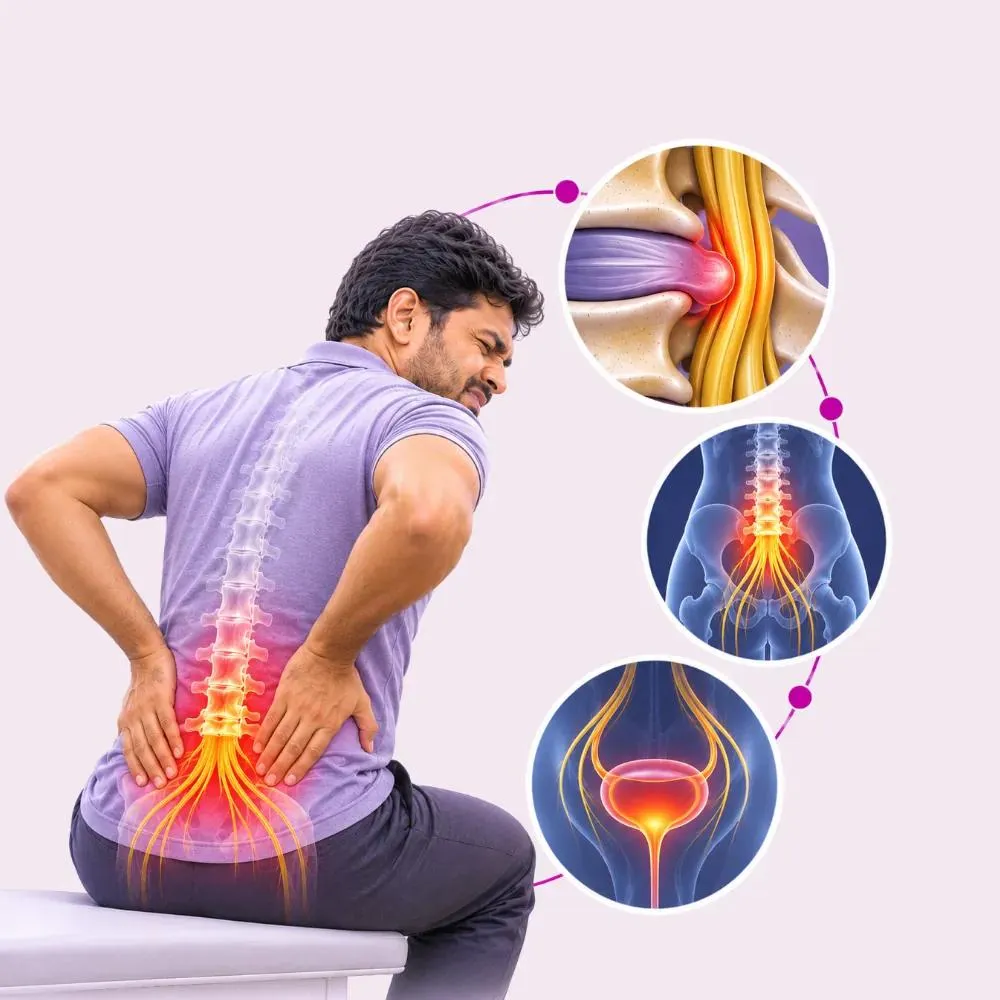
Cauda Equina Syndrome (CES) is a rare but serious neurological condition caused by compression or dysfunction of the nerve roots at the lower end of the spinal canal. These nerves, called the cauda equina, control bladder and bowel function, sensation around the groin, sexual function and movement in parts of the legs. Severe compression can disrupt these functions, causing urinary difficulties, changes in bowel control, numbness or muscle weakness. Early diagnosis and emergency treatment are essential to reduce the risk of permanent nerve damage.
Cauda Equina Syndrome may present as incomplete CES, where patients experience altered urinary sensation, difficulty starting urination or changes in bladder control, or as CES with urinary retention, where patients cannot empty their bladder normally and may develop overflow incontinence. Both stages require emergency medical assessment. Treatment should not be delayed until urinary retention develops.
Cauda Equina Syndrome occurs when the lower spinal nerve roots are compressed or otherwise seriously affected.
A large herniated disc is one of the most common causes. Disc material may protrude into the spinal canal and compress multiple nerve roots.
Advanced narrowing of the lumbar spinal canal may cause significant pressure on the cauda equina nerve roots.
Fractures, dislocations or other traumatic injuries may compress nerves within the spinal canal.
Certain tumours involving the spinal canal or nearby tissues can compress the cauda equina.
An infection such as a spinal epidural abscess may develop around the spinal nerves and cause compression.
Bleeding within the spinal canal can sometimes produce sudden nerve compression.
Rarely, compression may occur after spinal procedures because of bleeding or other complications.
Determining the underlying cause matters because the appropriate emergency treatment depends on the diagnosis.
Symptoms may develop suddenly or progress over hours or days. Not every patient experiences all the warning signs.
Possible symptoms
Emergency warning signs
Seek immediate emergency medical attention for any new combination of these warning signs: a patient does not need to have every symptom to be considered at risk. New changes in urinary function are particularly important when they come with back pain, sciatica or neurological symptoms, and new bowel incontinence or loss of normal bowel sensation requires emergency assessment. Bilateral sciatica can be a warning sign, particularly alongside changes in bladder, bowel or saddle sensation. Patients may first notice reduced sensation while wiping after using the toilet, and sexual symptoms are important to disclose during emergency assessment.
Diagnosis requires emergency clinical evaluation and urgent imaging. Clinical examination alone cannot reliably rule out Cauda Equina Syndrome.
The clinician assesses the onset and progression of symptoms, particularly changes in bladder, bowel, saddle sensation and leg function.
Muscle strength, sensation, reflexes and walking ability may be assessed.
A bladder ultrasound scan may help measure residual urine after attempting to pass urine. However, a low residual volume does not exclude CES and must not be used alone to delay necessary MRI.
MRI of the lumbar spine is the principal imaging investigation for suspected compressive CES. It helps identify disc herniation, spinal canal narrowing, infection, bleeding or other causes of nerve compression.
Depending on the suspected cause and the need for surgery, blood tests or other imaging may be advised. These should not unduly delay emergency assessment.
If MRI confirms significant cauda equina compression, an appropriately qualified spine surgeon evaluates the patient urgently. The medical team determines whether emergency decompression is required and arranges the appropriate treatment or transfer.
Neither a reassuring examination nor a low residual urine volume can exclude CES: when it is suspected, urgent MRI must not be delayed.
Treatment depends on the underlying cause and on confirmation of nerve compression. Unlike common lower back pain, proven compressive Cauda Equina Syndrome typically needs immediate surgical intervention.
Clinicians promptly assess the patient’s neurological function, vital signs and bladder or bowel symptoms.
Imaging is arranged as quickly as possible to identify or exclude surgically treatable compression.
If compression is confirmed, an appropriately equipped spine-surgical team must be consulted immediately.
Patients with urinary retention may need catheterisation under medical supervision. Although it helps manage the bladder, catheterisation does not address the underlying nerve compression.
A herniated disc, haematoma, infection or tumour may require different treatment approaches.
If a large herniated lumbar disc is compressing the cauda equina, the surgeon may remove the compressive disc material.
A laminectomy may be performed to enlarge the spinal canal and relieve pressure on affected nerve roots.
Patients with an epidural haematoma, abscess or other compressive lesion may require an appropriate emergency operation. Additional medical treatment may be required depending on the cause.
Confirmed CES caused by surgically treatable compression generally requires urgent surgical decompression. Medication, physiotherapy, bed rest and injections must not replace emergency assessment or delay indicated surgery. If MRI does not show cauda equina compression, the treating team investigates other causes of the symptoms and determines appropriate treatment.
The operation depends on the source and extent of nerve compression. For CES caused by a large lumbar disc herniation, decompression may involve a discectomy, sometimes combined with a laminectomy.
Emergency Decompression
The spine surgeon reviews MRI findings, neurological function and the urgency of intervention.
The procedure is commonly performed under general anaesthesia.
The patient is carefully positioned to provide access to the affected lumbar spinal level.
The surgeon makes an incision over the relevant area of the lower spine.
The surgeon locates the disc material or other structure compressing the cauda equina nerves.
The surgeon removes the compressive tissue to relieve pressure on the affected nerve roots.
Once the incision is closed, the team monitors the patient’s neurological function, bladder and bowel control, pain and any postoperative problems.
The exact procedure may differ considerably if CES results from infection, trauma, tumour or bleeding.
Cauda Equina Syndrome requires immediate recognition, imaging and access to a capable surgical team. The most important consideration is whether a hospital can provide the necessary emergency evaluation and treatment without delay.
New bladder or bowel incontinence, altered saddle sensation or progressive neurological changes should be evaluated promptly.
Emergency MRI is essential when compressive CES is suspected.
Confirmed compression requires urgent specialist evaluation.
Patients may need ongoing neurological, bladder, bowel and physical rehabilitation following treatment.
Recovery depends on the severity of nerve damage, the cause of compression and the timing of treatment. Some patients experience substantial improvement after decompression, while others develop lasting neurological problems.
The medical team monitors neurological function, pain, wound condition and bladder or bowel function. Patients may need assistance with movement or bladder management.
Early rehabilitation may focus on safe mobilisation, wound care and assessment of ongoing neurological symptoms.
Patients may gradually increase physical activity under guidance. Bladder or bowel support may still be necessary.
Rehabilitation may address walking ability, muscle strength, balance and daily functioning.
Some neurological improvement continues over several months. Persistent sensory, bladder, bowel or sexual-function difficulties may require specialist management.
Recovery can continue beyond six months, but some deficits may remain permanent.
Patients may require bladder monitoring, catheter management or referral to an appropriate urology service.
Bowel routines, medication or specialist support may be necessary for persistent dysfunction.
Rehabilitation may focus on strength, walking, coordination and a safe return to daily activities.
Patients experiencing sexual dysfunction may benefit from appropriate specialist consultation.
The emotional impact of serious neurological impairment can be significant, and patients may benefit from support.
Follow-up helps assess neurological recovery, functional independence and any continuing care needs.
Follow-up and rehabilitation should reflect each patient’s individual neurological and functional needs.
Seek emergency evaluation immediately if you develop any of the following. Do not arrange a routine spine appointment for these symptoms: go directly to an emergency department that can provide urgent MRI and spine-surgical assessment.
The cost of Cauda Equina Syndrome treatment depends on the cause of nerve compression, emergency investigations, surgery, admission requirements and rehabilitation. Never delay emergency assessment and treatment to obtain a cost quotation or insurance authorisation.
| Procedure | Estimated Cost |
|---|---|
| Urgent Microdiscectomy or Laminectomy Emergency surgery to relieve pressure on the cauda equina nerves. | ₹1,00,000 onward |
A herniated disc, haematoma, infection or tumour may each require a different treatment approach.
Urgent MRI and any blood tests or additional imaging the medical team advises.
The operation needed and the admission requirements depend on the source and extent of compression.
Some patients need ongoing neurological, bladder, bowel and physical rehabilitation after treatment.
The figure above is an indicative starting price, not a final quotation. Seeking emergency care comes first: an estimate can follow once the treatment needed is clear.

Consultant Endoscopic Spine Surgeon
MBBS, MS (Orthopaedics), Fellowship in Spine Surgery (RGUHS)
7 years experience
Common questions about Cauda Equina Syndrome, its emergency warning signs, surgery and recovery.
Still have questions? Call us at 079 6908 4422
Still have questions? Message us on WhatsApp at 079 6908 4444
New bladder or bowel problems, numbness around the groin or anus, or worsening leg weakness need emergency care, not a routine appointment. Go directly to an emergency department that can provide urgent MRI and spine-surgical assessment.
Plot No.116, Lumbini Avenue, HITEC CITY, Near IKEA, Hyderabad – 500032













