



Dr. Samhitha Reddy
Consultant Proctologist & Laparoscopic Surgeon
MBBS, MS, FMAS, FISCP, DMAS
- 8 Yrs
- ASCRS Member
A urethral stricture is scar tissue narrowing the tube that carries urine out of the bladder. The stream weakens, splits or sprays, and passing urine takes progressively longer.
The critical point is that stretching or cutting a stricture usually gives temporary relief and often makes it worse over time. Our urologists at Lux Hospitals, HITEC CITY assess strictures properly and offer urethroplasty: reconstruction that actually cures them.
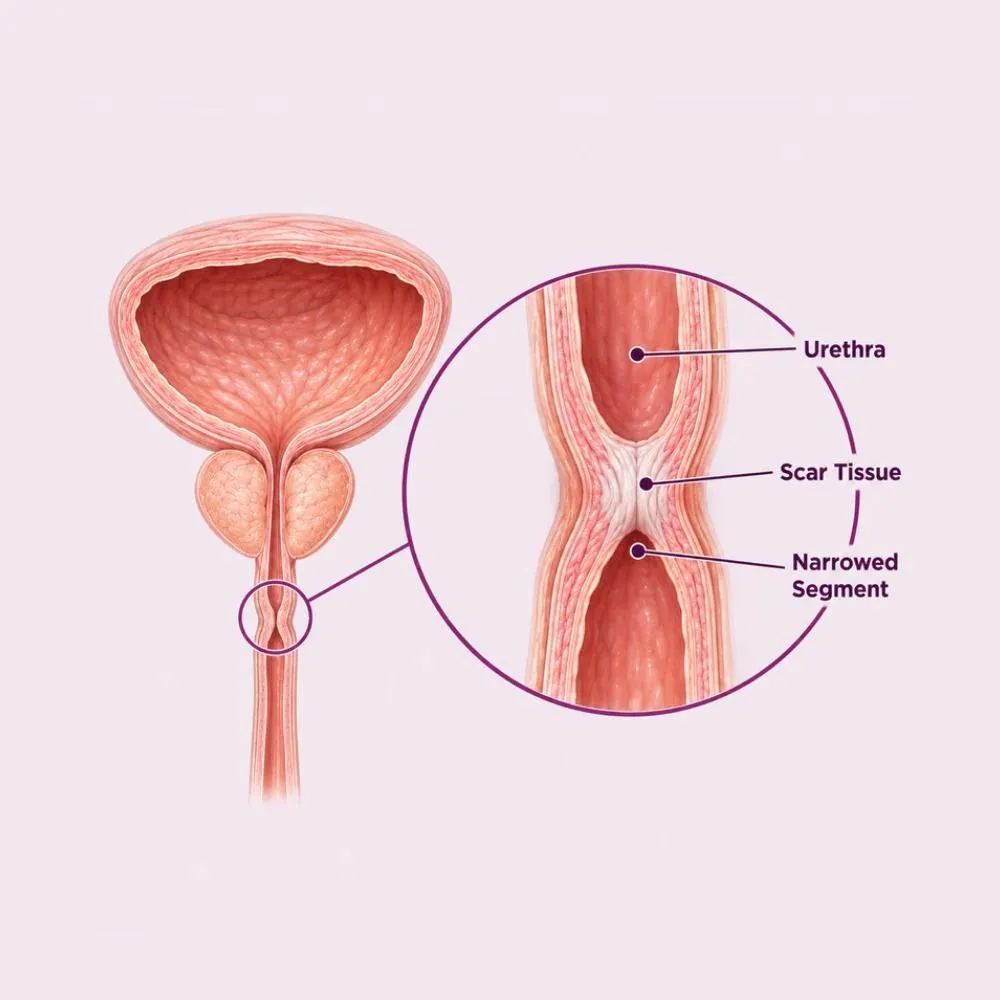
A urethral stricture is a narrowing of the urethra caused by scar tissue in its wall. Because that scar contracts over time, the narrowing tends to worsen rather than stabilise, and the bladder has to generate progressively higher pressure to overcome it.
The location matters greatly for treatment. Anterior strictures, in the bulbar or penile urethra, are the commonest and are usually the result of infection, instrumentation or straddle injury. Posterior strictures follow pelvic fracture and are technically far more demanding to repair.
Strictures are essentially a male condition. The female urethra is short and strictures in women are rare, which is why a woman with obstructive symptoms is investigated for other causes first rather than assumed to have one.
Every stricture is scar tissue, and the cause is whatever injured or inflamed the urethral lining in the first place.
The commonest cause in modern practice. Long-term catheters, difficult insertions or repeated endoscopic procedures all injure the urethral lining.
Gonorrhoea and chlamydia cause inflammation and scarring. Historically the leading cause, and still significant.
A straddle injury, falling astride a bar or bicycle crossbar, crushes the bulbar urethra against the pubic bone.
High-energy trauma can shear the posterior urethra completely. These strictures are the most complex to reconstruct.
Prostate surgery, hypospadias repair or radiotherapy to the pelvis can all leave scarring in the urethra.
A chronic inflammatory skin condition affecting the genitals, causing progressive scarring that can involve long segments.
Some men are born with a narrower urethral segment that becomes symptomatic in adulthood.
A substantial proportion have no identifiable cause, though many are thought to follow forgotten minor trauma.
Because catheterisation is now the leading cause, the safest stricture is the one prevented: by using the smallest appropriate catheter and avoiding forceful insertion.
The stream is the giveaway. A stricture narrows the calibre of the urethra, and that shows in how urine comes out.
Typical symptoms
Complications
A stream that splits or sprays is characteristic of a stricture rather than prostate obstruction, and it is worth mentioning specifically because it points the diagnosis quite precisely.
Mapping the stricture (its exact position, length and severity) is what determines which treatment will work.
A characteristic flat, plateau-shaped flow curve is highly suggestive of a stricture, and distinguishes it from prostate obstruction.
Contrast injected into the urethra and X-rayed, showing the position and length of the narrowing precisely. The key investigation.
Imaging while passing urine, showing the urethra above the stricture and defining the full extent of disease.
Direct visual inspection of the narrowing, though a tight stricture may not admit the scope past it.
Measures the depth of scar tissue in the urethral wall, which helps predict whether an endoscopic approach will succeed.
Excluding infection before any intervention, and measuring how much urine is left behind after voiding.
Stricture length is the single most useful measurement. Short strictures may respond to an endoscopic cut; longer ones will not, and attempting it simply delays the reconstruction that would have worked.
This is an area where the easier treatment is often the wrong one. Endoscopic options are quick but frequently temporary; urethroplasty is bigger surgery with far better long-term results.
Stretching the narrowing with graduated dilators. Quick and simple, but it tears the scar and frequently makes it worse over repeated attempts.
Cutting the stricture endoscopically under vision. Reasonable success for a single short bulbar stricture, but success falls sharply on repeat attempts.
The patient passes a catheter periodically to keep the urethra open. It maintains flow but does not treat the stricture, and it is a long-term commitment.
A tube into the bladder through the abdomen, bypassing the urethra entirely. A holding measure while definitive surgery is planned.
The scarred segment is excised entirely and the healthy ends joined. For short bulbar strictures this is close to curative, with success rates above ninety per cent.
Tissue taken from the inside of the cheek is used to widen the urethra. Ideal graft material: it thrives in a wet environment and the donor site heals quickly.
Combining excision of the worst segment with a graft, for strictures too long to excise entirely.
Reconstruction in two operations several months apart, for very long or complex strictures, particularly in lichen sclerosus.
Reconstruction after pelvic fracture injury. Technically demanding and best done by surgeons who perform it regularly.
Repeated dilatation or urethrotomy is the pattern most worth avoiding. Each attempt adds scar, lengthens the stricture and makes the eventual reconstruction harder: the second failed urethrotomy is the point to consider urethroplasty rather than a third.
A two to three hour reconstructive operation using tissue from the inside of the cheek, with a two to three night stay.
Buccal mucosal graft urethroplasty
Urethrogram reviewed to map stricture length and position, urine culture confirmed clear, and the operative plan decided in advance.
General anaesthesia, positioned to give access to both the perineum and the mouth for graft harvest.
A strip of mucosa is taken from the inside of the cheek. It heals within two weeks and is the ideal material, being naturally suited to a wet environment.
An incision in the perineum or on the penis exposes the urethra, and the strictured segment is identified along its full length.
The narrowed segment is opened longitudinally along its whole length, back to healthy urethra at both ends.
The buccal graft is sutured in to widen the urethra to a normal calibre, and its blood supply establishes over the following days.
A catheter is left for two to three weeks while the graft takes, and removed after a urethrogram confirms healing.
The catheter stays in for two to three weeks, which patients find the most tedious part of the recovery. Removing it early risks leakage at the repair, which would compromise the whole reconstruction.
Stricture care is an area where the easy option is often the wrong one. Here is why patients trust us:
Urethrogram and flow studies to define length and position, because that determines which treatment will actually work.
Urethroplasty offered rather than repeated dilatation, so strictures are cured rather than temporarily stretched.
From the first consultation through to post-treatment follow-up, with one team throughout.
Our hospital is in HITEC CITY, near IKEA: easily reachable from across Hyderabad.
Recovery from urethroplasty is dominated by the catheter period. Once it is out, the improvement in flow is usually immediate and marked.
In hospital with a catheter. Perineal discomfort and mouth soreness from the graft site, both settling within days.
Home with the catheter. The cheek donor site heals within two weeks. Avoid straining, cycling and sexual activity.
A urethrogram confirms healing, and the catheter is removed. The stream is usually dramatically better immediately.
Progressive return to normal activity. Flow rate is measured to confirm objective improvement against the pre-operative baseline.
Periodic flow measurement. Most recurrences, where they happen, appear within the first two years, which is why follow-up continues.
Keep it secured and avoid pulling or straining. Accidental dislodgement before the repair has healed is a genuine setback.
Salt water rinses, a soft diet for a few days and avoiding spicy food. The donor site heals fully within two weeks.
No heavy lifting, straining or cycling for six weeks, all of which put direct pressure on the perineal repair.
A weakening stream is the earliest sign of recurrence. Reporting it early allows treatment before the stricture re-establishes.
Inability to pass urine after catheter removal, fever, spreading redness, or leakage of urine from the wound.
Flow measurement periodically for two years. Recurrence caught early is much simpler to deal with than one left to progress.
Urethroplasty has success rates well above ninety per cent for appropriate strictures, and those results hold for years. That durability is the reason it is worth the bigger operation and the catheter.
Book a consultation if any of the following apply.
Endoscopic treatment costs less initially but frequently needs repeating. Urethroplasty is more expensive once and usually definitive.
| Procedure | Estimated Cost |
|---|---|
| Consultation & assessment Per visit | ₹800 – ₹1,500 |
| Uroflowmetry & urethrogram Mapping the stricture | ₹5,000 – ₹12,000 |
| Urethral dilatation Day care; frequently needs repeating | ₹15,000 – ₹35,000 |
| Optical internal urethrotomy Day care or one night | ₹35,000 – ₹70,000 |
| Anastomotic urethroplasty Two to three nights’ stay | ₹1,20,000 – ₹2,40,000 |
| Buccal graft urethroplasty Three nights’ stay; graft harvest included | ₹1,80,000 – ₹3,50,000 |
| Posterior or staged urethroplasty Complex reconstruction, longer stay | ₹2,50,000 – ₹5,00,000 |
A short bulbar stricture can be excised and rejoined. A long anterior stricture needs graft harvest and a considerably longer operation.
Repeated dilatations and urethrotomies add scar, lengthen the stricture and make the eventual reconstruction more complex and costly.
Urethrotomy is cheaper per procedure but often repeated. Over several years, repeated procedures frequently exceed the cost of one urethroplasty.
A shared ward, a twin-sharing room or a private suite: the largest single swing in most estimates.
We are empanelled with most major insurers, and our team files the pre-authorisation for you.
Every figure above is an indicative range, not a quote. After your consultation you are given a written, fixed-cost estimate, and that is the number you pay, with no additions once treatment begins.
The urologists who perform reconstructive urethral surgery at our HITEC CITY hospital.

Consultant Urologist & Andrologist
MBBS, MS, DrNB (Urology)
10 years experience

Consultant Urologist & Andrologist
MBBS, MS, MCh (Urology)
9 years experience
Reviews from patients treated for urological conditions at Lux Hospitals, Hyderabad.
Written by Dr. Vipin Reddy B on urinary flow problems and urological care.

Dr. Vipin Reddy B

Dr. Vipin Reddy B

Dr. Vipin Reddy B

Dr. Vipin Reddy B

Dr. Vipin Reddy B

Dr. Vipin Reddy B
Common questions about urethral stricture, urethroplasty, and what treatment costs at Lux Hospitals.
Still have questions? Call us at 079 6908 4422
Still have questions? Message us on WhatsApp at 079 6908 4444
Proper mapping of your stricture and reconstruction that cures it, rather than repeated dilatation, with costs shared upfront.
Plot No.116, Lumbini Avenue, HITEC CITY, Near IKEA, Hyderabad – 500032













