



Dr. Samhitha Reddy
Consultant Proctologist & Laparoscopic Surgeon
MBBS, MS, FMAS, FISCP, DMAS
- 8 Yrs
- ASCRS Member
Hip replacement has been described as the operation of the century, and the description is deserved. It reliably abolishes arthritic hip pain and restores walking, and patient satisfaction is higher than for almost any other elective procedure.
Recovery is also faster than most people expect: considerably faster than after a knee replacement. Our orthopaedic surgeons at Lux Hospitals, HITEC CITY perform total, partial and minimally invasive hip replacement with modern bearing surfaces built to last decades.
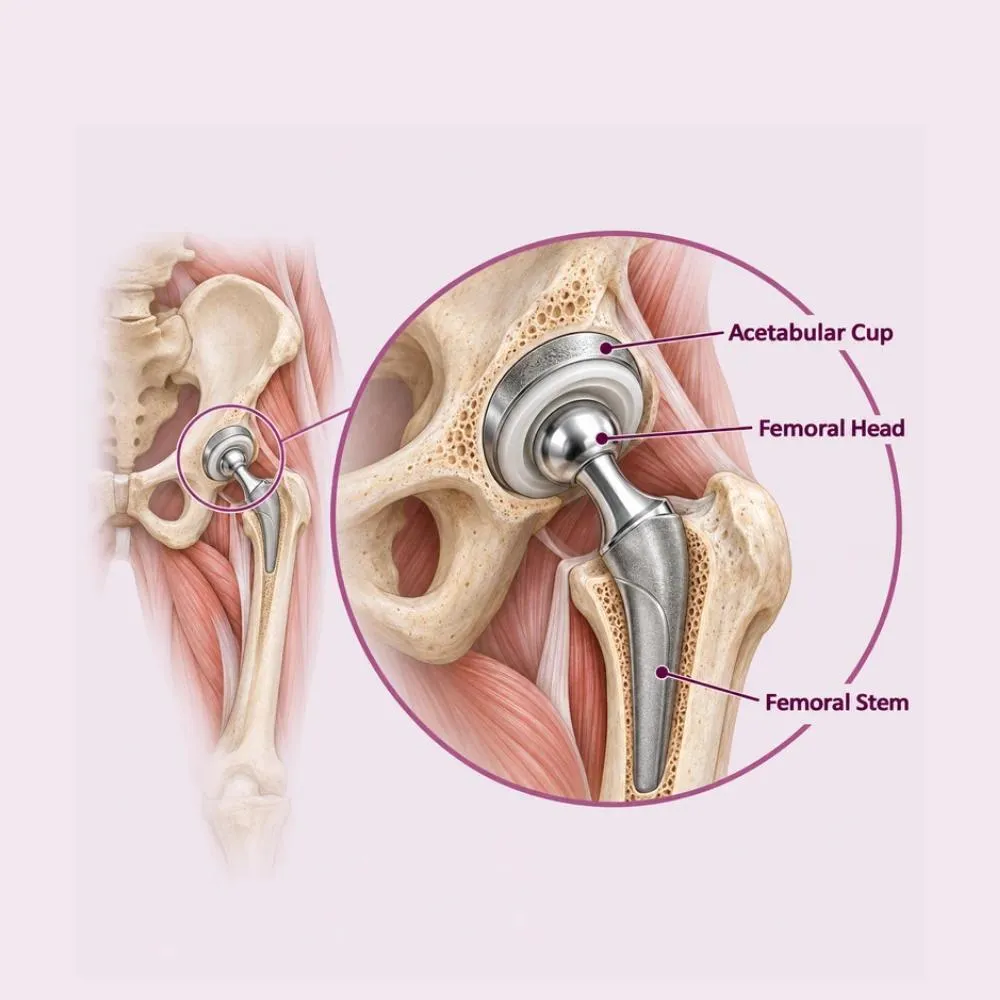
Hip replacement removes the damaged ball-and-socket joint and replaces it with artificial components: a metal or ceramic ball on a stem fitted into the thigh bone, articulating with a cup lined with plastic or ceramic fitted into the pelvis.
There are several variants. A total hip replacement replaces both the ball and the socket, and is the commonest. A partial replacement replaces only the femoral head, and is used mainly for hip fractures in older patients. Hip resurfacing caps the femoral head rather than removing it, conserving bone in young active patients. Minimally invasive approaches use smaller incisions and disturb less muscle.
It differs from knee replacement in an important practical respect: recovery is quicker and the result feels more natural. Most hip replacement patients forget the joint is artificial within a few months, which is less consistently true after a knee.
Osteoarthritis is the commonest cause, but avascular necrosis is a significant one in India and affects a much younger group.
Progressive loss of the cartilage lining the ball and socket, most often from midlife onward.
Loss of blood supply to the femoral head, which then collapses. Associated with steroids, alcohol and sickle cell disease, and it affects younger adults.
A displaced fracture of the femoral neck in an older patient is usually best treated by replacing the joint rather than fixing the bone.
Immune-mediated destruction of the joint, often affecting both hips and at a younger age than osteoarthritis.
A shallow socket present from childhood that loads the cartilage abnormally and causes early arthritis.
Abnormal bone shape causing repeated impingement, which damages the labrum and cartilage over years.
Trauma or a childhood joint infection can leave a hip that wears out decades later.
Inflammatory spinal disease that frequently involves the hips and can fuse them if untreated.
Avascular necrosis is worth highlighting because it presents in the thirties and forties. Caught before the femoral head collapses, joint-preserving surgery may still be possible.
Hip arthritis characteristically causes groin pain rather than pain over the outer hip, and it commonly refers down to the knee.
Symptoms suggesting it may be time
Findings on assessment
Pain felt in the buttock or outer hip is more often from the spine or the trochanteric bursa than from the joint. Distinguishing these matters, because replacing the hip would not help either.
The assessment confirms the hip is the source of the pain, plans the implant, and gets you into the best condition for surgery.
Hip mobility, particularly internal rotation, along with gait, leg length and an examination of the spine, which commonly refers pain to the hip.
Show joint space loss, deformity and bone quality, and are used to template the implant size and restore leg length.
The test for avascular necrosis before the femoral head collapses, and for assessing the labrum and soft tissues.
Screening for anaemia, infection and diabetes control, plus review of blood thinners and other medication.
Cardiac evaluation and anaesthetic review, with spinal anaesthesia usually preferred for its lower complication rate.
Strengthening exercises beforehand, and arranging handrails, a raised toilet seat and a high chair at home in advance.
Preparing your home before surgery matters more than people expect. The hip precautions in the first six weeks are much easier to keep with the right seat height and handrails already in place.
Non-surgical treatment helps early hip arthritis, though less reliably than in the knee. Several surgical options exist beyond total replacement.
Strengthening the hip abductors and maintaining range of motion reduces pain and improves gait, particularly in earlier arthritis.
Reduces load through the joint substantially and improves both symptoms and surgical outcomes.
Paracetamol and anti-inflammatories, used with awareness of long-term risks.
Steroid injected into the hip joint under X-ray or ultrasound guidance: both therapeutic and diagnostic, since relief confirms the hip as the pain source.
A stick used in the opposite hand reduces load through the hip by a substantial proportion.
Replacing both the ball and socket. The most common and most predictable option, with excellent pain relief and modern bearings lasting twenty years or more.
Replacing only the femoral head. Used mainly for displaced femoral neck fractures in older, less active patients.
Capping the femoral head rather than removing it, conserving bone. An option for young, active men with good bone quality.
Smaller incisions with less muscle disturbance, giving faster early recovery in suitable patients.
Drilling the femoral head to relieve pressure in early avascular necrosis, before collapse: a joint-preserving option in younger patients.
Replacing a loose, worn or infected implant. Considerably more complex than the primary operation.
In early avascular necrosis, before the femoral head has collapsed, core decompression may preserve the joint entirely. Once collapse has occurred that option closes, which is why early MRI matters in younger patients.
A sixty to ninety minute operation through a single incision over the hip, with a two to three night stay and walking on the day of surgery.
Total hip replacement
Spinal anaesthesia with sedation is usually preferred, being associated with less blood loss and fewer complications than a general anaesthetic.
A single incision over the hip. The approach (posterior, lateral or anterior) is chosen for your anatomy and the surgeon’s experience.
The worn femoral head is removed and the socket reamed to a smooth hemisphere, ready to accept the new cup.
A metal cup is fitted into the pelvis, with a plastic or ceramic liner inserted into it. Cup position determines both stability and wear.
A stem is fitted into the femur, cemented or press-fitted according to bone quality, and a ball fitted onto it.
The joint is reduced and tested through a full range for stability, with leg length compared against the other side.
Closed in layers, and you are stood up and walking with a physiotherapist the same day.
Restoring leg length and offset accurately is what makes the hip feel normal and prevents a limp. It is checked on the table rather than left to the post-operative X-ray.
Hip replacement is judged on pain relief, leg length and how natural the joint feels. Here is why patients trust us:
A dedicated orthopaedic team performing hip replacement regularly, including revision and minimally invasive approaches.
Bearing surfaces matched to your age and activity, from standard polyethylene through to ceramic-on-ceramic for younger patients.
From the first consultation through to post-treatment follow-up, with one team throughout.
Our hospital is in HITEC CITY, near IKEA: easily reachable from across Hyderabad.
Hip replacement recovery is noticeably quicker than knee replacement. Most patients walk without aids by four to six weeks.
Standing and walking with a frame within hours of surgery. Pain is usually well controlled, and often less than the arthritis pain beforehand.
Walking further, practising stairs, and learning the hip precautions. Home once safe and independent.
Progressive walking and physiotherapy. Hip precautions are observed to protect against dislocation while the soft tissues heal.
Walking without aids, driving from around six weeks, and returning to desk work. Precautions are relaxed at six weeks.
Full activity including swimming, cycling and golf. Most patients stop being aware of the hip altogether.
For the first six weeks: no bending past ninety degrees, no crossing your legs, and no twisting on the operated leg. These prevent dislocation.
Frequent short walks from day one, building distance progressively. Walking is the main rehabilitation for a hip.
A raised toilet seat and a high firm chair for six weeks. Low soft seating forces the hip past the safe range.
Blood thinners as prescribed with regular ankle exercises. Clots are the main early risk after hip surgery.
Sudden severe hip pain with inability to weight-bear, a leg that looks shortened or rotated, fever, wound discharge, or calf swelling.
Maintain a healthy weight, favour low-impact exercise, and mention your implant to dentists and doctors.
Dislocation is the complication the precautions exist to prevent, and the risk is highest in the first six weeks while the soft tissues heal. After that the hip becomes considerably more stable.
Book a consultation if any of the following apply.
The implant and bearing surface are the largest cost components. These are the ranges our patients fall into.
| Procedure | Estimated Cost |
|---|---|
| Consultation & assessment Per visit | ₹800 – ₹1,500 |
| Pre-operative workup X-rays, MRI where needed, bloods and cardiac review | ₹8,000 – ₹20,000 |
| Total hip replacement Three nights’ stay, standard implant | ₹2,00,000 – ₹3,50,000 |
| With ceramic-on-ceramic bearing Three nights’ stay, for younger patients | ₹2,80,000 – ₹4,50,000 |
| Partial hip replacement Usually for femoral neck fracture | ₹1,40,000 – ₹2,40,000 |
| Revision hip replacement Five to seven nights’ stay | ₹3,50,000 – ₹6,50,000 |
| Post-operative physiotherapy Six to twelve weeks of rehabilitation | ₹12,000 – ₹30,000 |
Metal-on-polyethylene, ceramic-on-polyethylene and ceramic-on-ceramic differ considerably in price and in expected longevity.
The choice depends on your age and bone quality, and affects both the implant cost and the operating time.
Revision surgery is substantially more complex, needs specialised implants, and involves a longer stay.
A shared ward, a twin-sharing room or a private suite: the largest single swing in most estimates.
We are empanelled with most major insurers, and our team files the pre-authorisation for you.
Every figure above is an indicative range, not a quote. After your consultation you are given a written, fixed-cost estimate, and that is the number you pay, with no additions once treatment begins.
What patients treated here can expect:
Among the highest satisfaction rates of any elective operation.
Walking the same day, and without aids by four to six weeks.
Modern implants routinely last twenty years or more.
The orthopaedic and joint replacement surgeons who perform hip replacement at our HITEC CITY hospital.

Consultant Orthopaedic Surgeon: Joint Replacement & Arthroscopy
MS (Ortho), FIJR, FIASM (UK), FIKS (Italy), FIRJR
8 years experience

Consultant Orthopaedic Surgeon
MBBS, MS, FIJR
6 years experience
Reviews from patients treated for hip, knee and orthopaedic conditions at Lux Hospitals, Hyderabad.
Written by Dr. Sai Kishan Sirasala on joint replacement and orthopaedic care.

Dr. Sai Kishan Sirasala
Dr. Sai Kishan Sirasala

Dr. Sai Kishan Sirasala
Dr. Sai Kishan Sirasala
Dr. Sai Kishan Sirasala
Dr. Sai Kishan Sirasala
Common questions about hip replacement, its recovery, and what surgery costs at Lux Hospitals.
Still have questions? Call us at 079 6908 4422
Still have questions? Message us on WhatsApp at 079 6908 4444
Expert hip replacement with modern implants and early mobilisation, and a fixed-cost estimate before treatment begins.
Plot No.116, Lumbini Avenue, HITEC CITY, Near IKEA, Hyderabad – 500032













