



Dr. Samhitha Reddy
Consultant Proctologist & Laparoscopic Surgeon
MBBS, MS, FMAS, FISCP, DMAS
- 8 Yrs
- ASCRS Member
Ovarian torsion is the ovary twisting on the ligaments carrying its blood supply. The blood flow is cut off, and without it the ovary begins to die within hours.
This is one of the few true emergencies in gynaecology, and the ovary is usually saveable if surgery happens quickly. Our gynaecologists at Lux Hospitals, HITEC CITY assess suspected torsion urgently and operate the same day, because the timing is what determines the outcome.
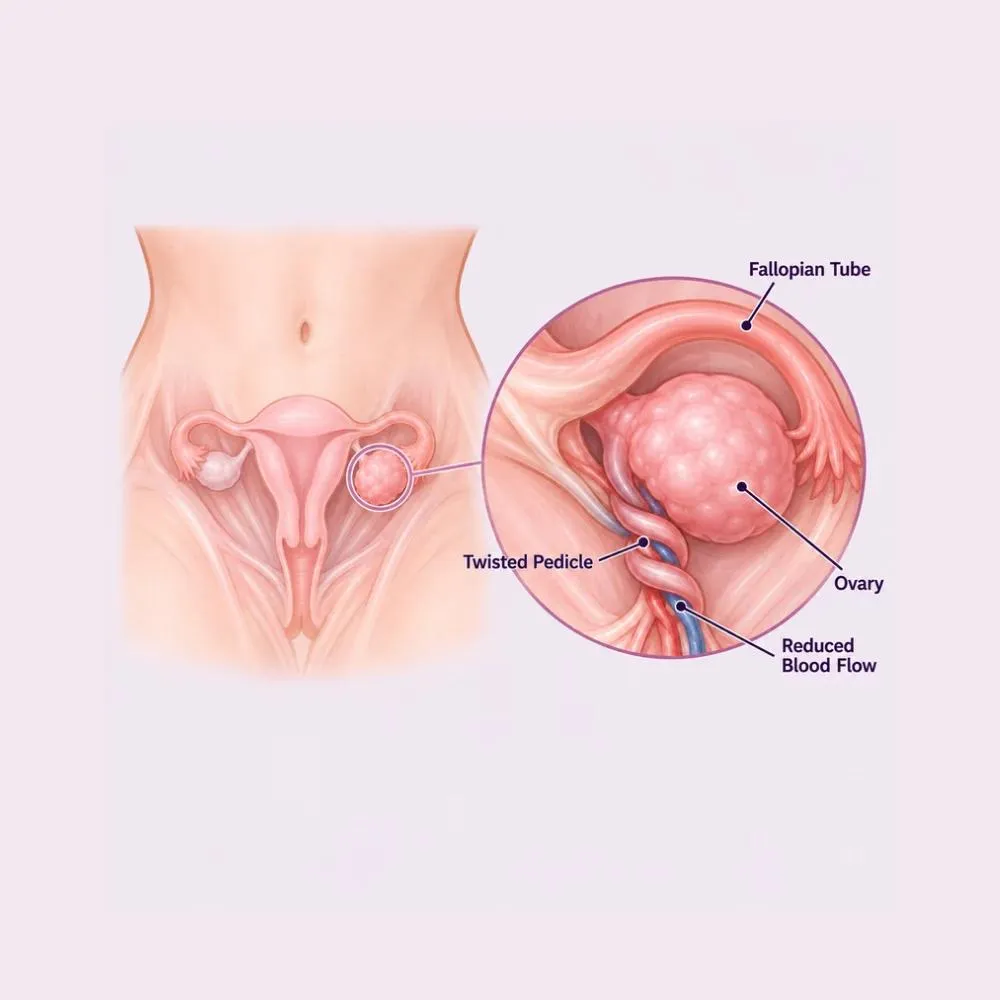
Ovarian torsion occurs when the ovary rotates around the ligaments that suspend it and carry its blood vessels. Twisting first obstructs the veins draining the ovary, so it swells; the rising pressure then compromises the arterial supply, and the tissue begins to become ischaemic. The fallopian tube is usually involved alongside, which is why it is more precisely called adnexal torsion.
It almost always requires something to make the ovary heavy or unbalanced enough to rotate. A cyst of around five centimetres or larger is the usual culprit, present in the large majority of cases. Dermoid cysts are particularly implicated because their fatty contents make them buoyant and mobile. Torsion of a completely normal ovary does happen, mostly in children, but it is uncommon.
Time is what matters here more than anything else. An ovary operated on within a few hours is usually recoverable, even when it looks black and lifeless at surgery: appearance at operation is a notoriously poor guide to whether it will recover. Delay of a day or more makes salvage progressively less likely, which is why suspected torsion is investigated the same day rather than at the next available clinic.
Torsion needs something to make the ovary heavy or mobile enough to rotate on its pedicle.
Present in the large majority of cases. A cyst of five centimetres or more makes the ovary heavy enough to swing on its ligaments.
Particularly associated with torsion. Their fatty contents make them buoyant and mobile, which is one reason dermoids are usually removed.
Fertility treatment enlarges the ovaries considerably, raising torsion risk substantially during stimulation cycles.
Corpus luteum cysts and the laxity of ligaments in pregnancy both increase risk, particularly in the first trimester.
Some women have naturally elongated suspensory ligaments, giving the ovary more freedom to rotate.
Having had torsion once raises the risk of it happening again, on either side.
Vigorous exercise, jumping or intercourse can trigger the rotation in an ovary already predisposed by a cyst.
This is why symptomatic and dermoid cysts are removed rather than watched indefinitely. Preventing torsion is one of the clearest arguments for treating a cyst that would otherwise be left alone.
Sudden severe one-sided pelvic pain with vomiting is the classic presentation, and it should be treated as an emergency.
Emergency symptoms
Variable features
Intermittent severe pain that keeps resolving is a genuinely dangerous pattern, because it suggests the ovary is twisting and untwisting repeatedly. It should not be reassuring: it is a warning that complete torsion may follow.
Diagnosis is urgent and clinical. Imaging supports it but must never delay surgery where suspicion is high.
Sudden severe one-sided pain with vomiting and localised tenderness. The history alone is often enough to justify going to theatre.
Shows an enlarged oedematous ovary, usually with a cyst. Doppler may show reduced flow, but normal flow does not exclude torsion.
Done immediately, since ectopic pregnancy presents identically and is itself an emergency requiring different treatment.
Full blood count and inflammatory markers, mainly to assess for appendicitis and pelvic infection as alternative diagnoses.
Occasionally used where the diagnosis is genuinely unclear, though imaging should never delay theatre when suspicion is high.
The definitive test. Where torsion is suspected clinically, going to theatre to look is both the diagnosis and the treatment.
The most dangerous mistake here is being reassured by a normal Doppler. The ovary has a dual blood supply, so flow can persist despite torsion: a normal scan does not exclude it when the history fits.
Treatment is surgical and urgent. There is no medical management for a twisted ovary.
The ovary untwisted through keyhole ports, restoring blood flow. The first choice in almost every case, whatever the ovary looks like.
Removing the cyst that caused the torsion, so it cannot recur. Sometimes deferred if the ovary is too swollen to operate on safely.
Fixing the ovary to reduce the risk of it twisting again. Considered after repeat torsion or where the ligaments are unusually long.
Removing the ovary, reserved for cases where it is clearly necrotic beyond recovery or where malignancy is suspected.
Where laparoscopy is not feasible: advanced pregnancy, a very large mass, or extensive previous adhesions.
Ultrasound at six weeks and again at three months to confirm blood flow has returned and follicles are developing.
Where cystectomy was deferred because of swelling, removing the cyst as a planned second procedure.
AMH testing where fertility is a concern, particularly if the opposite ovary has also been affected.
Removing dermoid and other persistent cysts, and considering oophoropexy where torsion has happened more than once.
Removing an ovary because it looks black at surgery was standard practice for decades and is now known to be wrong. Detorsion alone allows recovery in the large majority, even where the ovary appeared beyond saving.
The operation takes thirty to ninety minutes and is done as soon as theatre can be arranged.
Urgent keyhole surgery under general anaesthesia
Bloods, pregnancy test and consent taken quickly. Fasting is ideal but surgery is not delayed unduly for it where suspicion is high.
General anaesthesia, with a camera port at the umbilicus and two small ports low on the abdomen.
The ovary is seen to be enlarged, congested and twisted around its pedicle, often dark purple or black.
The pedicle is gently unwound. Blood flow frequently returns visibly over the following minutes as the tissue re-perfuses.
The ovary is observed for a period. Appearance is a poor guide to recovery, so it is conserved unless frankly necrotic.
The cyst shelled out where the ovary is not too oedematous. Where it is, this is deferred to a planned second operation.
Ports closed and the patient recovered on the ward. Most women go home within one to two days.
The old fear that untwisting the ovary would release a clot causing embolism has not been borne out by evidence. Detorsion is safe, and preserving the ovary is now the standard of care.
In torsion, how quickly you reach theatre determines whether the ovary survives. Here is why patients trust us:
Suspected torsion assessed immediately and operated on without waiting for a clinic slot, because the window is measured in hours.
Detorsion rather than removal wherever possible, since a black-looking ovary usually recovers and appearance is a poor guide.
From the first consultation through to post-treatment follow-up, with one team throughout.
Our hospital is in HITEC CITY, near IKEA: easily reachable from across Hyderabad.
Physical recovery from keyhole surgery is quick. Whether the ovary recovers is answered over the following months.
Pain settles substantially once blood flow is restored. Mobilising the same evening, with discharge at one to two days.
Port-site soreness reduces. Most women return to desk work at one to two weeks.
Normal activity resumes. Intercourse after clearance at four weeks. Any histology from a removed cyst is reviewed.
Ultrasound to assess whether blood flow has returned to the ovary and whether follicles are developing normally.
Repeat scan confirming ovarian recovery. In the large majority the ovary resumes normal function.
Whether the ovary recovered is only answered on imaging at six weeks and three months. It is worth knowing rather than assuming.
Torsion can happen again, on either side. Sudden severe one-sided pain after a previous torsion means going straight to hospital.
One healthy ovary is generally sufficient for normal fertility. Where reserve is a worry, AMH testing gives a clearer picture.
Nothing over five kilograms while the port sites heal. Walking is encouraged from the first day.
If cystectomy was deferred because of swelling, do not let the planned second procedure drift: the cyst is what caused the torsion.
Ovarian stimulation substantially raises torsion risk. A previous torsion is important information for anyone planning IVF.
Most ovaries operated on promptly recover fully, even those that looked black at surgery. And a woman with one functioning ovary generally has entirely normal fertility, which is worth knowing if the worst happened.
Go to hospital immediately if any of the following apply.
This is emergency surgery, so cost reflects urgent admission and out-of-hours theatre rather than a planned procedure.
| Procedure | Estimated Cost |
|---|---|
| Emergency consultation Urgent assessment | ₹1,000 – ₹2,500 |
| Urgent workup Bloods, pregnancy test, ultrasound with Doppler | ₹4,000 – ₹9,000 |
| Laparoscopic detorsion One to two nights | ₹1,20,000 – ₹2,10,000 |
| Detorsion with cystectomy Cyst removed at the same operation | ₹1,50,000 – ₹2,60,000 |
| Detorsion with oophoropexy Ovary fixed to prevent recurrence | ₹1,60,000 – ₹2,70,000 |
| Oophorectomy Where the ovary is not salvageable | ₹1,40,000 – ₹2,40,000 |
| Follow-up ultrasound At six weeks and three months | ₹1,500 – ₹3,500 |
Simple detorsion is the least involved. Adding cystectomy or oophoropexy lengthens the operation and raises the cost.
Torsion does not wait for a convenient time. Emergency admission and theatre outside normal hours cost more than planned surgery.
Torsion in pregnancy requires additional monitoring and obstetric input, and may need an open approach.
A shared ward, a twin-sharing room or a private suite: the largest single swing in most estimates.
We are empanelled with most major insurers, and our team files the pre-authorisation for you.
Every figure above is an indicative range, not a quote. After your consultation you are given a written, fixed-cost estimate, and that is the number you pay, with no additions once treatment begins.
The gynaecologists who treat ovarian torsion at our HITEC CITY hospital.

Consultant Gynaecologist & Advanced Laparoscopic Surgeon
MBBS, MS, FMAS
16 years experience

Consultant Obstetrician, Gynecologist & Laparoscopic Surgeon
MBBS, MS (Obstetrics & Gynaecology)
11 years experience
Reviews from women treated for gynaecological conditions at Lux Hospitals, Hyderabad.
Written by Dr. Harshita Kakarla on women’s health and gynaecological care.
Dr. Harshita Kakarla

Dr. Harshita Kakarla

Dr. Harshita Kakarla

Dr. Harshita Kakarla

Dr. Harshita Kakarla
Dr. Harshita Kakarla
Common questions about ovarian torsion, emergency surgery and what treatment costs at Lux Hospitals.
Still have questions? Call us at 079 6908 4422
Still have questions? Message us on WhatsApp at 079 6908 4444
Sudden severe one-sided pelvic pain needs assessing the same day. Our gynaecologists operate urgently to save the ovary.
Plot No.116, Lumbini Avenue, HITEC CITY, Near IKEA, Hyderabad – 500032













