



Dr. Samhitha Reddy
Consultant Proctologist & Laparoscopic Surgeon
MBBS, MS, FMAS, FISCP, DMAS
- 8 Yrs
- ASCRS Member
Diverticulitis is inflammation of small pouches that form in the wall of the colon. Most attacks settle on antibiotics and rest, but a proportion progress to an abscess or perforation, and those need treating quickly.
The important clinical judgement is which attack is which. Our gastrointestinal team at Lux Hospitals, HITEC CITY uses CT to grade severity accurately, treats most patients without surgery, and provides round-the-clock cover for the ones who need it.
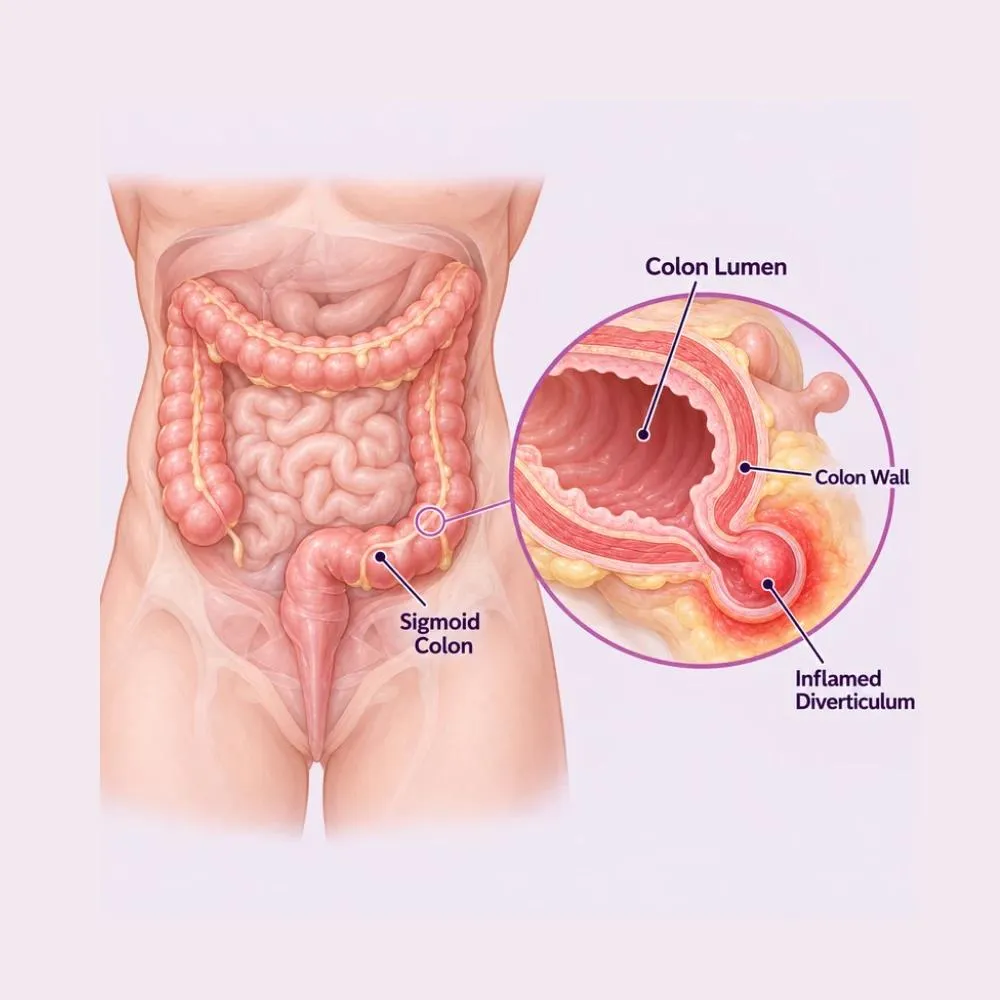
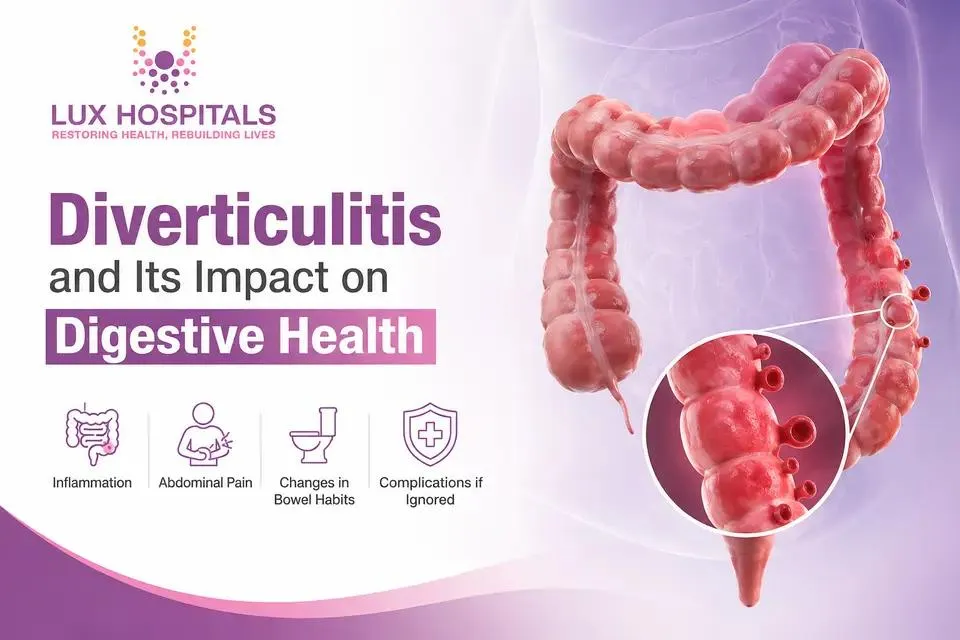
Small pouches called diverticula can form where the colon wall is weakest, pushing outward under pressure from inside. Having them is called diverticulosis, it is extremely common with age, and by itself it causes nothing at all. Diverticulitis is what happens when one of those pouches becomes inflamed or infected.
The distinction matters because the two are constantly confused. Most people over sixty have diverticula and will never have a problem. Only a minority ever develop diverticulitis, and of those, most have a single episode that settles and never recurs.
Attacks are divided into uncomplicated and complicated. Uncomplicated diverticulitis is inflammation confined to the colon wall, and it settles with antibiotics and rest. Complicated diverticulitis involves an abscess, a perforation, a fistula or an obstruction, and it needs drainage or surgery. CT is what separates the two, and it is why the scan matters more than the examination.
Diverticula form from pressure inside a colon whose wall has weakened. What turns a quiet pouch into an inflamed one is less well understood.
Less bulk means the colon must generate higher pressures to move stool along, and that pressure pushes pouches outward through weak points.
Straining raises intraluminal pressure repeatedly, which is the mechanical driver of diverticula formation.
The colon wall weakens with age. Diverticula are found in the majority of people over sixty, though most never develop symptoms.
Both are associated with a higher risk of diverticulitis and of complications when it occurs.
Smokers have a higher rate of complicated diverticulitis, including perforation and abscess formation.
Anti-inflammatory painkillers and corticosteroids increase the risk of perforation, and are best avoided in anyone with known diverticular disease.
Changes in the bacterial population of the colon appear to contribute to inflammation within the pouches.
Diverticular disease runs in families, reflecting inherited differences in connective tissue and colon wall structure.
The old advice to avoid nuts, seeds and popcorn has been disproved: studies show no association with diverticulitis at all. Fibre, weight and activity are what actually matter.
The characteristic presentation is persistent pain in the lower left abdomen with fever: a pattern distinctive enough that it is often recognisable from the history alone.
Typical symptoms
Signs of a complication
Left lower abdominal pain with fever in someone over fifty is diverticulitis until proved otherwise. The site is characteristic, because the sigmoid colon is where diverticula form most.
CT is the key investigation. It confirms the diagnosis, grades the severity, and identifies the complications that change management entirely.
The definitive test. It confirms diverticulitis, grades it on the Hinchey classification, and detects abscess, perforation or fistula.
Localised tenderness in the left lower abdomen, sometimes with a palpable mass. Guarding and rigidity suggest perforation.
Raised white cell count and CRP indicate the degree of inflammation and help track the response to treatment.
Performed six to eight weeks after recovery, never during an acute attack when the inflamed colon could perforate. It excludes an underlying cancer.
A useful alternative where CT is unavailable or in younger patients, though it is considerably less sensitive for complications.
Where a colovesical fistula is suspected, urine analysis and culture can show faecal organisms or air.
Colonoscopy is deliberately delayed until the inflammation has settled, but it is not optional. Colon cancer can present exactly as diverticulitis, and the interval scope is how that is excluded.
The great majority of attacks are treated without surgery. What determines the approach is whether the attack is uncomplicated or complicated on CT.
For mild uncomplicated diverticulitis in an otherwise well patient. A seven to ten day course, with review to confirm improvement.
Clear liquids or a low-fibre diet during the acute attack, then a gradual return to high fibre once the inflammation has settled.
For more severe attacks, patients unable to tolerate oral intake, or those with significant comorbidity.
Paracetamol and antispasmodics. NSAIDs are avoided because they increase the risk of perforation.
A drain placed through the skin into an abscess under CT guidance. It often settles a complicated attack and avoids emergency surgery altogether.
Removal of the affected segment with the healthy ends rejoined, done through keyhole incisions. The elective operation for recurrent or complicated disease.
The diseased segment is removed and a temporary colostomy formed. Used in emergencies with perforation or severe infection, where an immediate join would be unsafe.
A planned second operation three to six months later to close the colostomy and restore normal bowel continuity.
Washout of the abdomen without resection, for selected cases of purulent peritonitis where the colon can be preserved.
Resection of the diseased colon together with repair of a fistula into the bladder, vagina or small bowel.
Elective surgery is considered after recurrent attacks, a complicated attack, a fistula, or in immunosuppressed patients. It is now decided case by case rather than by counting episodes, as it once was.
A two to three hour keyhole operation removing the affected segment of colon, with a four to six night stay.
Laparoscopic sigmoid colectomy
Bowel preparation, antibiotics, bloods and an anaesthetic review. Surgery is timed at least six to eight weeks after an acute attack where possible.
General anaesthetic. The abdomen is inflated with carbon dioxide and four to five ports are placed.
The sigmoid colon is freed from its attachments, taking care to identify and preserve the ureter, which lies close to the dissection.
The vessels supplying the affected segment are divided and sealed, with enough length preserved for a tension-free join.
The affected colon is divided above and below and removed through a small incision, usually extended from one port site.
The healthy ends are rejoined with a circular stapler passed through the rectum, and the join is tested for leaks with air under water.
Sips of fluid the same evening, walking the next day, diet advanced progressively, and home after four to six nights once the bowel is working.
Whether the ends can be joined immediately depends on how inflamed the tissue is. In an emergency with significant contamination, a temporary colostomy is the safer choice, and it is usually reversible later.
The skill in diverticulitis is knowing which attacks can be treated with antibiotics and which cannot. Here is why patients trust us:
Every significant attack is scanned and graded, so complications are identified rather than discovered later.
Perforated diverticulitis is a surgical emergency, and cover is available round the clock.
From the first consultation through to post-treatment follow-up, with one team throughout.
Our hospital is in HITEC CITY, near IKEA: easily reachable from across Hyderabad.
A medically treated attack settles within a week. Recovery after colon resection takes six to eight weeks.
Antibiotics started with bowel rest. Pain and fever usually improve within 48 to 72 hours in an uncomplicated attack.
Diet advanced from liquids to low fibre as symptoms settle. Antibiotic course completed. Review to confirm resolution.
Gradual return to a high-fibre diet: the opposite of what is eaten during the attack. Normal activity resumes.
Interval colonoscopy to exclude an underlying cancer. This is when a decision about elective surgery is made if attacks have been recurrent.
Four to six nights in hospital, desk work from around three weeks, and full recovery over six to eight weeks.
Low fibre during an attack, high fibre afterwards. Building to 25–30g daily is the most effective way to prevent recurrence.
Two to three litres of water daily, and reducing excess weight: both independently lower the risk of further attacks.
Ibuprofen and diclofenac increase the risk of perforation in diverticular disease. Use paracetamol instead.
Smokers have markedly higher rates of complicated diverticulitis, including perforation and abscess.
Six to eight weeks after the attack, without exception. Colon cancer can present exactly as diverticulitis.
Returning fever, spreading pain, a rigid abdomen or inability to pass wind: all need same-day assessment.
Around a third of patients have a further attack. Fibre, weight, activity and avoiding NSAIDs genuinely reduce that risk, which is why the diet advice is treatment rather than a suggestion.
Book a consultation for persistent symptoms, and seek emergency care for the last three.
Most attacks are treated medically at modest cost. Complicated disease requiring surgery is a different order of expense.
| Procedure | Estimated Cost |
|---|---|
| Consultation & assessment Per visit | ₹1,000 – ₹2,000 |
| CT abdomen with contrast The key diagnostic test | ₹6,000 – ₹14,000 |
| Outpatient antibiotic treatment Mild uncomplicated attack managed at home | ₹3,000 – ₹8,000 |
| Hospital admission with IV antibiotics Three to five nights | ₹60,000 – ₹1,30,000 |
| CT-guided abscess drainage Five to eight nights with IV antibiotics | ₹90,000 – ₹1,80,000 |
| Laparoscopic sigmoid colectomy Four to six nights’ stay | ₹2,50,000 – ₹4,50,000 |
| Emergency Hartmann’s procedure Seven to twelve nights, colostomy formed | ₹3,50,000 – ₹6,00,000 |
The single biggest factor. An uncomplicated attack costs a few thousand rupees; emergency surgery for perforation runs into lakhs.
Planned laparoscopic resection is shorter, safer and cheaper than emergency surgery, and usually avoids a colostomy.
A temporary colostomy commits you to stoma supplies and a second operation to reverse it, both of which add to the total.
A shared ward, a twin-sharing room or a private suite: the largest single swing in most estimates.
We are empanelled with most major insurers, and our team files the pre-authorisation for you.
Every figure above is an indicative range, not a quote. After your consultation you are given a written, fixed-cost estimate, and that is the number you pay, with no additions once treatment begins.
The gastrointestinal and colorectal surgeon who treats diverticulitis at our HITEC CITY hospital.

Senior Consultant: Bariatric & Gastrointestinal Surgery
MBBS, MS, FRCS (UK), DLS (France)
28 years experience
Reviews from patients treated for colorectal and gastrointestinal conditions at Lux Hospitals, Hyderabad.
Written by Dr. Tagore Mohan Grandhi on digestive health and colorectal surgery.

Dr. Tagore Mohan Grandhi
Dr. Tagore Mohan Grandhi
Dr. Tagore Mohan Grandhi
Dr. Tagore Mohan Grandhi
Dr. Tagore Mohan Grandhi
Dr. Tagore Mohan Grandhi
Common questions about diverticulitis, its treatment, and what care costs at Lux Hospitals.
Still have questions? Call us at 079 6908 4422
Still have questions? Message us on WhatsApp at 079 6908 4444
CT-graded assessment and treatment matched to the severity of your attack, with costs shared upfront.
Plot No.116, Lumbini Avenue, HITEC CITY, Near IKEA, Hyderabad – 500032













