



Dr. Samhitha Reddy
Consultant Proctologist & Laparoscopic Surgeon
MBBS, MS, FMAS, FISCP, DMAS
- 8 Yrs
- ASCRS Member
A myomectomy removes fibroids while leaving the uterus in place. It is the operation for a woman who wants her fibroid symptoms gone and her uterus kept: whether for future pregnancy or simply because it is hers.
It is technically harder than a hysterectomy and takes longer, which is part of why it is offered less often than it should be. Our gynaecologists at Lux Hospitals, HITEC CITY perform it hysteroscopically and laparoscopically, with the uterine repair done to withstand a future pregnancy.
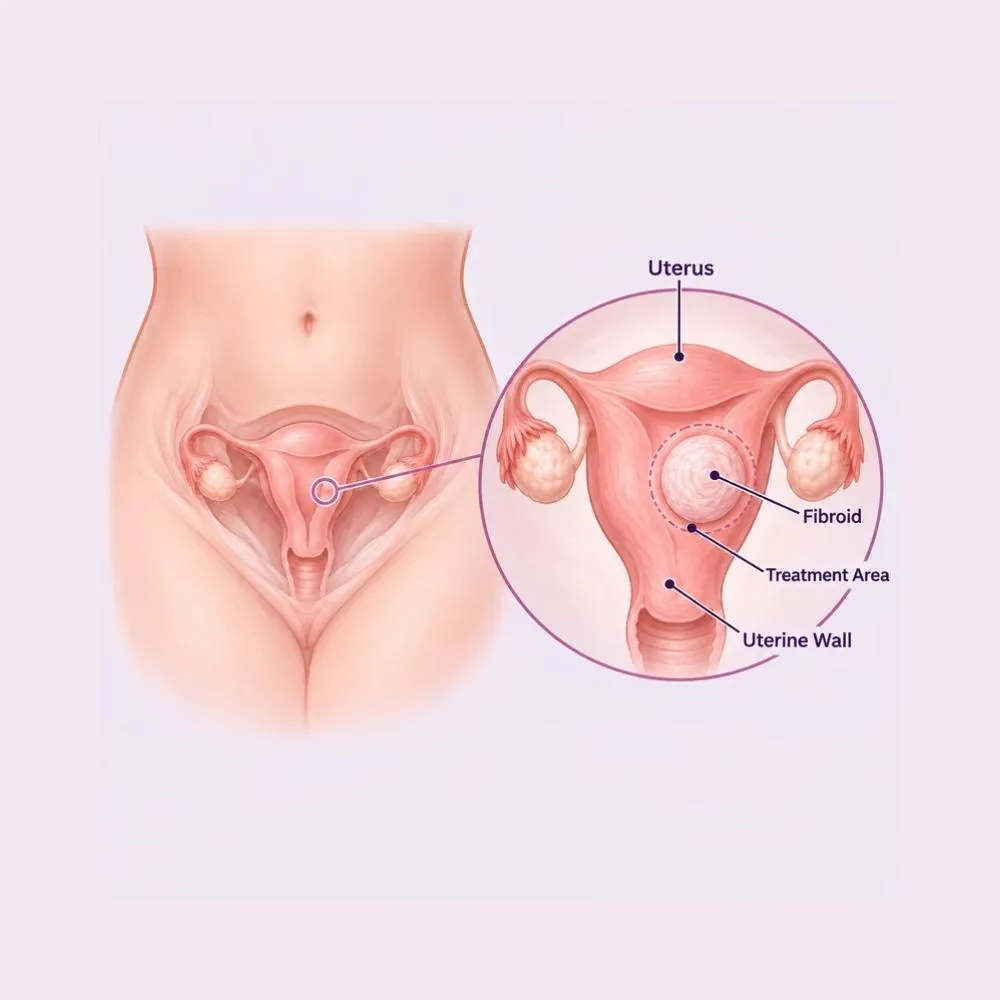
A myomectomy is the surgical removal of fibroids from the uterus, leaving the uterus itself intact and functional. The fibroid is separated from the surrounding muscle along a natural plane (its pseudocapsule) and shelled out, and the defect left behind is repaired in layers. The uterus heals, periods continue, and pregnancy remains possible.
Three routes exist, and which one applies depends almost entirely on where the fibroid sits. A submucosal fibroid bulging into the cavity is removed hysteroscopically, through the cervix, with no incision anywhere. Intramural and subserosal fibroids are removed laparoscopically through keyhole ports. Very large or very numerous fibroids may still require an open abdominal myomectomy.
The step that defines a good myomectomy is not removing the fibroid: it is repairing the uterus afterwards. The wall must be closed in layers strong enough to withstand the stretch of a full-term pregnancy and the force of labour. A poorly repaired uterus carries a real risk of rupture later, which is why this operation rewards experience and why the closure takes as long as the removal.
The reason to operate is symptoms or fertility, never the mere presence of a fibroid on a scan.
The commonest reason. Fibroids increase the surface area of the uterine lining and interfere with the muscle contracting to stop bleeding.
Submucosal fibroids reduce implantation rates and increase miscarriage. This is the clearest fertility indication for surgery.
Large fibroids press on the bladder causing frequency, or on the bowel causing constipation, and can cause visible abdominal swelling.
From degeneration within a fibroid outgrowing its blood supply, or from a pedunculated fibroid twisting on its stalk.
A fibroid growing quickly, or growing after menopause, is removed so it can be examined rather than watched.
Where a hormonal IUD, tranexamic acid or other medical management has not controlled symptoms adequately.
A large fibroid causing no symptoms in a woman not trying to conceive does not need removing. Size alone is not an indication, however alarming the measurement on the scan report looks.
Myomectomy is for symptomatic fibroids in a woman who wants to keep her uterus. Symptomless fibroids need nothing.
Symptoms that justify surgery
Fertility indications
Submucosal fibroids are the ones that genuinely affect fertility, because they distort the cavity where implantation happens. Removing those measurably improves conception and reduces miscarriage: the evidence for intramural fibroids is much weaker.
Planning a myomectomy is about mapping: knowing exactly how many fibroids there are and precisely where each one sits.
Counts and measures the fibroids and establishes their relationship to the cavity, which determines the surgical route.
Fluid instilled into the cavity to define submucosal fibroids precisely and how much of each projects into the cavity.
Essential where fibroids are numerous or large. It maps each one for surgical planning and distinguishes fibroids from adenomyosis.
Anaemia from prolonged bleeding is corrected with iron before surgery, since myomectomy itself involves significant blood loss.
Direct inspection of the cavity, which both confirms submucosal fibroids and often allows removal in the same sitting.
Where pregnancy is the goal, assessing ovarian reserve and tubal patency, and checking the partner’s semen analysis, before committing to surgery.
MRI before a complex myomectomy is not an indulgence. Knowing there are eleven fibroids rather than the four ultrasound showed changes the surgical plan, the counselling and the consent entirely.
Three approaches, chosen by fibroid position, size and number rather than by preference.
Submucosal fibroids shaved away through the cervix with no incision at all. Day care, quick recovery, and the best operation for bleeding and fertility problems.
Intramural and subserosal fibroids removed through keyhole ports, with the uterus repaired laparoscopically. Two to three nights and a two-week recovery.
Laparoscopic surgery with robotic instruments, which makes the layered uterine suturing easier in complex cases. Higher cost, similar outcomes.
Keyhole dissection with removal and repair through a small incision. A middle route for larger fibroids where full keyhole repair is difficult.
Through a horizontal incision, for very large fibroids or where there are many. It allows the surgeon to feel fibroids that cannot be seen, and gives the most secure repair.
Two to three months of hormonal treatment to shrink fibroids and correct anaemia beforehand, sometimes converting an open case to a keyhole one.
Temporary clamping or tying of the uterine arteries during surgery to reduce blood loss during a large myomectomy.
Collecting and returning the patient’s own blood during surgery where substantial loss is anticipated, reducing the need for transfusion.
Blood loss is the main risk of myomectomy, not the removal itself. Correcting anaemia beforehand, shrinking fibroids with GnRH analogues and using vasopressin during surgery are what keep it manageable.
A hysteroscopic myomectomy takes thirty to sixty minutes; a laparoscopic one, ninety minutes to three hours.
Uterus-preserving surgery under general anaesthesia
Iron to correct anaemia, and GnRH analogues for two to three months where fibroids are large. Blood is cross-matched for major cases.
General anaesthesia. For hysteroscopic surgery the scope passes through the cervix; for laparoscopic, four small abdominal ports.
Dilute vasopressin injected into the uterine wall around each fibroid to constrict the vessels before any incision is made.
A single incision made over the fibroid, positioned so that several fibroids can be reached through it where possible.
The fibroid shelled out of its pseudocapsule with traction and countertraction, staying in the correct plane so healthy muscle is spared.
The defect closed in two or three layers with strong sutures, obliterating any dead space. This is the step that determines whether the uterus is safe for pregnancy.
Fibroids removed in a containment bag, an anti-adhesion barrier placed over the uterine incision, and the ports closed.
Anti-adhesion barriers matter here more than in most operations. Adhesions forming between the healing uterus and the tubes or ovaries are a genuine cause of infertility after an otherwise successful myomectomy.
Myomectomy is harder than hysterectomy, which is why it is offered less often than it should be. Here is why patients trust us:
Layered closure of the uterine wall done to withstand a future pregnancy, with anti-adhesion measures to protect the tubes and ovaries.
Ultrasound and MRI used to locate every fibroid, so the route is chosen properly and nothing is found unexpectedly mid-operation.
From the first consultation through to post-treatment follow-up, with one team throughout.
Our hospital is in HITEC CITY, near IKEA: easily reachable from across Hyderabad.
Recovery ranges from a day after hysteroscopic removal to six weeks after open surgery. Conception waits three to six months.
Hysteroscopic myomectomy is day care. After laparoscopic surgery, discharge at two to three days with light bleeding expected.
Port-site soreness settles. Fatigue is common, particularly if you were anaemic beforehand. Most women return to desk work at two weeks.
Activity increases gradually. Intercourse resumes at four to six weeks. Histology of the fibroids reviewed at follow-up.
Conception generally advised to wait this long, allowing the uterine repair to heal fully. Your surgeon will advise based on how deep the incisions were.
Periods usually become substantially lighter. Around a quarter of women develop new fibroids within five years.
The uterine repair needs to heal completely. Conceiving too soon risks the scar giving way in later pregnancy, which is the one serious long-term risk.
A myomectomy scar affects how labour is managed. Where the cavity was entered, a planned caesarean is usually recommended. This must be on your record.
Iron stores take months to rebuild after years of heavy bleeding, and surgery adds its own loss. Continue supplements as long as advised.
Both the uterine repair and the abdominal wall need time. Walking is encouraged from the first day.
Periods usually become markedly lighter and shorter. They do not stop: the uterus and its lining remain, which is the point of the operation.
Bleeding heavier than a normal period, fever, offensive discharge, or increasing pain all need review rather than waiting.
Around three-quarters of women see their symptoms resolve after myomectomy, and pregnancy rates afterwards are good. The trade-off against hysterectomy is recurrence: new fibroids form in about a quarter within five years.
Book a consultation if any of the following apply.
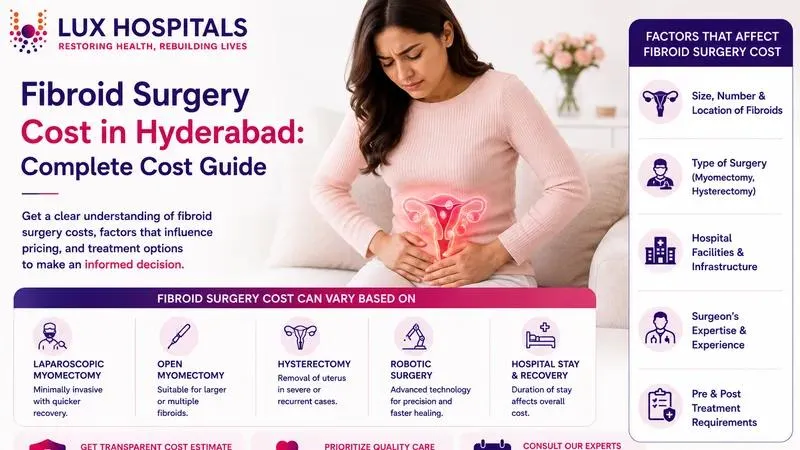
Cost depends on the route, which in turn depends on how many fibroids there are and where they sit.
| Procedure | Estimated Cost |
|---|---|
| Consultation Per visit | ₹800 – ₹1,500 |
| Pre-operative workup Bloods, ultrasound, ECG, anaesthetic review | ₹5,000 – ₹12,000 |
| MRI pelvis for mapping For multiple or large fibroids | ₹8,000 – ₹18,000 |
| Hysteroscopic myomectomy Day care; no incision | ₹75,000 – ₹1,40,000 |
| Laparoscopic myomectomy Two to three nights | ₹1,50,000 – ₹2,80,000 |
| Open abdominal myomectomy Four to five nights | ₹1,40,000 – ₹2,60,000 |
| Robotic-assisted myomectomy Includes robotic consumables | ₹2,80,000 – ₹4,50,000 |
Removing one fibroid is a different operation from removing fifteen. Each requires its own dissection and repair, and the time adds up.
Hysteroscopic removal is day care and least expensive. Laparoscopic surgery costs more in consumables but less in hospital stay than open surgery.
GnRH analogues for two to three months and intravenous iron add cost, but reduce blood loss and can make keyhole surgery feasible.
A shared ward, a twin-sharing room or a private suite: the largest single swing in most estimates.
We are empanelled with most major insurers, and our team files the pre-authorisation for you.
Every figure above is an indicative range, not a quote. After your consultation you are given a written, fixed-cost estimate, and that is the number you pay, with no additions once treatment begins.
The gynaecologists who perform myomectomy at our HITEC CITY hospital.

Consultant Gynaecologist & Advanced Laparoscopic Surgeon
MBBS, MS, FMAS
16 years experience

Consultant Obstetrician, Gynecologist & Laparoscopic Surgeon
MBBS, MS (Obstetrics & Gynaecology)
11 years experience
Reviews from women treated for gynaecological conditions at Lux Hospitals, Hyderabad.
Written by Dr. Harshita Kakarla on women’s health and gynaecological care.
Dr. Harshita Kakarla
Dr. Harshita Kakarla

Dr. Harshita Kakarla

Dr. Harshita Kakarla

Dr. Harshita Kakarla
Dr. Harshita Kakarla
Common questions about myomectomy, fertility afterwards, recovery and costs at Lux Hospitals.
Still have questions? Call us at 079 6908 4422
Still have questions? Message us on WhatsApp at 079 6908 4444
Fibroid removal that keeps your uterus, with the repair done for a future pregnancy and costs shared upfront.
Plot No.116, Lumbini Avenue, HITEC CITY, Near IKEA, Hyderabad – 500032













