



Dr. Samhitha Reddy
Consultant Proctologist & Laparoscopic Surgeon
MBBS, MS, FMAS, FISCP, DMAS
- 8 Yrs
- ASCRS Member
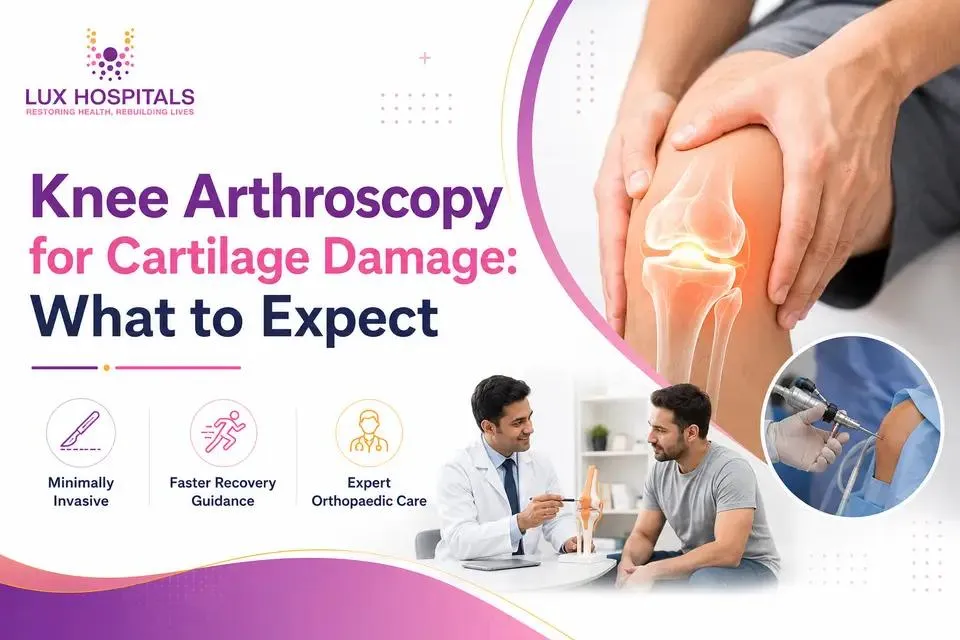
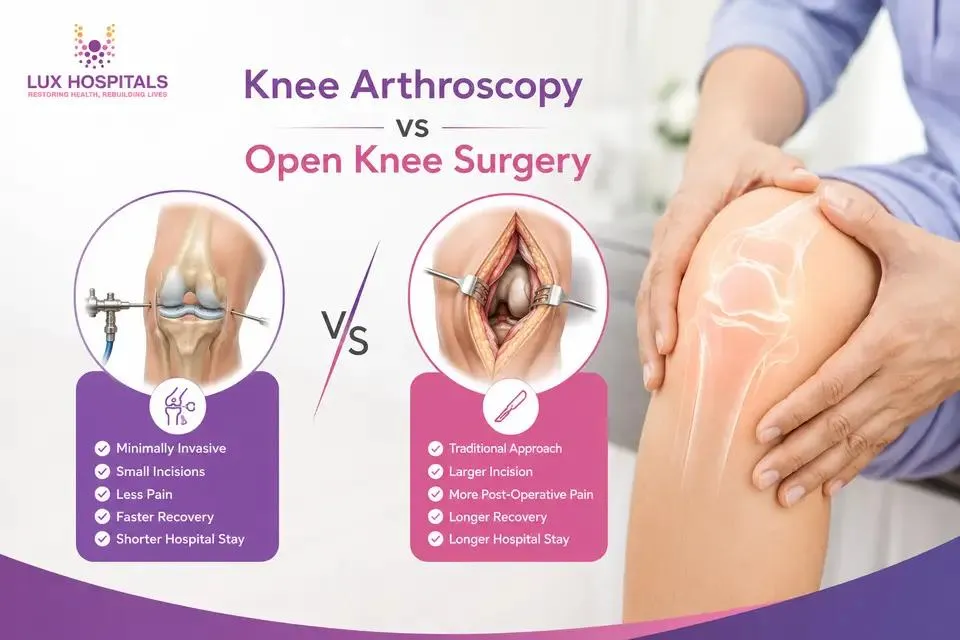
Knee arthroscopy is keyhole surgery inside the joint, done through two or three incisions the size of a buttonhole. It is excellent for mechanical problems: a torn meniscus, a loose fragment, a damaged ligament.
It is not, however, a treatment for arthritis, and it is worth being clear about that. Our orthopaedic surgeons at Lux Hospitals, HITEC CITY use arthroscopy where it genuinely helps, and will say so where it would not.
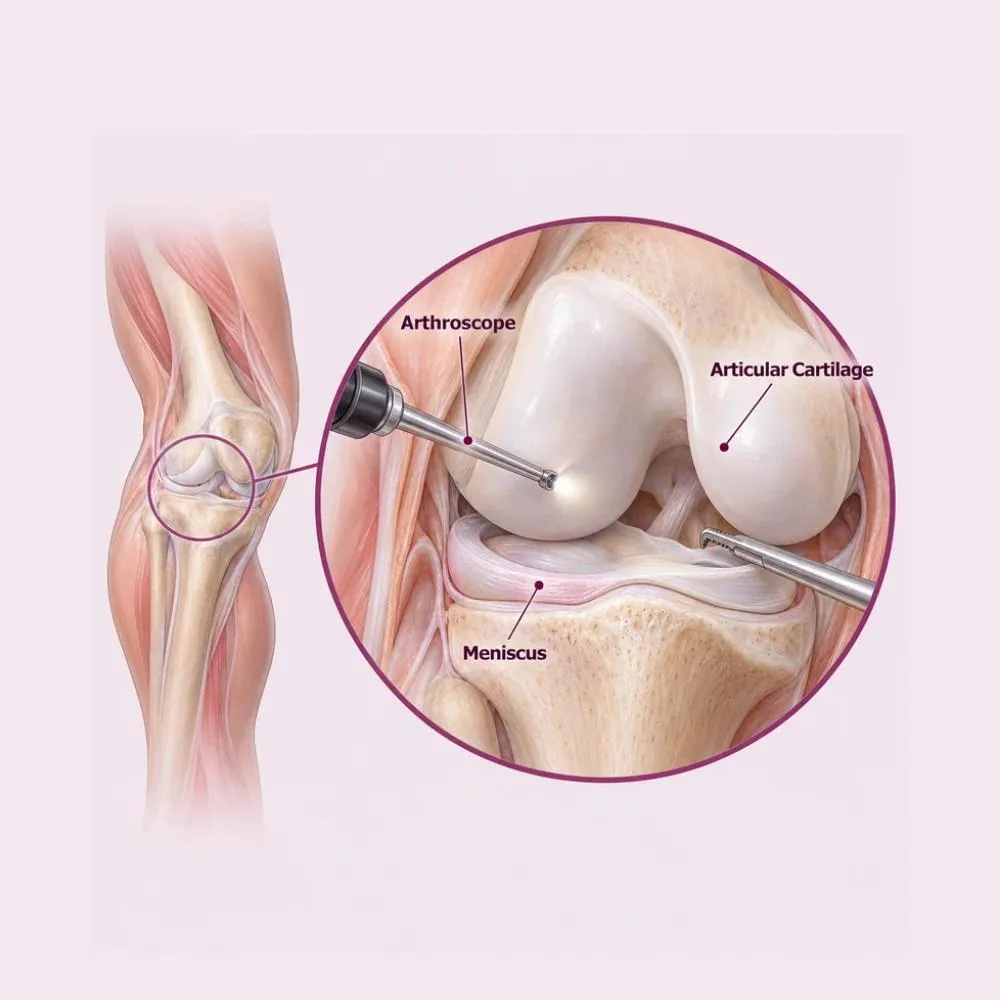
Knee arthroscopy is a minimally invasive procedure in which a small camera is passed into the knee joint through an incision of a few millimetres, with instruments introduced through one or two further portals. The surgeon sees the inside of the joint magnified on a screen and works through those tiny openings.
It is both diagnostic and therapeutic. Everything inside the joint can be inspected directly (the menisci, the cruciate ligaments, the cartilage surfaces) and most problems found can be treated in the same sitting.
What it is good for is mechanical problems: a torn meniscus catching in the joint, a loose fragment of cartilage, a ruptured cruciate ligament. What it does not treat is osteoarthritis. Large trials have shown clearly that arthroscopy for arthritic knee pain offers no benefit over physiotherapy, and offering it would be doing you no favour.
These are the problems inside the knee that keyhole surgery genuinely addresses.
The commonest reason. A torn meniscus can be repaired or the damaged portion trimmed, depending on the tear pattern and blood supply.
The ACL is reconstructed arthroscopically using a graft, restoring stability in patients whose knee gives way.
Focal areas of damaged articular cartilage can be smoothed, micro-fractured or grafted, particularly in younger patients.
Fragments of cartilage or bone floating in the joint that cause locking. Removing them gives immediate and complete relief.
Inflamed joint lining causing swelling and pain, which can be biopsied and excised arthroscopically.
Where the kneecap does not run in its groove correctly, a lateral release or realignment can be performed.
An infected joint can be thoroughly washed out arthroscopically, which is both urgent and highly effective.
Where imaging does not explain the symptoms and mechanical signs persist, diagnostic arthroscopy has a genuine role.
Meniscal tears deserve a note. Small degenerate tears in an arthritic knee are common findings on MRI that often cause no symptoms: treating the scan rather than the patient is a well-recognised error.
Mechanical symptoms are the ones arthroscopy addresses: the sensation that something is physically catching or giving way inside the joint.
Symptoms it treats well
Symptoms it does not treat
The distinction matters. A knee that locks has something mechanical inside it that arthroscopy can remove. A knee that simply aches from arthritis will not be improved by looking inside it.
The assessment establishes that the symptoms are genuinely mechanical and that the problem is one arthroscopy can fix.
Joint line tenderness, meniscal provocation tests, ligament stability testing and assessment of range of motion and effusion.
Weight-bearing films to assess the degree of arthritis: the finding that most often argues against arthroscopy being helpful.
Shows menisci, ligaments and cartilage in detail. Interpreted alongside the examination, not in isolation, since incidental findings are common.
Blood tests, an ECG where age or history calls for one, and a review of blood thinners that need pausing.
Discussion of general versus spinal anaesthesia. Most knee arthroscopies are done as day cases either way.
Fasting for six hours beforehand, and arranging for someone to take you home, since you cannot drive afterwards.
An MRI reported as showing a meniscal tear does not by itself justify an operation. What matters is whether your symptoms match that finding, which is what the examination establishes.
Many knee problems settle without surgery. Arthroscopy is chosen where the symptoms are mechanical and the problem is one that keyhole surgery can correct.
Strengthening the quadriceps and hamstrings. Effective for many meniscal tears and the first-line treatment for degenerate ones.
Avoiding deep squatting and twisting allows many acute injuries to settle over six to twelve weeks.
Reduces swelling and pain during the settling phase, used alongside physiotherapy rather than instead of it.
Useful where inflammation and swelling dominate, and it can help clarify whether pain is coming from the joint at all.
Supports an unstable knee and offloads a damaged compartment while other treatment takes effect.
Stitching a torn meniscus back together. Preferred wherever possible, since preserving the meniscus protects against later arthritis.
Trimming the torn portion where repair is not feasible. Effective for locking, though it removes tissue that cannot be replaced.
Rebuilding the torn ligament with a graft, restoring stability for patients whose knee gives way.
Microfracture, chondroplasty or cartilage grafting for focal defects, particularly in younger patients.
Retrieving fragments causing locking. One of the most satisfying procedures in arthroscopy: the relief is immediate.
Removing inflamed lining, or thoroughly irrigating an infected joint, which is an urgent indication.
Repairing a meniscus rather than trimming it is preferred wherever the tear pattern allows, because meniscal tissue removed cannot be replaced and its loss accelerates arthritis over the following decades.
A thirty to sixty minute day-care procedure through two or three incisions of a few millimetres. Home the same day, walking immediately.
Arthroscopic knee surgery
General or spinal anaesthesia, with local anaesthetic infiltrated into the portals for post-operative comfort.
Two or three incisions of five to ten millimetres are made around the front of the knee, giving access for the camera and instruments.
The whole joint is inspected systematically: both menisci, both cruciate ligaments, all cartilage surfaces and the joint lining.
Meniscal repair or trimming, removal of loose bodies, cartilage smoothing or ligament reconstruction, depending on the findings.
The joint is inspected again to confirm the problem is addressed, and irrigated to remove debris.
The tiny portals are closed with a single stitch each or adhesive strips, and a dressing applied.
Two to four hours of observation, walking with crutches, and home the same day with physiotherapy instructions.
The surgeon decides much of what is done during the operation rather than before it, because the arthroscopic view is more informative than any scan. The plan is therefore discussed as a range of possibilities beforehand.
The most useful thing a surgeon can do here is know when arthroscopy will not help. Here is why patients trust us:
Orthopaedic surgeons performing knee arthroscopy regularly, including meniscal repair and ligament reconstruction.
We do not offer arthroscopy for arthritic knee pain, because the evidence is clear that it does not help.
From the first consultation through to post-treatment follow-up, with one team throughout.
Our hospital is in HITEC CITY, near IKEA: easily reachable from across Hyderabad.
Recovery depends entirely on what was done. A simple meniscectomy takes weeks; a meniscal repair or ACL reconstruction takes months.
Home the same day, walking with crutches. Some swelling and discomfort at the portal sites, controlled with simple painkillers.
Ice and elevation to control swelling. Gentle range of motion exercises begin. Crutches discarded within days after a simple procedure.
After a meniscectomy or washout, normal walking and desk work resume. After a repair or reconstruction, protected weight-bearing continues.
Return to most activities after simple procedures. Progressive strengthening after repairs, with running usually permitted around three months.
Return to pivoting sport after ACL reconstruction, subject to passing functional testing rather than to time alone.
Regular icing and elevation in the first week controls swelling, which is the main limit on regaining movement.
Rehabilitation differs enormously between procedures. A meniscal repair needs protection that a meniscectomy does not.
Getting the knee completely straight early is a priority. A knee that will not straighten causes lasting problems with gait.
Keep dressings dry for the first few days and shower rather than bathe until the portals have sealed.
Fever, spreading redness, increasing swelling and pain, calf pain and swelling, or the knee locking again.
Returning before strength and control are restored is the main cause of re-injury, particularly after ACL reconstruction.
Where a meniscus was repaired rather than trimmed, the recovery is longer and the restrictions stricter, but preserving that tissue protects the knee for decades afterwards, which makes the extra months worthwhile.
Book a consultation if any of the following apply.
Cost depends on what is done inside the joint, not on the arthroscopy itself. These are the ranges our patients fall into.
| Procedure | Estimated Cost |
|---|---|
| Consultation & assessment Per visit | ₹800 – ₹1,500 |
| MRI knee Where indicated by examination | ₹6,000 – ₹12,000 |
| Diagnostic arthroscopy with washout Day care, same-day discharge | ₹55,000 – ₹95,000 |
| Arthroscopic partial meniscectomy Day care, same-day discharge | ₹70,000 – ₹1,20,000 |
| Arthroscopic meniscal repair Day care or one night; implants included | ₹90,000 – ₹1,60,000 |
| ACL reconstruction One night’s stay, graft fixation included | ₹1,40,000 – ₹2,50,000 |
| Post-operative physiotherapy Depends on the procedure performed | ₹10,000 – ₹35,000 |
A washout, a meniscal trim, a meniscal repair and an ACL reconstruction differ enormously in time, implants and cost.
Meniscal repair devices and ACL graft fixation implants are a significant part of the total, and vary between manufacturers.
A meniscectomy needs a few weeks of physiotherapy; an ACL reconstruction needs six to nine months of structured rehabilitation.
A shared ward, a twin-sharing room or a private suite: the largest single swing in most estimates.
We are empanelled with most major insurers, and our team files the pre-authorisation for you.
Every figure above is an indicative range, not a quote. After your consultation you are given a written, fixed-cost estimate, and that is the number you pay, with no additions once treatment begins.
The orthopaedic and sports injury surgeons who perform knee arthroscopy at our HITEC CITY hospital.

Consultant Orthopaedic Surgeon: Joint Replacement & Arthroscopy
MS (Ortho), FIJR, FIASM (UK), FIKS (Italy), FIRJR
8 years experience

Consultant Orthopaedic Surgeon
MBBS, MS, FIJR
6 years experience
Reviews from patients treated for knee, shoulder and sports injuries at Lux Hospitals, Hyderabad.
Written by Dr. Sai Kishan Sirasala on knee arthroscopy, sports injuries and orthopaedic care.
Dr. Sai Kishan Sirasala
Dr. Sai Kishan Sirasala
Dr. Sai Kishan Sirasala
Dr. Sai Kishan Sirasala
Dr. Sai Kishan Sirasala
Dr. Sai Kishan Sirasala
Common questions about knee arthroscopy, its recovery, and what surgery costs at Lux Hospitals.
Still have questions? Call us at 079 6908 4422
Still have questions? Message us on WhatsApp at 079 6908 4444
Keyhole knee surgery where it genuinely helps, with an honest assessment first and a fixed-cost estimate before treatment.
Plot No.116, Lumbini Avenue, HITEC CITY, Near IKEA, Hyderabad – 500032













