Dr. Samhitha Reddy
Consultant Proctologist & Laparoscopic Surgeon
MBBS, MS, FMAS, FISCP, DMAS
- 8 Yrs
- ASCRS Member
Circumcision is the surgical removal of the foreskin. It is performed for medical reasons (a tight foreskin, recurrent infection, scarring) and for religious and cultural ones, and it is among the most commonly performed operations worldwide.
What has changed is the technique. Stapler and laser circumcision have made the procedure faster, near-bloodless and considerably less painful than the conventional operation. Our urologists at Lux Hospitals, HITEC CITY offer all three and will tell you honestly which suits your case.
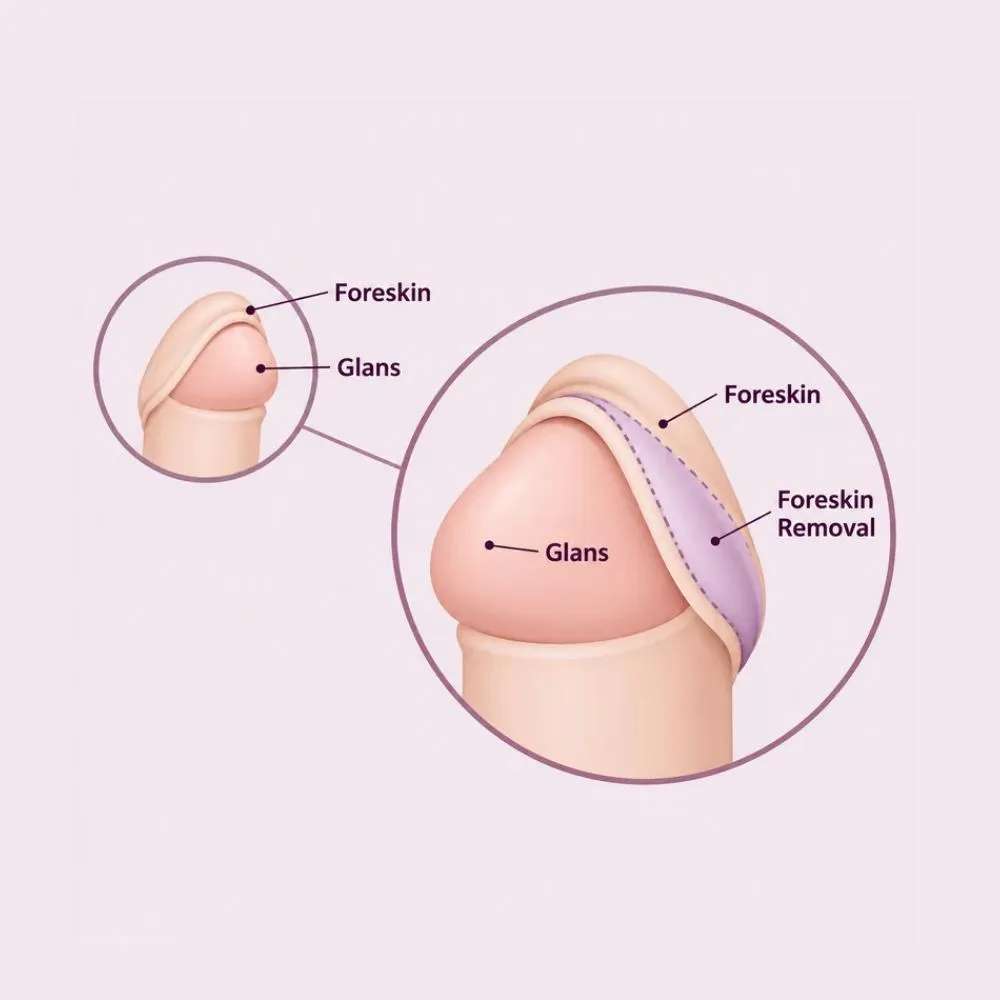
Circumcision removes the foreskin: the retractable fold of skin covering the head of the penis. The operation separates the foreskin from the glans, removes the excess, and closes the two remaining skin edges together.
The medical indications are specific. Phimosis is a foreskin too tight to retract, which in adults causes pain, difficulty with hygiene and problems during intercourse. Paraphimosis is the reverse and a genuine emergency: a retracted foreskin trapped behind the glans, constricting it and threatening blood supply. Recurrent balanitis, lichen sclerosus and a torn frenulum are the other common reasons.
It is also performed as a religious and cultural practice in Muslim and Jewish communities, and increasingly as a preventive measure: circumcision reduces the risk of urinary tract infection in infancy, of some sexually transmitted infections, and of penile cancer. Whichever the reason, the operation itself is the same.
Most adult circumcisions follow from a foreskin that has become tight or scarred, and there are several routes to that.
A foreskin that is naturally non-retractile in early childhood. This is normal and usually resolves by itself, and is not an indication for surgery.
Repeated episodes of balanitis cause scarring, and scar tissue does not stretch. This is the commonest route to true adult phimosis.
Sugar in the urine promotes fungal and bacterial growth under the foreskin. Recurrent balanitis in an adult should always prompt a blood sugar test.
A chronic inflammatory skin condition producing white, hardened, inelastic tissue. Circumcision is the definitive treatment.
Pulling back a child’s foreskin before it is naturally ready tears the tissue, and the resulting scarring creates the very phimosis it was meant to prevent.
Accumulated smegma under the foreskin causes irritation and inflammation, contributing to repeated infection.
Tears during intercourse, particularly of a short frenulum, heal with scarring that narrows the opening further.
A child’s foreskin should never be forcibly retracted. It separates from the glans naturally over years, and forcing it is a common and entirely avoidable cause of the scarring that later needs surgery.
Circumcision is done for clear medical indications, and separately as an elective religious or personal choice.
Medical indications
Symptoms needing urgent care
Paraphimosis, where a retracted foreskin becomes trapped and swollen behind the glans, is a urological emergency. Go to a hospital the same day rather than waiting for an appointment.
The consultation establishes whether circumcision is needed, whether a less invasive option would do, and which technique suits you.
Assessing how far the foreskin retracts, the degree of scarring, the state of the glans and the length of the frenulum.
Fasting glucose and HbA1c in any adult with recurrent balanitis. Undiagnosed diabetes is a frequent finding.
Where there is active discharge, to identify bacterial or fungal infection so it can be treated before surgery.
Characteristic white, thickened tissue. This finding makes circumcision the definitive treatment rather than one option among several.
Routine bloods, clotting profile and anaesthetic review. Bleeding disorders and blood thinners are specifically asked about.
Stapler, laser or conventional, chosen on the anatomy, the reason for surgery and your own preference after being shown what each involves.
Not every tight foreskin needs surgery. Mild phimosis without scarring often responds to a course of topical steroid with gentle stretching, and that is worth trying first.
Three techniques are in common use. They differ in speed, bleeding, pain and cosmetic result rather than in the end point.
A four to six week course with gentle daily stretching resolves mild phimosis in a substantial proportion of cases, avoiding surgery entirely.
Antifungal or antibiotic treatment for active balanitis, plus control of blood sugar where diabetes is found. Sometimes this alone settles the problem.
A small incision to widen the tight ring while preserving the foreskin. An option for mild phimosis in men who wish to keep it.
Lengthening a short frenulum without removing the foreskin, where tearing during intercourse is the only problem.
A single-use device cuts and seals in one action, taking around five to ten minutes. Near-bloodless, no stitches needed, and the neatest cosmetic result. The device separates on its own in one to two weeks.
The foreskin is removed with a laser that seals vessels as it cuts. Minimal bleeding, faster than conventional surgery, and less post-operative swelling.
The traditional operation with a scalpel and absorbable sutures. Takes longer with more bleeding, but allows the greatest control over how much skin is removed: useful for scarred or unusual anatomy.
Performed under general anaesthesia in children, usually with the conventional or stapler technique, as a day-care procedure.
Stapler circumcision is the fastest and most comfortable option for straightforward cases. Heavily scarred anatomy or lichen sclerosus is often better handled conventionally, where the surgeon controls exactly how much tissue comes away.
The procedure takes five to ten minutes with a stapler and twenty to forty minutes conventionally. You go home the same day.
Day-care surgery under local, regional or general anaesthesia
Fasting where general or spinal anaesthesia is planned. The area is shaved and cleaned, and a single antibiotic dose given.
A penile block with local anaesthetic is sufficient for most adults. Spinal anaesthesia is used where preferred, and general anaesthesia for children.
The surgeon marks how much foreskin will be removed, balancing enough removal to resolve the problem against leaving a natural result.
Any adhesions between the foreskin and the glans are gently released, and accumulated smegma cleared.
With a stapler, the device is positioned and fired, cutting and sealing in one action. With laser or scalpel, the foreskin is incised along the marked line and the frenular artery secured.
Stapler circumcision needs no stitches. Laser and conventional techniques are closed with fine absorbable sutures that dissolve over two to three weeks.
A light dressing applied, observation for one to two hours, then discharge with painkillers, an antibiotic and clear wound-care instructions.
The judgement that matters is how much skin to remove. Too little leaves the original problem; too much causes tightness on erection. That balance is why an experienced surgeon matters for an operation that otherwise looks simple.
A simple-looking operation still depends on judgement and technique. Here is why patients trust us:
Conventional, laser and stapler, with an honest recommendation based on your anatomy rather than on what we prefer to do.
Admission, procedure and discharge on the same day, with the assessment completed in a single prior visit.
From the first consultation through to post-treatment follow-up, with one team throughout.
Our hospital is in HITEC CITY, near IKEA: easily reachable from across Hyderabad.
Most men return to desk work within a week. The wound heals in two to three weeks, and sexual activity resumes at four to six.
Soreness and swelling, worst in the first forty-eight hours. Simple painkillers are usually sufficient. Loose clothing and ice help.
Swelling begins settling. Most men return to desk work at the end of this week. Showering is allowed once permitted.
With a stapler, the device separates and falls away on its own. Sutures from other techniques begin dissolving. Wound review at this point.
The wound has healed. Residual swelling and colour change settle. Light exercise resumes.
Sexual activity resumes. Full sensation settles over the following months as the glans adapts to being uncovered.
Shower rather than bathe, pat dry gently, and avoid swimming until the wound has fully healed at two to three weeks.
They are unavoidable and uncomfortable for the first week or two. Passing urine before sleeping and taking your painkiller at bedtime helps.
Snug cotton underwear keeps the dressing in place and prevents rubbing against clothing. Avoid anything tight or seamed.
It separates naturally in one to two weeks. Do not pull at it, even when it looks ready to come away.
Including masturbation. The healing edge needs time, and early activity risks reopening the wound.
Persistent bleeding, increasing pain, pus, fever or difficulty passing urine all need review rather than waiting for the follow-up.
Swelling of the skin just behind the cut is normal and can look alarming in the first two weeks. It settles by itself and is not a sign that anything has gone wrong.
Book a consultation if any of the following apply.
Cost depends mainly on the technique and the anaesthesia. Stapler circumcision carries a device cost but a shorter theatre time.
| Procedure | Estimated Cost |
|---|---|
| Consultation Includes examination | ₹800 – ₹1,500 |
| Pre-operative workup Bloods, sugar profile, clotting | ₹2,500 – ₹5,000 |
| Conventional circumcision Day care, local or spinal anaesthesia | ₹25,000 – ₹45,000 |
| Laser circumcision Less bleeding and swelling | ₹35,000 – ₹60,000 |
| Stapler circumcision Includes the single-use device | ₹40,000 – ₹70,000 |
| Paediatric circumcision General anaesthesia, day care | ₹30,000 – ₹55,000 |
| Preputioplasty or frenuloplasty Foreskin-preserving alternatives | ₹20,000 – ₹40,000 |
Stapler circumcision includes a single-use device that accounts for much of the difference. Laser needs specific equipment.
A local penile block costs least. Spinal and general anaesthesia add anaesthetist and recovery charges, and general is unavoidable in children.
Dense scarring, lichen sclerosus or severe active infection takes longer and needs conventional technique.
A shared ward, a twin-sharing room or a private suite: the largest single swing in most estimates.
We are empanelled with most major insurers, and our team files the pre-authorisation for you.
Every figure above is an indicative range, not a quote. After your consultation you are given a written, fixed-cost estimate, and that is the number you pay, with no additions once treatment begins.
The urologists who perform circumcision at our HITEC CITY hospital.

Consultant Urologist & Andrologist
MBBS, MS, DrNB (Urology)
10 years experience

Consultant Urologist & Andrologist
MBBS, MS, MCh (Urology)
9 years experience
Reviews from patients treated for urological and men’s health conditions at Lux Hospitals, Hyderabad.
Written by Dr. Vipin Reddy B on men’s health and urological care.

Dr. Vipin Reddy B

Dr. Vipin Reddy B

Dr. Vipin Reddy B

Dr. Vipin Reddy B

Dr. Vipin Reddy B

Dr. Vipin Reddy B
Common questions about circumcision techniques, recovery and what the procedure costs at Lux Hospitals.
Still have questions? Call us at 079 6908 4422
Still have questions? Message us on WhatsApp at 079 6908 4444
Stapler, laser and conventional circumcision as day care, with the technique explained and costs shared upfront.
Plot No.116, Lumbini Avenue, HITEC CITY, Near IKEA, Hyderabad – 500032