



Dr. Samhitha Reddy
Consultant Proctologist & Laparoscopic Surgeon
MBBS, MS, FMAS, FISCP, DMAS
- 8 Yrs
- ASCRS Member
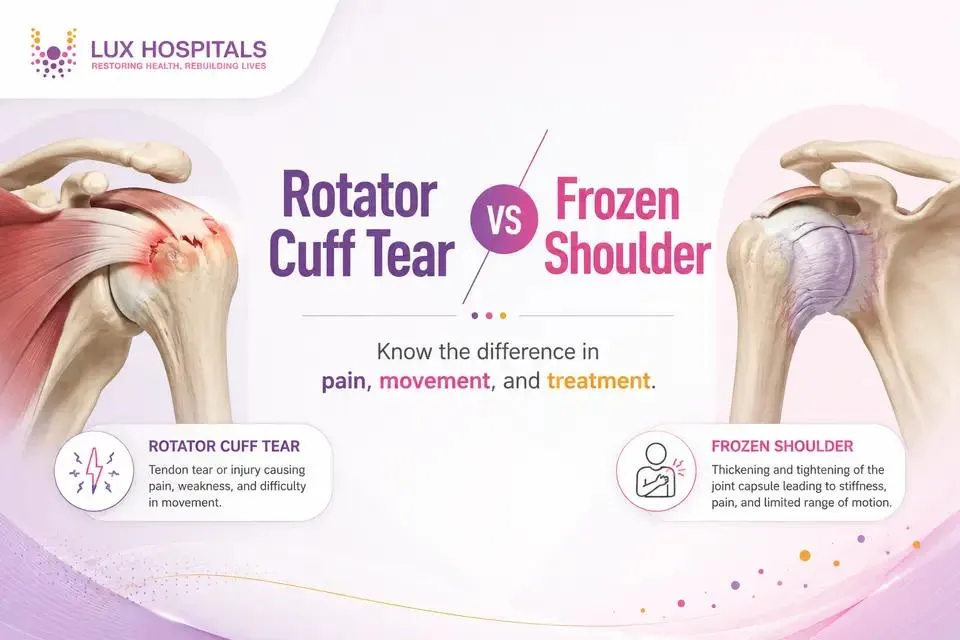
The rotator cuff is a set of four tendons that lift and rotate the arm and hold the shoulder joint centred. When one tears, the characteristic complaint is not just pain but night pain: a deep ache that stops you sleeping on that side.
Not every tear needs repairing, and many people manage well with physiotherapy alone. Our orthopaedic surgeons at Lux Hospitals, HITEC CITY perform arthroscopic cuff repair where it is indicated, with a staged rehabilitation programme afterwards.
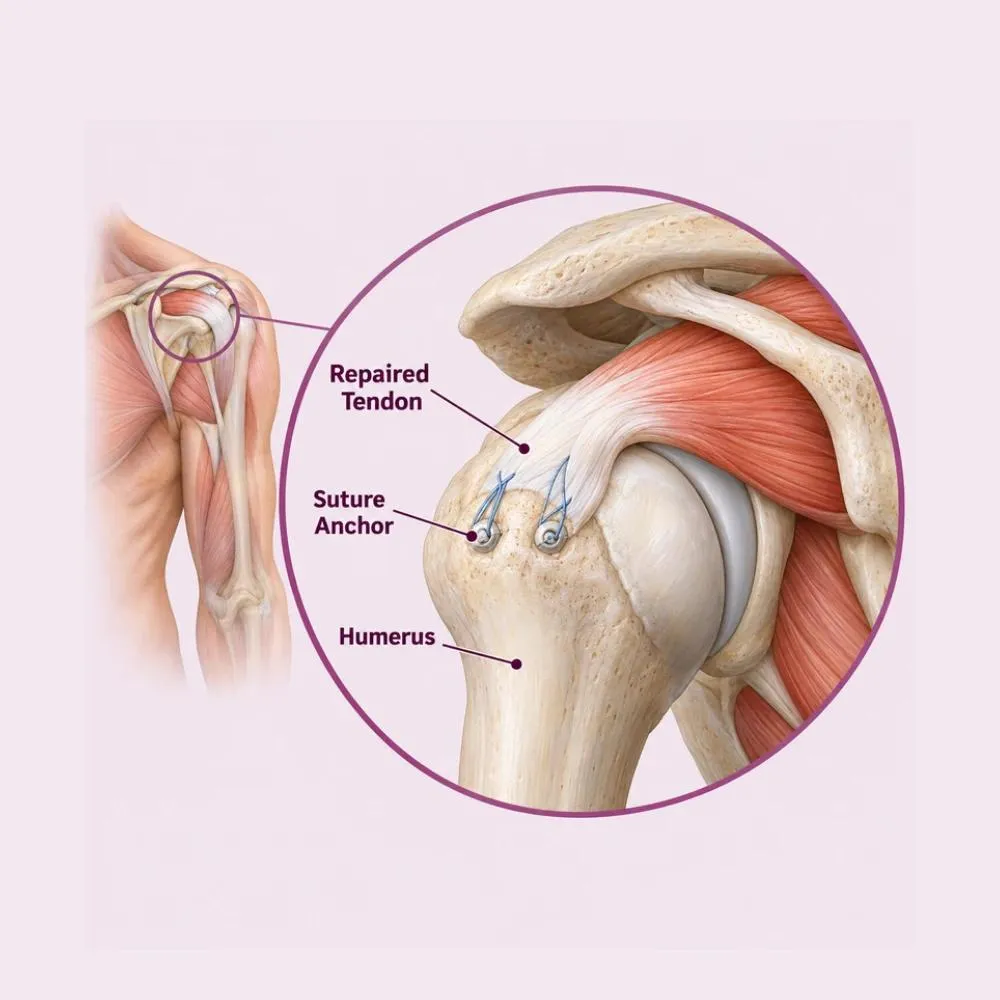
The rotator cuff is formed by four tendons (supraspinatus, infraspinatus, teres minor and subscapularis) that wrap around the head of the humerus. They lift and rotate the arm, and just as importantly they hold the ball centred in the socket while the larger deltoid does the lifting.
Rotator cuff repair reattaches a torn tendon to its footprint on the bone, using small anchors loaded with strong sutures. It is performed arthroscopically in the great majority of cases, through portals a few millimetres across.
Tears are described as partial or full-thickness, and by size. That matters because it predicts both whether repair is worthwhile and whether it will heal. A small acute tear in a fifty-year-old repairs and heals reliably; a massive retracted tear in an eighty-year-old with poor tendon quality often will not, and is better managed differently.
Most tears result from gradual degeneration rather than a single injury, though an acute event often brings the problem to light.
The tendons weaken with age and their blood supply diminishes. Tears become progressively more common from the fifties onward.
Painting, construction, sport and any occupation involving sustained overhead work loads the cuff repeatedly.
A fall onto an outstretched arm, or lifting something heavy suddenly, can tear a tendon outright, often one already weakened.
A bone spur narrowing the space above the cuff causes the tendon to rub and fray, eventually tearing.
Dislocation in a patient over forty frequently tears the cuff, and that is easily missed if only instability is looked for.
Impairs tendon blood supply and healing, and is independently associated with both tearing and repair failure.
Associated with a higher rate of cuff tears, frozen shoulder and poorer healing after repair.
Weak muscles controlling the shoulder blade alter mechanics and increase impingement on the cuff.
Smoking is worth singling out. It measurably reduces the chance a repaired tendon will heal to bone, and stopping before surgery genuinely improves the outcome.
Night pain is the most characteristic symptom, and it is usually what finally brings people in.
Common symptoms
Features suggesting a significant tear
A sudden loss of power after a fall is treated differently from years of gradual aching. Acute traumatic tears in younger patients are repaired promptly, because delay allows the tendon to retract.
Examination localises which tendon is affected; MRI or ultrasound confirms the tear and (importantly) the quality of the muscle.
Specific strength tests isolate each tendon, and impingement signs are assessed alongside range of motion.
Show bone spurs and, in long-standing large tears, upward migration of the humeral head: a sign the cuff has failed.
The key investigation. It shows tear size, how far the tendon has retracted, and the degree of fatty change in the muscle.
A quick, dynamic alternative that shows the tendon moving in real time and is useful for follow-up assessment.
Tear size, retraction, tendon quality and muscle fatty infiltration together determine whether repair is likely to heal.
Blood tests, diabetes control, smoking status and anaesthetic review, since all affect healing rates.
Fatty infiltration of the muscle on MRI is the finding that most often argues against repair. Once the muscle has degenerated it will not recover strength even if the tendon is reattached.
Many cuff tears are managed successfully without surgery. Repair is chosen for acute tears, younger patients and persistent weakness.
Strengthening the remaining cuff and the muscles controlling the shoulder blade. Many patients with degenerate tears do very well on this alone.
Steroid into the space above the cuff, reducing inflammation and allowing rehabilitation to progress.
Controls pain and inflammation during the rehabilitation phase.
Reducing overhead loading and adapting how tasks are performed while the shoulder settles.
Sleeping semi-upright or with the arm supported on a pillow substantially helps the night pain that troubles most patients.
The torn tendon is reattached to bone with suture anchors through keyhole portals. The standard operation, with a three to six month rehabilitation.
Removing the bone spur to create space for the repaired tendon, usually performed alongside the repair.
Dealing with a damaged biceps tendon, which is frequently a significant source of pain alongside the cuff tear.
Where a massive tear cannot be fully repaired, partial repair with debridement can still relieve pain considerably.
A graft used to restore stability in irreparable tears in younger patients, avoiding a joint replacement.
For irreparable tears with arthritis in older patients, restoring the ability to lift the arm without a functioning cuff.
An acute traumatic tear in a younger patient is repaired promptly, because delay allows retraction and fatty change. A degenerate tear in an older patient is often better served by physiotherapy first.
A sixty to ninety minute arthroscopic procedure through three or four small portals, usually as a day case.
Arthroscopic rotator cuff repair
MRI reviewed, diabetes optimised and smoking ideally stopped, since both affect whether the repair heals.
General anaesthesia with an interscalene nerve block, which gives excellent pain relief for the first twelve to eighteen hours.
The joint and subacromial space are inspected, the tear size and pattern confirmed, and the biceps tendon assessed.
The bone where the tendon attaches is lightly abraded to a bleeding surface, which is what allows the tendon to heal back to it.
Suture anchors are inserted into the bone, each loaded with strong sutures. Larger tears need several.
The tendon is drawn back to its footprint and secured, often in a double-row configuration that spreads the load across a broader contact area.
Any bone spur is removed to protect the repair, portals are closed, and the arm placed in a sling.
The tendon takes around three months to heal to bone, and that biology does not change with keyhole surgery. The sling and the staged protocol exist to protect the repair during that window.
Cuff repair succeeds on selection, technique and rehabilitation together. Here is why patients trust us:
Orthopaedic surgeons performing arthroscopic cuff repair regularly, including large and revision tears.
A protocol matched to your tear size and repair, run over three to six months rather than left to chance.
From the first consultation through to post-treatment follow-up, with one team throughout.
Our hospital is in HITEC CITY, near IKEA: easily reachable from across Hyderabad.
Rotator cuff rehabilitation is long and staged, because the tendon needs three months to heal to bone before it can be loaded.
Home the same day in a sling. Start oral painkillers before the nerve block wears off: the pain when it does can be sharp.
Sling worn continuously. Passive movements only, performed by a physiotherapist or with the other arm. No active lifting at all.
Sling discarded. Active movement begins gradually. The tendon is healing but not yet strong enough to load.
Strengthening begins in earnest. Return to driving, desk work and most daily activities. Overhead work resumes gradually.
Return to sport and heavy overhead work. Strength continues improving for up to a year after surgery.
This protects the repair while the tendon heals to bone. Discarding it early is the commonest cause of a repair failing.
No active lifting for six weeks. Passive movement keeps the shoulder from stiffening without loading the repair.
Take painkillers before the nerve block wears off on the first evening. Catching up afterwards is much harder.
A recliner or a wedge of pillows is more comfortable than lying flat for the first few weeks.
Smoking measurably reduces the chance the repaired tendon heals to bone. Stopping before and after surgery genuinely matters.
Shoulder recovery is slower than knee or hip. Strength improves for a year, and expecting that makes the middle months easier.
Re-tearing is the main risk, and it correlates with tear size, tendon quality, smoking, diabetes and (most controllably) with loading the repair too early. The protocol is what protects against it.
Book a consultation if any of the following apply.
The number of suture anchors is the main cost variable, and it scales with tear size.
| Procedure | Estimated Cost |
|---|---|
| Consultation & assessment Per visit | ₹800 – ₹1,500 |
| MRI shoulder The key diagnostic investigation | ₹7,000 – ₹14,000 |
| Physiotherapy programme Three months, often sufficient alone | ₹10,000 – ₹25,000 |
| Subacromial decompression alone Day care, same-day discharge | ₹75,000 – ₹1,25,000 |
| Arthroscopic cuff repair: small tear Day care; two to three anchors | ₹1,40,000 – ₹2,00,000 |
| Arthroscopic cuff repair: large tear Day care or one night; more anchors | ₹2,00,000 – ₹3,00,000 |
| Post-operative physiotherapy Three to six months of staged rehabilitation | ₹15,000 – ₹40,000 |
Anchors are the largest single consumable. A small tear may need two; a large retracted tear can need six or more.
Biceps tenodesis, decompression and acromioclavicular joint excision are frequently done at the same sitting.
Three to six months of staged physiotherapy is required and is a genuine cost that is often underestimated.
A shared ward, a twin-sharing room or a private suite: the largest single swing in most estimates.
We are empanelled with most major insurers, and our team files the pre-authorisation for you.
Every figure above is an indicative range, not a quote. After your consultation you are given a written, fixed-cost estimate, and that is the number you pay, with no additions once treatment begins.
The orthopaedic and shoulder surgeons who perform rotator cuff repair at our HITEC CITY hospital.

Consultant Orthopaedic Surgeon: Joint Replacement & Arthroscopy
MS (Ortho), FIJR, FIASM (UK), FIKS (Italy), FIRJR
8 years experience

Consultant Orthopaedic Surgeon
MBBS, MS, FIJR
6 years experience
Reviews from patients treated for shoulder, knee and sports injuries at Lux Hospitals, Hyderabad.
Written by Dr. Sai Kishan Sirasala on shoulder surgery, sports injuries and orthopaedic care.
Dr. Sai Kishan Sirasala
Dr. Sai Kishan Sirasala
Dr. Sai Kishan Sirasala
Dr. Sai Kishan Sirasala
Dr. Sai Kishan Sirasala
Dr. Sai Kishan Sirasala
Common questions about rotator cuff repair, its recovery, and what surgery costs at Lux Hospitals.
Still have questions? Call us at 079 6908 4422
Still have questions? Message us on WhatsApp at 079 6908 4444
Arthroscopic rotator cuff repair with staged rehabilitation, and a fixed-cost estimate before treatment begins.
Plot No.116, Lumbini Avenue, HITEC CITY, Near IKEA, Hyderabad – 500032













