



Dr. Samhitha Reddy
Consultant Proctologist & Laparoscopic Surgeon
MBBS, MS, FMAS, FISCP, DMAS
- 8 Yrs
- ASCRS Member
A sudden fall, road accident or injury can cause a fracture in one or more bones of the spine. Some spinal fractures remain stable and may heal without surgery, while others can affect spinal alignment, compress nerves or damage the spinal cord. Spinal fractures may also develop in people with osteoporosis, sometimes after relatively minor movements or falls.
The appropriate treatment depends on the fracture type, spinal stability, neurological findings and overall health. At Lux Hospitals, Hyderabad, patients can enquire about specialist consultations for vertebral compression fractures, spinal injuries and related conditions.
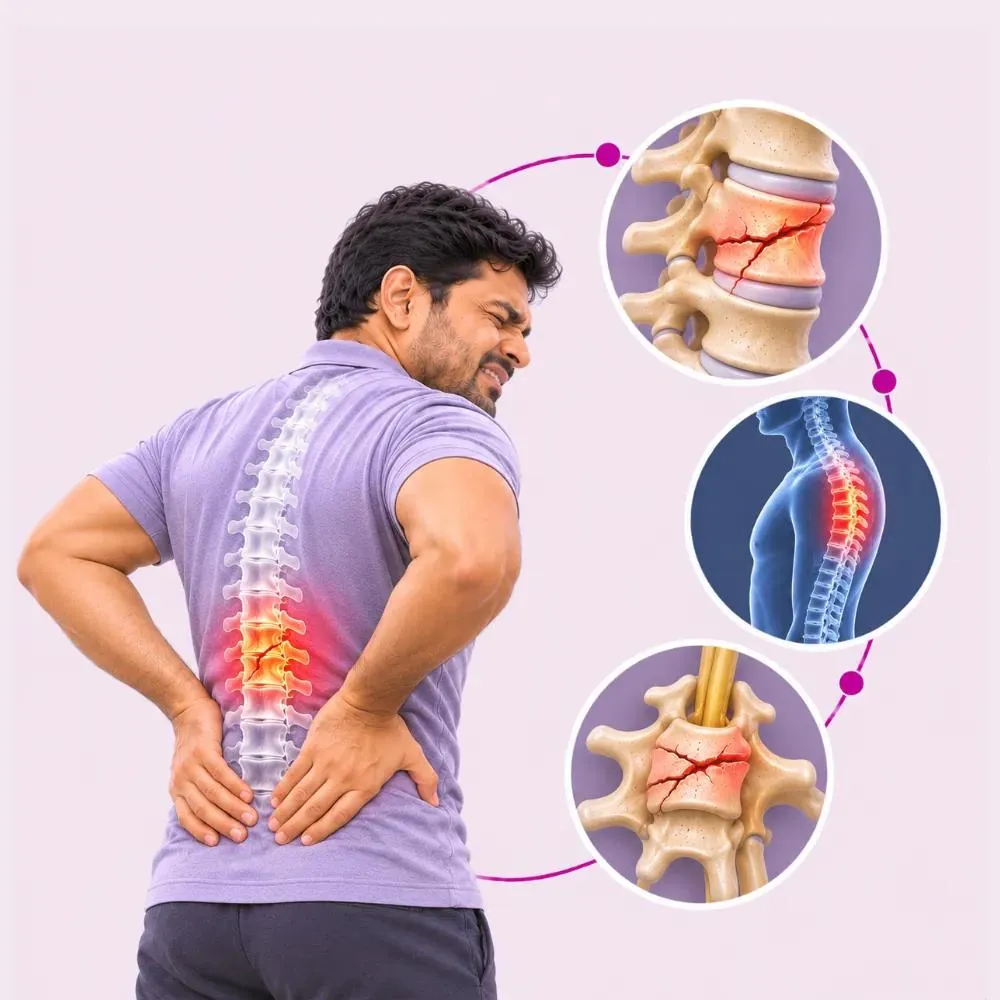
A spine fracture, also known as a vertebral fracture, occurs when one or more bones in the spinal column break or collapse. The spine consists of vertebrae that protect the spinal cord and nerve roots while supporting body movement and stability. Fractures can affect the cervical (neck), thoracic (upper and middle back) or lumbar (lower back) spine, or the sacrum, and may involve the vertebral body, joints, posterior bones or supporting ligaments.
Spine fractures are classified as stable or unstable based on spinal alignment and structural damage. Stable fractures generally maintain spinal stability and may be treated without surgery, while unstable fractures may require surgical stabilisation. A vertebral fracture is different from a spinal cord injury, which involves damage to neurological tissue, but both can occur together, making proper evaluation essential.
Clinicians categorise spine fractures by location, form, mechanism and stability. In a vertebral compression fracture, the vertebral body partially collapses; these commonly affect the thoracic or lumbar spine and may be associated with osteoporosis. A burst fracture involves more extensive compression of the vertebral body, potentially producing multiple bone fragments, some of which may extend towards the spinal canal. Not every burst fracture is unstable, but careful imaging and neurological assessment are important.
A flexion-distraction injury can occur when the spine bends forwards under substantial force; it may involve the bones and supporting ligaments and can produce instability. In a fracture-dislocation, the spine’s alignment is disturbed and stabilising structures are often severely damaged; these injuries are typically unstable and carry a high risk of neurological injury. People with weakened bones may develop an osteoporotic vertebral fracture after minor trauma or ordinary daily activities, causing sudden back pain, loss of vertebral height and changes in posture.
Spinal fractures may occur because of trauma, reduced bone strength or underlying disease.
High-energy collisions can produce substantial forces across the spinal column, causing fractures and associated injuries.
Falls may cause compression, burst or other spinal fracture patterns.
Osteoporosis reduces bone strength and increases the risk of fragility fractures. A vertebral compression fracture can occur after a relatively minor fall or movement.
High-impact activities, falls and collisions can occasionally cause spinal fractures.
Falls, heavy impacts or other occupational accidents may cause traumatic spinal injury.
Certain tumours, infections or metabolic bone conditions can weaken vertebrae and increase fracture risk. These are sometimes called pathological fractures.
Identifying the cause matters because a fracture related to osteoporosis or another disease may need treatment beyond stabilising the bone.
Symptoms depend on the fracture location, severity and whether the spinal cord or nerve roots are affected.
Common symptoms
Emergency warning signs
Some osteoporotic compression fractures cause mild symptoms or are discovered incidentally. Numbness or tingling in the arms or legs, limb weakness, difficulty walking, reduced coordination, changes in sensation and problems with bladder or bowel control suggest nerve or spinal cord involvement. After a suspected significant injury, do not try to straighten the spine or force the person to stand: trained emergency professionals should manage movement and protect the spine.
Spinal fracture diagnosis involves clinical assessment, neurological examination and imaging selected according to how the injury occurred.
The doctor reviews how the injury occurred, when symptoms started and any previous spinal or bone-related conditions. For possible fragility fractures, the doctor may assess osteoporosis risk factors and past fractures.
The clinician evaluates pain, tenderness, spinal alignment and associated injuries. In significant trauma, the examination is performed while maintaining appropriate spinal precautions.
When needed, the doctor assesses muscle strength, reflexes, sensation and other neurological functions. This helps identify possible nerve-root or spinal cord injury.
Spinal X-rays may show vertebral height loss, alignment changes or certain fractures. Their usefulness depends on the spinal region and clinical circumstances.
CT provides detailed images of the spinal bones and is particularly useful in significant trauma or when fracture complexity needs assessment. It can help identify fracture fragments, displacement and changes in alignment.
MRI may be recommended when spinal cord injury, nerve compression, ligament damage or other soft-tissue abnormalities are suspected. In adults with neurological abnormalities attributable to spinal cord injury, MRI is recommended after CT even when the CT does not show an obvious explanation.
The findings help determine the fracture type, whether it is stable and whether nerves or the spinal cord are involved.
Treatment depends on fracture stability, location, spinal alignment, neurological findings and other medical conditions. Not every spinal fracture requires surgery.
Selected stable fractures can be managed through pain control, appropriate activity modification and follow-up. The doctor may recommend repeat imaging when necessary to assess healing or alignment.
The doctor may prescribe suitable medicines to relieve acute pain. Medication selection depends on individual risks, including kidney function, other medical conditions and existing prescriptions.
A cervical collar or thoracolumbar brace may be recommended for selected fractures, with the type and duration depending on the fracture pattern and stability. Not every stable thoracolumbar fracture requires a brace, and evidence does not show a consistent benefit from bracing in every case.
Patients may be advised to avoid heavy lifting, excessive bending or other activities that could aggravate the fracture during healing. Instructions should come from the treating specialist.
Rehabilitation may begin once the fracture is assessed as sufficiently stable. It can include safe mobility, gradual strengthening, balance exercises and functional training.
Patients with fragility fractures may require evaluation and treatment for osteoporosis. This may include prescribed bone-strengthening medicines, nutritional assessment, fall prevention and suitable exercise.
Involves injecting specialised bone cement into a fractured vertebral body. It may be considered for carefully selected patients with severe pain from an appropriate vertebral compression fracture. It is not suitable for every spinal fracture, and its benefits and limitations should be discussed.
Involves introducing a balloon or other device into a selected collapsed vertebra to create a space before injecting bone cement. It may provide pain relief in some patients with symptomatic vertebral compression fractures, and the degree of vertebral height restoration varies. Neither vertebroplasty nor kyphoplasty treats every type of fracture or replaces stabilisation surgery for major instability.
May be required when fracture fragments or other structures compress the spinal cord or nerve roots.
Screws and connecting rods may be used to stabilise selected thoracic or lumbar fractures.
May be performed when long-term stabilisation between spinal levels is necessary.
Selected complex fractures may require reconstruction of a severely damaged vertebral body.
Certain unstable neck fractures require specialised cervical fixation or fusion. The approach depends on the injured vertebral level, neurological findings and associated ligament damage.
Surgery may be considered for unstable fractures, major deformity, significant neurological compression or other structural indications.
The operation depends on the location and pattern of the injury. For selected unstable thoracolumbar fractures, posterior spinal fixation is one established surgical approach.
Posterior Spinal Fixation
The surgeon reviews general medical stability, neurological findings, CT and, if needed, MRI. Other injuries may require treatment before or alongside spinal surgery.
Spinal fixation is commonly performed under general anaesthesia.
The patient is carefully positioned while protecting the injured spine.
The surgeon approaches the affected spinal region using an open or minimally invasive technique as appropriate.
Specialised screws and rods may be placed to support the injured spinal segments.
If neurological structures are compressed, the surgeon may perform an appropriate decompression procedure.
The surgical site is closed, and the patient is monitored for neurological function, pain and postoperative complications.
Not every operation needs direct decompression or fusion: the procedure is tailored to neurological risk, bone quality and fracture stability. Possible risks include infection, bleeding, nerve or spinal cord injury, dural tear, implant-related complications, blood clots, anaesthesia-related complications, persistent pain, failure of fracture healing or fusion, and the need for further surgery. The surgeon should explain the expected benefits, alternatives and risks before obtaining informed consent.
Spinal fractures require careful assessment because treatment decisions depend on stability, fracture pattern and possible neurological involvement.
Appropriate imaging and clinical examination help determine the injury type and severity.
Spinal cord and nerve-root symptoms require timely evaluation.
Many stable fractures can be managed without an operation.
Certain unstable fractures require specialist assessment for fixation, decompression or fusion.
Patients may require mobilisation guidance, physiotherapy and bone-health evaluation during recovery.
Patients can contact Lux Hospitals, Hyderabad, to enquire about available spine consultations.
Recovery depends on the fracture type, stability, age, bone strength and treatment approach. Some uncomplicated compression fractures improve within approximately three months, while complex injuries and neurological deficits may require much longer recovery.
After severe trauma, patients receive appropriate evaluation and stabilisation. For stable fractures, pain management and medically guided movement may start once it is considered safe. After surgery, monitoring focuses on neurological function, wound condition and general recovery.
Patients may gradually begin suitable daily activities, following the treating team’s advice. Some require a brace or mobility assistance.
Pain may gradually improve. Rehabilitation may focus on safe walking, mobility and preventing unnecessary physical deconditioning.
Functional rehabilitation and fracture healing continue. Follow-up imaging may be advised when clinically appropriate.
Some patients gradually return to more physically demanding activities. Longer rehabilitation may be necessary after complex fractures, extensive surgery or neurological damage.
Avoid movements or activities restricted by the treating surgeon.
If a brace is prescribed, follow guidance on fit, duration and skin care.
Early activity may support recovery once stability is established.
Rehabilitation should reflect fracture healing and neurological function.
Osteoporosis evaluation and treatment are important after fragility fractures.
Follow-up may assess pain, movement, fracture alignment and healing.
New weakness, numbness, fever, wound problems or bladder and bowel changes require prompt medical attention.
Persistent neurological problems, chronic pain or spinal deformity may require ongoing specialist care, and patients with osteoporosis may need long-term fracture-prevention treatment.
Seek medical evaluation if:
The cost of spine fracture treatment in Hyderabad depends on the fracture type, severity, investigations and whether non-surgical or surgical care is required. Patients with stable compression fractures may have different treatment requirements from those with unstable fractures or spinal cord injuries.
| Procedure | Estimated Cost |
|---|---|
| Spine Fracture Surgery (Fixation) Stabilises fractured vertebrae using implants to restore spinal stability. | ₹2,50,000 onward |
Stable compression fractures may have different treatment requirements from unstable fractures or those with spinal cord injury.
Displacement, deformity and neurological involvement influence whether decompression, fixation or fusion is needed.
X-ray, CT and MRI are selected according to the injury and the clinical findings.
Observation, bracing, vertebroplasty or kyphoplasty and surgical fixation involve different clinical requirements.
The figure above is an indicative starting price, not a final quotation. After clinical assessment, the hospital can provide a personalised estimate based on the treatment recommended.

Consultant Endoscopic Spine Surgeon
MBBS, MS (Orthopaedics), Fellowship in Spine Surgery (RGUHS)
7 years experience
Common questions about spine fractures, healing, bracing and when fixation surgery is considered.
Still have questions? Call us at 079 6908 4422
Still have questions? Message us on WhatsApp at 079 6908 4444
Spine fracture assessment at Lux Hospitals, HITEC CITY: imaging to judge stability, non-surgical care for suitable fractures, and spinal fixation when it is needed.
Plot No.116, Lumbini Avenue, HITEC CITY, Near IKEA, Hyderabad – 500032













