



Dr. Samhitha Reddy
Consultant Proctologist & Laparoscopic Surgeon
MBBS, MS, FMAS, FISCP, DMAS
- 8 Yrs
- ASCRS Member
Breast augmentation increases breast size and improves shape using implants or your own transferred fat. It is one of the most commonly performed cosmetic operations worldwide.
It is also a long-term commitment rather than a one-off procedure, because implants do not last a lifetime and will eventually need replacing. Our plastic surgeon at Lux Hospitals, HITEC CITY sets that out clearly before you decide, alongside everything else the operation involves.
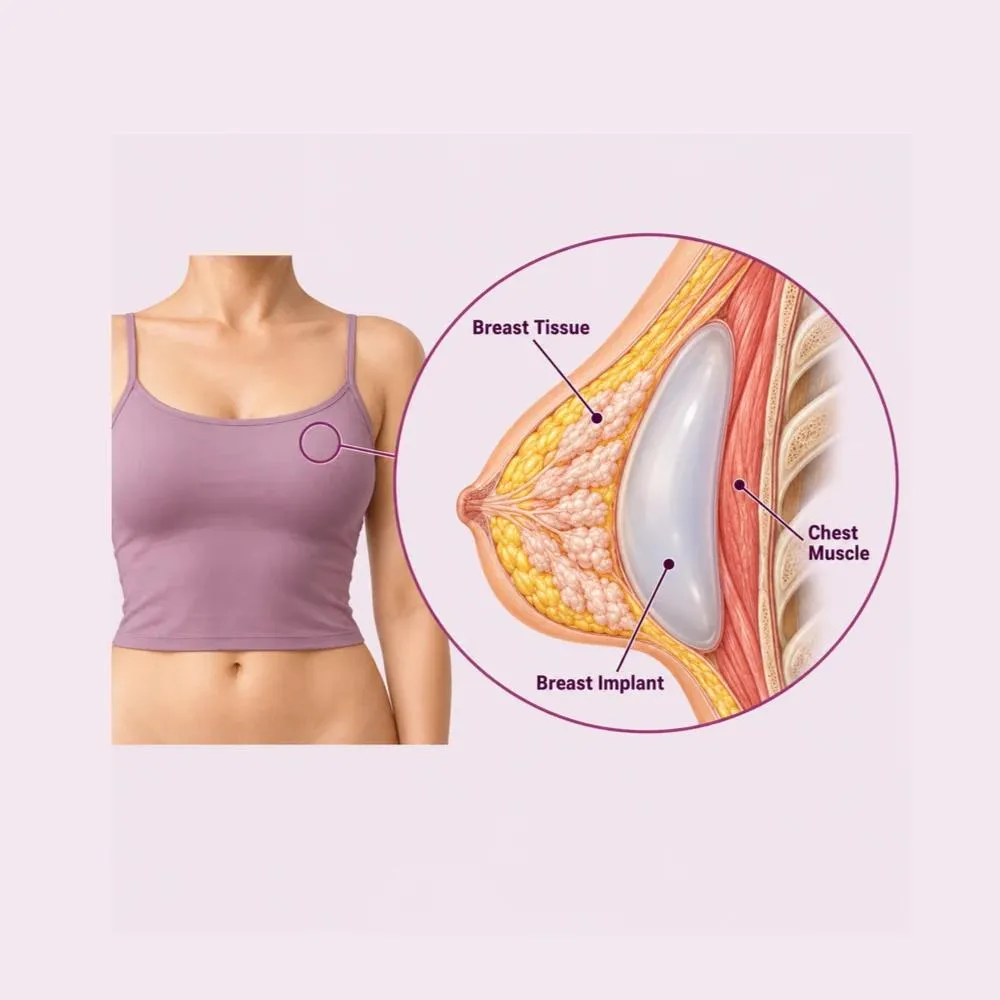
Breast augmentation enlarges the breast either by placing an implant beneath the breast tissue or muscle, or by transferring fat harvested from elsewhere on your body. Implants give a predictable, substantial increase in size; fat transfer gives a modest, natural increase using your own tissue, and how much of the transferred fat survives is not entirely predictable.
Modern implants are silicone shells filled either with cohesive silicone gel or with saline. Cohesive gel is what most patients receive today: it holds its shape, feels closer to natural breast tissue, and does not leak in the way older devices could. They are placed either in front of the pectoral muscle or partly behind it, a choice made on your own tissue thickness rather than on preference alone.
The single most important thing to understand before proceeding is that implants are not permanent devices. They have a finite lifespan, commonly ten to fifteen years, and will at some point need replacing or removing. Anyone considering augmentation in their twenties should expect further surgery during their lifetime, and that should form part of the decision rather than be discovered later.
Breast size and shape change through life for reasons largely outside your control.
Breast size, shape and the proportion of glandular tissue to fat are substantially inherited and set during puberty.
Breasts enlarge then involute afterwards, frequently leaving less volume and looser skin than before: the commonest reason women present.
Breasts are largely fat, so significant weight loss reduces volume disproportionately and leaves the skin envelope loose.
Glandular tissue is replaced by fat and skin elasticity declines, so breasts lose both firmness and projection over time.
A degree of asymmetry is normal in most women. Marked asymmetry can be corrected with different implant sizes on each side.
Volume lost after lumpectomy or mastectomy, where augmentation forms part of reconstruction rather than pure cosmetic surgery.
No cream, supplement, exercise or device increases breast size. The pectoral muscle sits behind the breast rather than within it, so chest exercise changes the underlying platform but not the breast itself.
Augmentation suits specific goals. Being clear about what you want is what makes the result satisfying.
Common reasons
Where it should be deferred
Where breasts have sagged as well as lost volume, an implant alone makes a fuller but still low breast. That situation needs a lift, either instead of or alongside the implant, and it is worth understanding before you choose.
The assessment matches implant choice to your own anatomy, which is what determines whether the result looks natural.
Chest wall width, breast base diameter, tissue thickness, nipple position and degree of sagging: all of which constrain what implant will suit you.
Size, shape, profile and placement chosen against your measurements. An implant wider than your breast base looks obviously artificial.
Thin tissue shows implant edges and rippling, and often means placing the implant partly behind the muscle rather than in front.
A baseline mammogram or ultrasound where age or family history warrants it, before implants make future imaging more complex.
Bloods, clotting profile, ECG and anaesthetic review, with smoking cessation for at least four weeks beforehand.
A frank discussion of implant lifespan, the likelihood of further surgery, and the effect on future mammograms and breastfeeding.
Sizers and photographs help, but the honest answer is that your final size is constrained by your own chest measurements. A surgeon who agrees to any size you ask for regardless of anatomy is not doing you a favour.
Two broad approaches, with several decisions within each: implant type, placement and incision.
Fat harvested by liposuction, purified and injected into the breast. Natural feel, no implant, and it contours the donor area at the same time.
A modest increase, typically around one cup size per session. It cannot deliver a large augmentation, and expecting that leads to disappointment.
Roughly sixty to seventy per cent of transferred fat survives long term; the rest is reabsorbed. More than one session is often needed.
You need adequate donor fat. Very slim women often do not have enough to harvest for a meaningful result.
The most commonly used today. They hold their shape, feel closest to natural tissue, and do not leak as older devices could.
Filled with sterile salt water after placement, allowing a smaller incision. Less natural in feel and more prone to visible rippling.
In front of the pectoral muscle. Shorter recovery and less discomfort, but requires adequate tissue cover or the edges show.
Partly behind the muscle, giving better upper-pole cover in thin women and interfering less with mammography. Recovery is more uncomfortable.
In the fold beneath the breast. The most commonly used approach, giving the best access and a scar hidden in the crease.
Combined mastopexy and augmentation where breasts have sagged as well as lost volume: a larger operation with more scars.
Fat transfer is genuinely appealing: your own tissue, no device, no replacement surgery. Its limitation is size: it delivers around a cup, not a dramatic change, and pretending otherwise sets patients up to be disappointed.
The operation takes sixty to ninety minutes for implants, or two to three hours with fat transfer.
Day-care or overnight surgery under general anaesthesia
Stopping smoking for at least four weeks, fasting from midnight, antibiotics given at induction and clot prevention arranged.
The breast fold, midline and implant pocket boundaries marked with you sitting upright, since these shift when lying down.
General anaesthesia. An incision of four to five centimetres, usually in the fold beneath the breast.
A pocket made either beneath the breast tissue or partly behind the pectoral muscle, sized precisely to the implant so it sits correctly.
The implant inserted using a no-touch technique with a funnel, minimising contact and reducing the risk of capsular contracture.
You are sat upright during surgery to compare sides and confirm position, projection and the level of the fold.
Closed in layers with absorbable sutures and a surgical bra fitted immediately, worn continuously for several weeks.
No-touch technique with a funnel, antibiotic irrigation and minimal handling all exist to reduce capsular contracture: the commonest long-term complication, in which scar tissue around the implant tightens and distorts it.
This is a decision with lifelong consequences, and it deserves honest counselling. Here is why patients trust us:
Performed by a trained plastic surgeon with anaesthetic support and proper sterile conditions, which matters particularly with implants.
Implant lifespan, the likelihood of further surgery, and the effect on mammography and breastfeeding: all set out before you decide.
From the first consultation through to post-treatment follow-up, with one team throughout.
Our hospital is in HITEC CITY, near IKEA: easily reachable from across Hyderabad.
Most women return to desk work within a week. Implants take three to six months to settle into position.
Tightness and soreness across the chest, more pronounced with submuscular placement. Controlled with regular painkillers.
Discomfort settles steadily. Most women return to desk work at around one week. Surgical bra worn continuously.
Light activity resumes. No upper body exercise or lifting until six weeks so the implant pocket heals without disturbance.
Implants begin dropping into their natural position and softening. Full exercise resumes.
Final shape established. Implants have settled, swelling resolved, and scars begin fading.
They look high, tight and unnaturally round for the first weeks, then drop and soften over three to six months. This is expected, not a bad result.
Continuously for six weeks. It supports the implants while the pocket heals and helps them settle into the correct position.
Chest exercise in particular can displace an implant before the pocket has healed. Walking is encouraged from day one.
Brand, size, batch number and date. You will need these for future surgery, and the warranty depends on them.
Mammography needs special views to image breast tissue around an implant. Screening remains possible but must be adapted.
A breast becoming hard, changing shape or developing new pain months later suggests capsular contracture and needs assessment.
Implants are not lifetime devices. Plan on replacement or removal at some point, commonly ten to fifteen years, and factor that into the decision rather than treating it as a distant hypothetical.
A consultation is worthwhile if any of the following apply.
Implant cost is a substantial part of the total, and it is worth knowing what device you are getting.
| Procedure | Estimated Cost |
|---|---|
| Consultation Includes measurement and planning | ₹800 – ₹1,500 |
| Pre-operative workup Bloods, ECG, imaging, anaesthetic review | ₹5,000 – ₹12,000 |
| Augmentation with silicone implants Includes implants; day care or one night | ₹2,20,000 – ₹4,00,000 |
| Premium or anatomical implants Higher-specification devices | ₹3,00,000 – ₹5,00,000 |
| Fat transfer augmentation Includes liposuction harvest; may need repeating | ₹2,50,000 – ₹4,20,000 |
| Augmentation with breast lift Combined procedure | ₹3,50,000 – ₹5,80,000 |
| Implant replacement or removal Expect this eventually | ₹1,80,000 – ₹3,50,000 |
| Surgical bra and garments Worn for six weeks | ₹3,000 – ₹8,000 |
Devices vary considerably in cost. Ask which brand is being used and what warranty it carries: this is a significant part of the total.
Fat transfer costs more in theatre time but avoids implant costs and future replacement. It delivers a smaller increase.
Combining augmentation with mastopexy is a considerably larger operation with more scars and a higher cost.
A shared ward, a twin-sharing room or a private suite: the largest single swing in most estimates.
We are empanelled with most major insurers, and our team files the pre-authorisation for you.
Every figure above is an indicative range, not a quote. After your consultation you are given a written, fixed-cost estimate, and that is the number you pay, with no additions once treatment begins.
The plastic surgeon who performs breast augmentation at our HITEC CITY hospital.

Consultant Plastic & Cosmetic Surgeon
MBBS, MS, MCh (Plastic Surgery)
16 years experience
Reviews from patients treated for cosmetic and plastic surgery at Lux Hospitals, Hyderabad.
Written by Dr. M. Ram Prabhu on plastic and cosmetic surgery.
Dr. M. Ram Prabhu

Dr. M. Ram Prabhu

Dr. M. Ram Prabhu

Dr. M. Ram Prabhu
Dr. M. Ram Prabhu

Dr. M. Ram Prabhu
Common questions about breast augmentation, implants, fat transfer and costs at Lux Hospitals.
Still have questions? Call us at 079 6908 4422
Still have questions? Message us on WhatsApp at 079 6908 4444
Implant and fat transfer options explained with the long-term implications set out honestly, and costs shared upfront.
Plot No.116, Lumbini Avenue, HITEC CITY, Near IKEA, Hyderabad – 500032













