











Knee Arthroscopy vs Open Knee Surgery: What’s the Difference?
If you have persistent knee pain, a sports injury, or a damaged knee joint, your doctor may recommend surgery. Many patients are unsure whether knee arthroscopy vs. open knee surgery is the better option. Both procedures are designed to treat knee problems, but they differ significantly in terms of surgical technique, recovery time, pain, and suitability for different conditions. Understanding the differences between open knee surgery and knee arthroscopy helps patients make well-informed treatment decisions. Based on the severity of each patient’s knee issue and unique lifestyle requirements, skilled orthopaedic surgeons at Lux Hospitals carefully assess each patient and provide the best surgical solution.

What is Knee Arthroscopy?
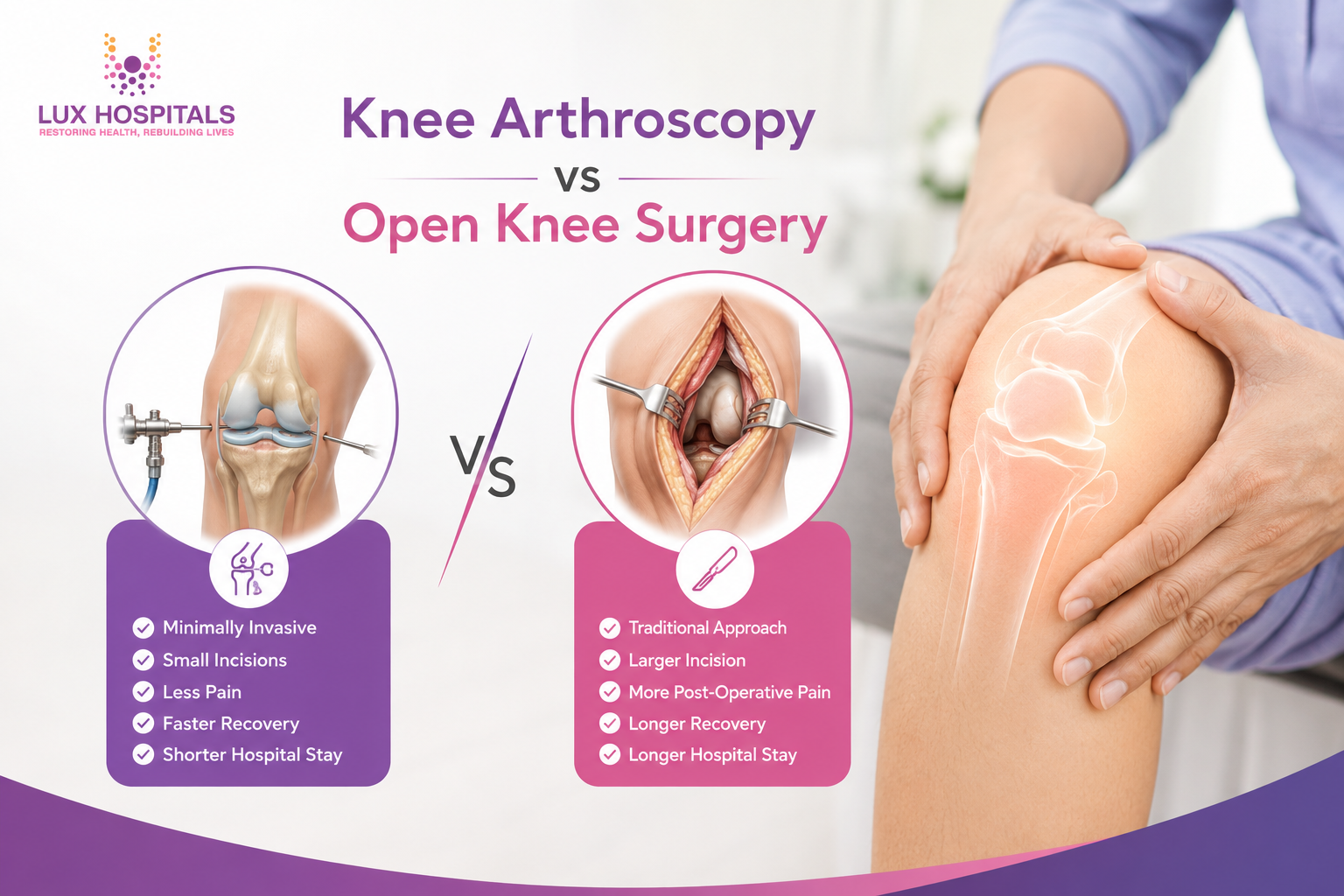
Knee Arthroscopy is a minimally invasive surgical procedure performed using a tiny camera called an arthroscope. The surgeon inserts the camera and specialised instruments through small incisions to diagnose and treat problems inside the knee joint.
Common conditions treated with arthroscopy include:
- Torn meniscus
- ACL and PCL injuries
- Cartilage damage
- Loose bone or cartilage fragments
- Inflamed joint lining
- Early arthritis evaluation
Because the incisions are small, patients usually experience less pain, minimal scarring, and faster recovery.
What is Open Knee Surgery?
Open knee surgery involves making a larger incision to directly access the knee joint. This approach allows surgeons to perform complex procedures that cannot be performed solely with arthroscopy.
Open surgery is commonly recommended for:
- Total knee replacement
- Complex fractures
- Severe ligament reconstruction
- Advanced osteoarthritis
- Large bone deformities
- Tumour removal around the knee
Although recovery takes longer, open surgery provides excellent outcomes for severe knee conditions.
Knee Arthroscopy vs Open Knee Surgery: Key Differences
Understanding Knee Arthroscopy vs Open Knee Surgery requires comparing several important factors.
Surgical Technique
Knee Arthroscopy
The surgeon makes two or three tiny incisions and inserts a miniature camera along with specialised instruments to repair damaged tissues.
Open Knee Surgery
A larger incision is made to fully expose the knee joint, allowing surgeons to perform extensive repairs or replacement procedures.
Incision Size
- Arthroscopy: Small incisions (approximately 0.5–1 cm)
- Open Surgery: Larger incision (typically 10–20 cm)
Smaller incisions generally mean less tissue damage and faster healing.
Recovery Time
One of the biggest advantages of Knee Arthroscopy vs Open Knee Surgery is the speed of recovery.
Knee Arthroscopy
- Walking within a day or two
- Return to desk work in 1–2 weeks.
- Sports recovery takes several weeks, depending on the injury.
Open Knee Surgery
- Hospital stay of several days
- Recovery may take several months.
- Physical therapy is often more extensive.
Compare Your Knee Surgery Options
Benefits of Knee Arthroscopy
When comparing knee arthroscopy vs. open knee surgery, arthroscopy offers several advantages for suitable patients.
Advantages
- Smaller incisions
- Less pain after surgery
- Lower risk of infection
- Minimal blood loss
- Faster recovery
- Short hospital stay
- Better cosmetic results
- Return to daily activities earlier.
Many athletes and active individuals prefer arthroscopy whenever medically appropriate.
Benefits of Open Knee Surgery
For many advanced knee issues, open surgery is still the best option despite being more intrusive.
Advantages
- Suitable for severe joint damage
- Better access for complex procedures
- Ideal for total knee replacement
- Long-term relief for advanced arthritis
- Allows reconstruction of severely damaged structures
The orthopaedic specialists at Lux Hospitals recommend open surgery only when it offers the best chance for lasting recovery.
Which Procedure Is Right for You?
Choosing between knee arthroscopy and open knee surgery depends on several factors.
Your doctor will consider:
- Age
- Activity level
- Severity of injury
- Type of knee damage
- Arthritis stage
- Overall health
- Previous knee surgeries
For example:
Arthroscopy is often recommended for:
- Meniscus tears
- ACL injuries
- Cartilage repair
- Loose bodies inside the knee
Open surgery is usually recommended for:
- Knee replacement
- Complex fractures
- Severe osteoarthritis
- Major ligament reconstruction
Only a thorough orthopaedic evaluation can determine the most suitable procedure.
Risks of Both Procedures
Like all surgeries, both options carry certain risks.
Possible Risks
- Infection
- Blood clots
- Bleeding
- Swelling
- Joint stiffness
- Nerve injury
- Persistent pain
- Delayed healing
Choosing an experienced surgical team significantly reduces these risks.
Recovery After Knee Surgery
Recovery depends on whether Knee Arthroscopy vs Open Knee Surgery is performed.
Recovery Tips
- Attend all physiotherapy sessions.
- Follow medication instructions carefully.
- Keep the wound clean and dry.
- Avoid high-impact activities until approved.
- Maintain a healthy weight.
- Eat a protein-rich diet.
- Perform prescribed strengthening exercises.
At Lux Hospitals, every patient receives a personalised rehabilitation program to regain mobility safely and effectively.
Why Choose Lux Hospitals for Knee Surgery?
When considering knee arthroscopy vs. open knee surgery, choosing the right hospital is just as important as selecting the procedure.
At Lux Hospitals, patients benefit from:
- Experienced orthopedic surgeons
- Advanced arthroscopic technology
- Modern operating theatres
- Comprehensive rehabilitation services
- Personalised treatment plans
- Minimally invasive surgical expertise
- Compassionate patient care
- Complete follow-up support
Whether you need arthroscopy or open knee surgery, Lux Hospitals focuses on delivering excellent outcomes with patient-centred care.
Conclusion
Understanding the differences between Knee Arthroscopy and Open Knee Surgery is essential before making a treatment decision. Open surgery is still the best choice for complicated injuries and joint replacement procedures, but arthroscopy provides a quicker recovery, smaller incisions, and less postoperative pain for appropriate knee problems. The best lifestyle, lifestyle, lifestyle. Our orthopaedic specialists at Lux Hospitals offer precise diagnosis, cutting-edge surgical knowledge, and thorough rehabilitation to help you restore mobility and confidently resume your everyday activities.
Frequently Asked Questions
In general, neither process is superior. The kind and severity of your knee issue will determine whether you need open knee surgery or knee arthroscopy. While open surgery is frequently required for complex injuries and total knee replacement, arthroscopy is the best option for many less invasive treatments.
Most patients experience only mild to moderate discomfort after arthroscopy because the procedure uses very small incisions. Pain is generally well managed with medication, and recovery is usually much faster than with open surgery.
Depending on the surgery, recovery is different. While open surgery may necessitate several months of rehabilitation and physical therapy for the best possible recovery, arthroscopy may enable patients to resume their regular activities in a few weeks.
Some people with early-stage arthritis may benefit from knee arthroscopy, which can remove loose cartilage or repair mild damage. However, severe arthritis sometimes requires extensive surgery or a total knee replacement for long-term care.
Indeed. Following both arthroscopic and open surgery, physiotherapy is essential because it increases strength, restores flexibility, lessens stiffness, and speeds up patients' return to normal knee function.
Lux Hospitals provides cutting-edge orthopaedic care with skilled surgeons, cutting-edge arthroscopic tools, individualised treatment regimens, and committed rehabilitation programs. Every single patient receives an extensive, comprehensive diagnosis.
Yes. Lux Hospitals specialises in minimally invasive knee arthroscopy for eligible patients and also performs advanced open knee surgeries when clinically indicated. Our orthopaedic team recommends the safest and most effective procedure based on each patient's condition.