Dr. Samhitha Reddy
Consultant Proctologist & Laparoscopic Surgeon
MBBS, MS, FMAS, FISCP, DMAS
- 8 Yrs
- ASCRS Member
Gynecomastia is enlargement of the male breast from glandular tissue rather than fat. It affects a substantial proportion of men, and it does not respond to exercise or weight loss.
That is the crucial point: glandular tissue is not fat, and no amount of chest training removes it. Our plastic surgeon at Lux Hospitals, HITEC CITY distinguishes true gynecomastia from fat, treats it as day-care surgery, and keeps the whole thing confidential.
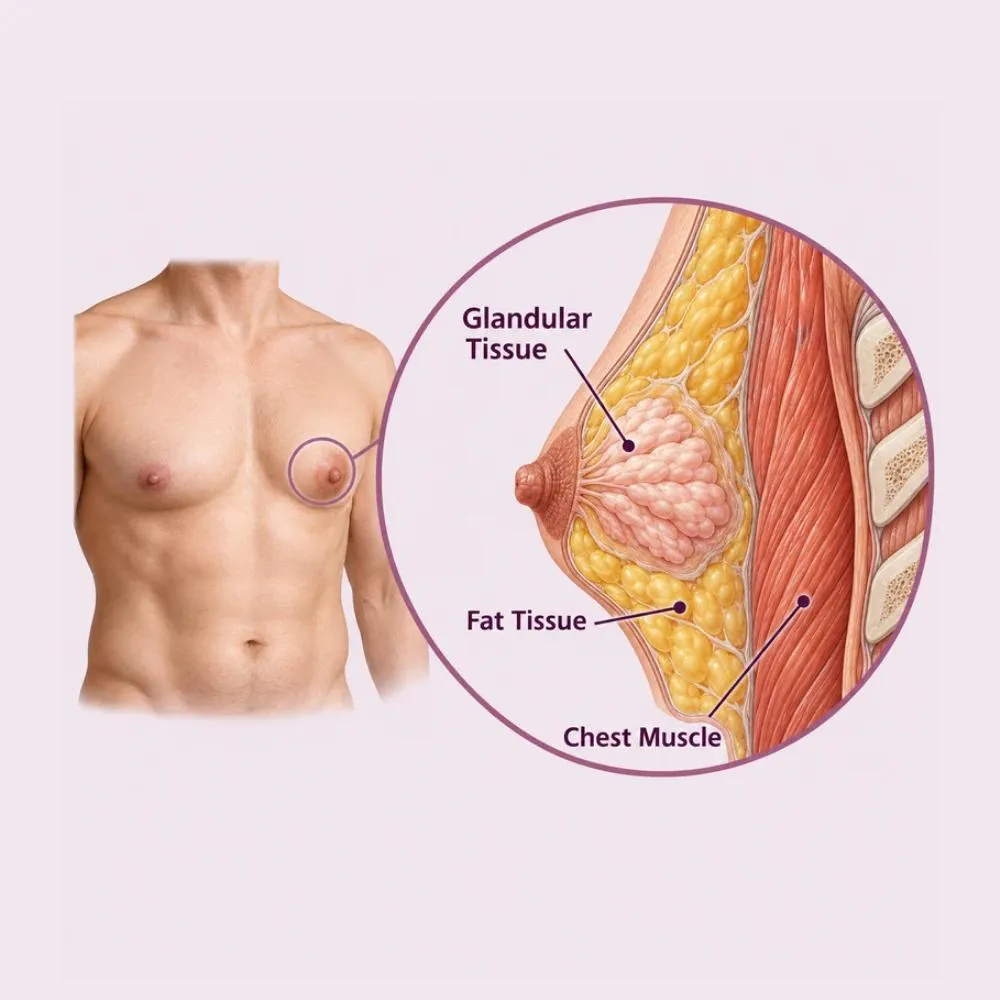
Gynecomastia is enlargement of the glandular breast tissue in men, caused by an imbalance between oestrogen and testosterone. Every man produces small amounts of oestrogen; when that balance shifts, the breast tissue responds by proliferating exactly as it would in a woman. The result is a firm, sometimes tender disc of tissue beneath the nipple.
It must be distinguished from pseudogynecomastia, which is simply fat deposition on the chest with no glandular component. The two feel quite different: glandular tissue is firm, rubbery and concentrated under the areola, while fat is soft and diffuse. Many men have both. The distinction matters because fat responds to weight loss and liposuction, whereas glandular tissue responds to neither and must be cut out.
It is far more common than most men realise, affecting a substantial proportion at some point in life, with peaks during puberty and again in later middle age. Pubertal gynecomastia usually resolves on its own within two years. Persistent gynecomastia in an adult, present for more than a year, has usually become fibrotic and will not regress, which is when surgery becomes the reasonable answer.
Anything shifting the balance between oestrogen and testosterone can cause it, and in many cases no cause is ever found.
Hormonal fluctuation during adolescence causes gynecomastia in a large proportion of boys. It usually resolves spontaneously within one to two years.
In a substantial proportion of adult cases no cause is identified despite full investigation. This does not make it less real or less treatable.
Anabolic steroids, spironolactone, some antipsychotics, cimetidine, finasteride and certain antiretrovirals are all recognised causes.
Excess testosterone is converted to oestrogen in the body. A common and frequently unmentioned cause in men who train, and the gland persists after stopping.
Fat tissue converts testosterone to oestrogen, so higher body fat both adds chest fat and promotes genuine glandular growth.
Impaired hormone metabolism raises circulating oestrogen. Chronic liver disease in particular is a well-recognised cause.
Low testosterone, thyroid disease and, rarely, testicular or adrenal tumours, which is why hormonal testing is part of the assessment.
Testosterone declines and body fat rises with age, shifting the balance and producing the second peak of incidence in later middle age.
Anabolic steroid use is one of the commonest causes seen in men who train, and it is frequently not volunteered. It is worth mentioning: the consultation is confidential, and it genuinely changes the assessment.
The characteristic finding is firm tissue concentrated beneath the nipple, quite unlike diffuse chest fat.
Typical features
Features needing prompt assessment
Male breast cancer is rare but it exists, and it presents as a hard fixed lump rather than the soft rubbery disc of gynecomastia. Any atypical feature warrants imaging rather than reassurance.
The assessment confirms it is glandular, looks for a treatable cause, and excludes anything sinister.
Distinguishing firm glandular tissue beneath the areola from soft diffuse fat, assessing symmetry, skin excess and nipple position.
Graded one to four by the amount of tissue and degree of skin excess, which determines whether skin needs removing alongside the gland.
Testosterone, oestradiol, LH, FSH, prolactin and hCG, plus thyroid, liver and kidney function, looking for a treatable underlying cause.
A full list including supplements and anabolic steroids, since a drug cause identified early may make surgery avoidable.
Where the lump is hard, fixed, one-sided or atypical, to exclude male breast cancer before proceeding.
Part of the standard assessment, since a testicular tumour is a rare but important cause that must not be missed.
Gynecomastia present for less than a year may still regress, particularly if a drug cause is found and stopped. Beyond a year the tissue has become fibrotic, and surgery is the only thing that will remove it.
Recent gynecomastia may respond to treating its cause. Established fibrotic tissue needs surgical removal.
Pubertal gynecomastia resolves spontaneously in the large majority within one to two years. Surgery is generally deferred until then.
Where a medication or anabolic steroid is responsible and the tissue is recent, stopping it may allow regression.
Correcting low testosterone, thyroid disease or liver dysfunction, which sometimes resolves recent glandular growth.
Effective for pseudogynecomastia (chest fat) and reduces oestrogen conversion. It does not remove glandular tissue.
Can reduce recent, painful gynecomastia within the first six to twelve months. Ineffective once the tissue has become fibrotic.
The disc of glandular tissue removed through a small incision at the lower edge of the areola. Essential: liposuction alone cannot remove it.
Ultrasound-assisted liposuction of the surrounding fat, which contours the chest and blends the edges. Well suited to the fibrous male chest.
The standard operation: gland cut out and fat suctioned, addressing both components in one procedure.
For higher grades with significant skin excess, removing skin alongside the gland. It leaves a longer scar but gives a flat result.
In severe cases the nipple is repositioned to a natural male location on the chest wall.
Liposuction alone is the classic mistake here and produces a characteristic result: the fat goes, but the firm disc under the nipple remains and becomes more obvious. Excising the gland is not optional.
The operation takes sixty to ninety minutes and you go home the same day.
Day-care surgery under general anaesthesia
Stopping smoking and any anabolic steroids well beforehand, fasting from midnight, and antibiotics given at induction.
The extent of glandular tissue and the areas to be liposuctioned marked with you standing, so the surgeon works to an accurate map.
General anaesthesia, or local anaesthesia with sedation for smaller cases.
VASER or standard liposuction of the chest and the edges toward the armpit, done first so the gland is better defined.
A small incision at the lower border of the areola, through which the glandular disc is dissected out and removed.
A thin layer of tissue deliberately left beneath the nipple. Removing everything causes a visible crater: this judgement is what separates a good result from a poor one.
The incision closed with fine sutures within the areolar border so the scar is inconspicuous, and a compression vest fitted immediately.
Over-resection beneath the nipple leaves a saucer-shaped depression that is considerably harder to correct than leaving a little extra tissue. Restraint at this step is deliberate.
This is a procedure men delay for years out of embarrassment. Here is why patients trust us:
Private consultations where anabolic steroid use and other contributing factors can be discussed openly and without judgement.
Glandular excision combined with liposuction, rather than liposuction alone, which leaves the firm disc behind and looks worse.
From the first consultation through to post-treatment follow-up, with one team throughout.
Our hospital is in HITEC CITY, near IKEA: easily reachable from across Hyderabad.
Most men return to desk work within a week. The final chest contour settles over three to six months.
Soreness like heavy bruising, controlled with simple painkillers. Compression vest worn continuously from the moment of surgery.
Bruising and swelling peak then settle. Most men return to desk work at around one week.
Swelling reduces steadily. Light cardiovascular exercise resumes at two to three weeks. Compression continues.
Chest and upper body training resumes at six weeks. Most swelling has settled and the contour becomes apparent.
Final result established. Firmness under the skin softens and the areolar scar fades to a fine line.
Continuously for the first two weeks and most of the day for four to six. It controls swelling, prevents fluid collections and shapes the result.
If steroids caused it, resuming them will cause it to recur. Surgery removes the gland but not the mechanism that produced it.
Light walking from day one and cardiovascular exercise at two to three weeks, but chest and upper body work waits until six.
Swelling and firmness under the skin persist for weeks. Assessing the contour too early causes needless worry about a result still settling.
The gland does not regrow, but chest fat can return with weight gain and will look similar. Weight stability preserves the result.
Rapid one-sided swelling suggests a haematoma and needs same-day review. Fever or spreading redness suggests infection.
The glandular tissue removed does not grow back, so recurrence is uncommon, unless the original cause returns. In practice that almost always means anabolic steroids or substantial weight gain.
A consultation is worthwhile if any of the following apply.
This is day-care surgery, so the cost is predictable and there is no extended stay.
| Procedure | Estimated Cost |
|---|---|
| Consultation Private and confidential | ₹800 – ₹1,500 |
| Hormonal blood tests Testosterone, oestradiol, LH, FSH, prolactin, thyroid | ₹3,000 – ₹8,000 |
| Ultrasound or mammography Where the lump is atypical | ₹2,000 – ₹5,000 |
| Pre-operative workup Bloods, ECG, anaesthetic review | ₹4,000 – ₹9,000 |
| Grade 1–2 surgery Excision with liposuction, day care | ₹1,10,000 – ₹1,90,000 |
| Grade 3–4 surgery Includes skin excision | ₹1,80,000 – ₹3,00,000 |
| VASER-assisted surgery Includes technology charges | ₹1,60,000 – ₹2,60,000 |
| Compression vest Worn for four to six weeks | ₹2,500 – ₹6,000 |
Lower grades are straightforward day-care surgery. Higher grades needing skin excision take longer and leave a longer scar.
Hormonal testing is standard. Imaging is added where the lump is hard, one-sided or otherwise atypical.
VASER-assisted liposuction carries technology charges above standard technique but handles the fibrous male chest more effectively.
A shared ward, a twin-sharing room or a private suite: the largest single swing in most estimates.
We are empanelled with most major insurers, and our team files the pre-authorisation for you.
Every figure above is an indicative range, not a quote. After your consultation you are given a written, fixed-cost estimate, and that is the number you pay, with no additions once treatment begins.
The plastic surgeon who performs gynecomastia surgery at our HITEC CITY hospital.

Consultant Plastic & Cosmetic Surgeon
MBBS, MS, MCh (Plastic Surgery)
16 years experience
Reviews from patients treated for cosmetic and plastic surgery at Lux Hospitals, Hyderabad.
Written by Dr. M. Ram Prabhu on plastic and cosmetic surgery.

Dr. M. Ram Prabhu

Dr. M. Ram Prabhu

Dr. M. Ram Prabhu

Dr. M. Ram Prabhu
Dr. M. Ram Prabhu

Dr. M. Ram Prabhu
Common questions about gynecomastia surgery, recovery and what it costs at Lux Hospitals.
Still have questions? Call us at 079 6908 4422
Still have questions? Message us on WhatsApp at 079 6908 4444
Gynecomastia assessed properly and treated as day-care surgery, privately and with costs shared upfront.
Plot No.116, Lumbini Avenue, HITEC CITY, Near IKEA, Hyderabad – 500032