Dr. Samhitha Reddy
Consultant Proctologist & Laparoscopic Surgeon
MBBS, MS, FMAS, FISCP, DMAS
- 8 Yrs
- ASCRS Member
A tummy tuck removes excess abdominal skin and fat and repairs the separated abdominal muscles underneath. It is the operation for an abdomen that no amount of exercise will flatten.
The reason exercise fails is usually structural rather than a matter of effort: stretched skin does not shrink and separated muscles do not rejoin on their own. Our plastic surgeon at Lux Hospitals, HITEC CITY assesses which of those applies to you before recommending anything.
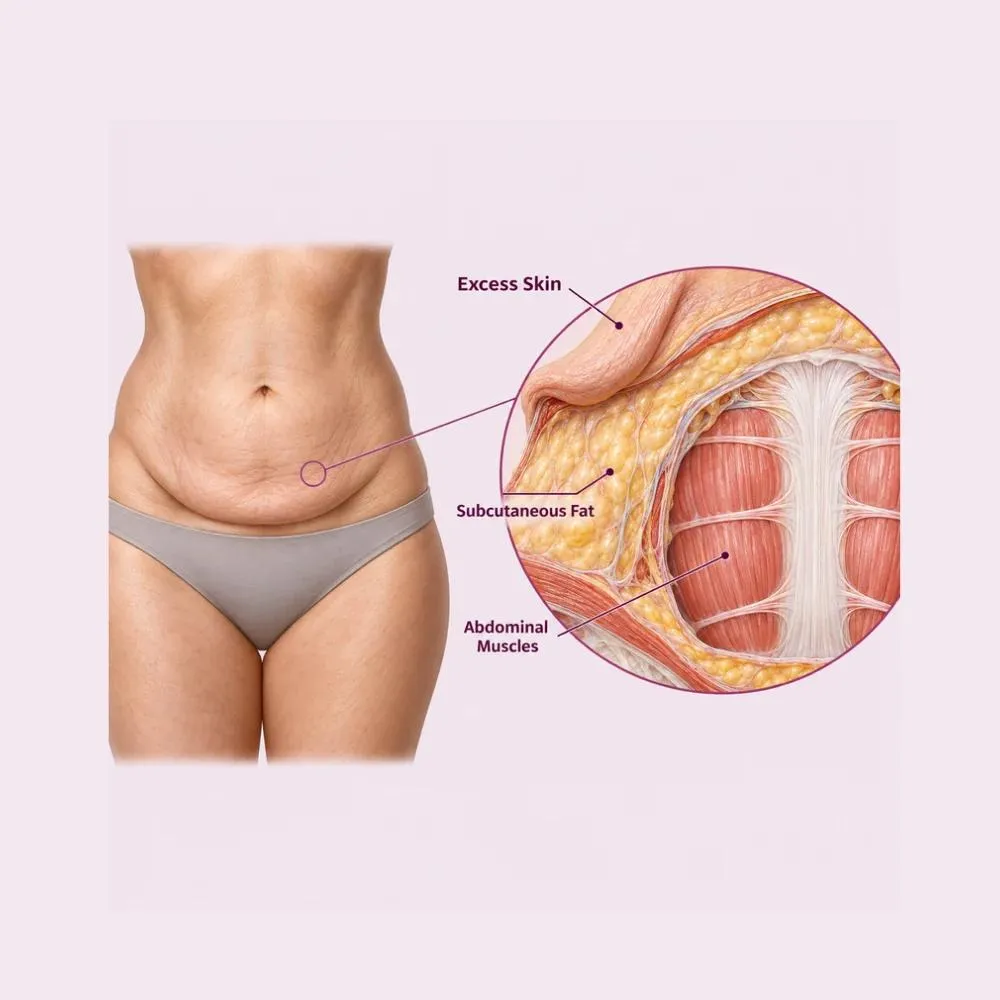
Abdominoplasty removes excess skin and fat from the lower abdomen and, in most cases, repairs the separation of the abdominal muscles beneath. That second element is what distinguishes it from liposuction and is frequently the more important half of the operation.
Rectus diastasis, separation of the two vertical abdominal muscles, occurs when pregnancy or substantial weight gain stretches the connective tissue joining them. Once separated they do not come back together with exercise, because the tissue between them has permanently stretched. The abdominal wall then bulges outward regardless of how strong the muscles themselves become, which is why so many women find sit-ups make no difference after childbirth.
A tummy tuck addresses skin, fat and muscle together. Liposuction alone removes fat but leaves loose skin looser and does nothing for muscle separation. Understanding which of the three is your actual problem determines which operation you need, and getting that wrong is the commonest reason a result disappoints.
The structural changes behind a protruding abdomen are largely mechanical and not reversible by exercise.
Stretches skin and separates the abdominal muscles. The connective tissue between them does not fully recover, particularly after multiple or large pregnancies.
Permanent separation of the vertical abdominal muscles. The wall bulges outward regardless of muscle strength, and exercise cannot close the gap.
Skin stretched over years does not retract when the volume beneath it goes. This is the commonest reason after bariatric surgery.
Collagen and elastin decline with age, so skin that would once have retracted no longer does.
Caesarean scars and other incisions can tether the skin, creating an overhang above the scar that no exercise addresses.
Skin quality, collagen strength and fat distribution are all substantially inherited, which is why outcomes after identical pregnancies differ so much.
If your abdomen is firm and protrudes rather than hanging loose, the fat is visceral and inside the abdominal cavity. No operation reaches it safely: that responds to weight loss, and surgery would not help.
A tummy tuck is a major operation with a real recovery. It suits a specific problem rather than general dissatisfaction.
Good candidates
Where it should be deferred
A pregnancy after a tummy tuck stretches the repaired muscles and skin again, largely undoing the result. It is safe to become pregnant, but it is worth completing your family first if you can.
The assessment establishes what is causing your abdominal shape and which operation, if any, addresses it.
Assessing skin excess, fat distribution and the degree of muscle separation, both lying flat and standing.
Feeling for the gap between the muscles while you lift your head. The width of that gap determines whether muscle repair is needed.
Pinching the abdominal wall to separate subcutaneous fat, which can be addressed, from visceral fat, which cannot.
Reviewing previous surgery, and checking for umbilical or incisional hernias that can be repaired at the same time.
Bloods, clotting profile, blood sugar, ECG, chest X-ray and anaesthetic review: this is major surgery and the workup reflects that.
A tummy tuck leaves a permanent hip-to-hip scar. Where it will sit and what it will look like is discussed and marked before you consent.
The scar is the trade-off, and it is permanent. It sits low enough to be covered by underwear, but it is long and it does not disappear: anyone who suggests otherwise is not being straight with you.
Four variations, chosen by how much skin is excess and whether muscle repair is needed.
Surgery at a stable weight gives a better and more durable result. Operating during active weight loss means the skin loosens again afterwards.
Specific deep core exercises improve function and can narrow a mild separation, though they cannot close a wide one.
Radiofrequency and similar treatments achieve modest tightening of mild laxity, with correspondingly modest results.
Appropriate where fat is the only problem and skin quality is good: a much smaller operation with a far shorter recovery.
The standard operation. Skin removed from hip to hip, muscles repaired, and the navel repositioned. Addresses skin above and below the navel.
For excess skin below the navel only, with a shorter scar and no navel repositioning. A smaller operation with a quicker recovery.
Extends around the flanks, for patients after major weight loss with excess skin extending to the back.
Adds a vertical incision for very substantial skin excess. It gives the tightest result but leaves a visible vertical scar.
Liposuction combined with skin excision, which improves contour of the flanks and upper abdomen alongside the tuck.
Umbilical or incisional hernias repaired during the same operation, since the abdominal wall is already exposed.
A mini tummy tuck sounds appealing because the scar is shorter and the recovery quicker, but it only addresses skin below the navel and does not allow full muscle repair. Choosing it when a full abdominoplasty is needed produces a disappointing result.
The operation takes two to four hours, with two to three nights in hospital.
Major surgery under general anaesthesia
Stopping smoking for at least four weeks, adjusting medications, fasting from midnight, and clot prevention with stockings and injections.
Incision lines marked with you standing, positioned low enough to sit within underwear. This is checked with you before you go to sleep.
General anaesthesia. A horizontal incision made low across the abdomen from hip to hip, above the pubic area.
The skin and fat lifted off the abdominal wall up to the ribs, with the navel freed on its stalk so it can be repositioned later.
The separated abdominal muscles brought back together with strong permanent sutures down the midline. This is what flattens and narrows the waist.
You are flexed at the hips, the excess skin drawn down and trimmed, and the amount removed judged to close without excessive tension.
A new opening made for the navel and it is sutured into position. Drains placed, the wound closed in layers, and a compression binder fitted.
Muscle repair is what produces the flat, narrowed waist, and it is also what makes the first few days uncomfortable. Skin removal alone would be a far easier recovery but would not give the same result.
This is major surgery and deserves to be treated as such. Here is why patients trust us:
Performed by a trained plastic surgeon with anaesthetic support and inpatient care, not as an outpatient cosmetic procedure.
Diastasis assessed and repaired where present, since skin excision alone leaves the abdominal wall bulging.
From the first consultation through to post-treatment follow-up, with one team throughout.
Our hospital is in HITEC CITY, near IKEA: easily reachable from across Hyderabad.
This is the longest recovery in cosmetic surgery. Plan for three to four weeks off work rather than one.
In hospital. You walk bent forward to avoid tension on the closure. Drains in place, and pain managed with regular medication.
Home with drains removed at around a week. Still walking slightly bent. Compression binder worn continuously.
Standing upright again. Most people return to desk work at three to four weeks. Driving once you can perform an emergency stop.
Light activity resumes. No abdominal exercise or heavy lifting until eight weeks, so the muscle repair is not stressed.
Swelling settles fully and the scar matures: red and firm initially, fading over twelve to eighteen months.
No abdominal exercise or lifting over five kilograms for eight weeks. The permanent sutures need time for tissue to heal around them.
Early walking prevents clots, which are the most serious risk of this operation. Walking slightly flexed avoids tension on the closure.
Continuously for six to eight weeks. It controls swelling, supports the repair and improves the final contour.
Smoking dramatically increases the risk of wound breakdown and skin necrosis after this operation specifically. Stop at least four weeks before and after.
Silicone gel or sheets from three weeks, sun protection for a year, and massage once healed. The scar takes twelve to eighteen months to fade.
The skin between the scar and the navel is usually numb for months and sometimes permanently. This is expected rather than a complication.
The most common thing patients underestimate is the recovery. This is genuinely major surgery: three to four weeks off work, eight weeks before exercise, and a scar that takes a year to fade.
A consultation is worthwhile if any of the following apply.
This is major surgery with a hospital stay, and the cost reflects theatre time and inpatient care.
| Procedure | Estimated Cost |
|---|---|
| Consultation Includes assessment and photographs | ₹800 – ₹1,500 |
| Pre-operative workup Bloods, ECG, chest X-ray, anaesthetic review | ₹5,000 – ₹12,000 |
| Mini abdominoplasty One to two nights | ₹1,40,000 – ₹2,40,000 |
| Full abdominoplasty Two to three nights; includes muscle repair | ₹2,20,000 – ₹3,80,000 |
| Lipoabdominoplasty Liposuction combined with skin excision | ₹2,80,000 – ₹4,50,000 |
| Extended or fleur-de-lis After major weight loss | ₹3,20,000 – ₹5,20,000 |
| Combined hernia repair Added to the above | ₹40,000 – ₹90,000 |
| Compression binders Worn for six to eight weeks | ₹3,000 – ₹8,000 |
A mini tuck is shorter and needs a briefer stay. Extended and fleur-de-lis procedures after major weight loss take considerably longer.
Repairing diastasis adds theatre time and makes recovery longer, but it is what produces the flat result most people are seeking.
Liposuction of the flanks or hernia repair performed at the same time each add to the total but avoid a second operation.
A shared ward, a twin-sharing room or a private suite: the largest single swing in most estimates.
We are empanelled with most major insurers, and our team files the pre-authorisation for you.
Every figure above is an indicative range, not a quote. After your consultation you are given a written, fixed-cost estimate, and that is the number you pay, with no additions once treatment begins.
The plastic surgeon who performs abdominoplasty at our HITEC CITY hospital.

Consultant Plastic & Cosmetic Surgeon
MBBS, MS, MCh (Plastic Surgery)
16 years experience
Reviews from patients treated for cosmetic and plastic surgery at Lux Hospitals, Hyderabad.
Written by Dr. M. Ram Prabhu on plastic and cosmetic surgery.

Dr. M. Ram Prabhu

Dr. M. Ram Prabhu

Dr. M. Ram Prabhu

Dr. M. Ram Prabhu
Dr. M. Ram Prabhu

Dr. M. Ram Prabhu
Common questions about tummy tuck surgery, recovery and what it costs at Lux Hospitals.
Still have questions? Call us at 079 6908 4422
Still have questions? Message us on WhatsApp at 079 6908 4444
Assessment of skin, fat and muscle separation, with an honest account of what surgery involves and what it costs.
Plot No.116, Lumbini Avenue, HITEC CITY, Near IKEA, Hyderabad – 500032