Dr. Samhitha Reddy
Consultant Proctologist & Laparoscopic Surgeon
MBBS, MS, FMAS, FISCP, DMAS
- 8 Yrs
- ASCRS Member
Piles are a common condition that can cause discomfort, itching, pain and bleeding, affecting daily life. Early diagnosis and proper care are essential for effective management and recovery.
For advanced and minimally invasive piles treatment in Hyderabad, trust the experienced proctologists at Lux Hospitals, HITEC CITY. Our specialists offer advanced laser procedures to ensure a pain-free and quick recovery, improving your overall quality of life.
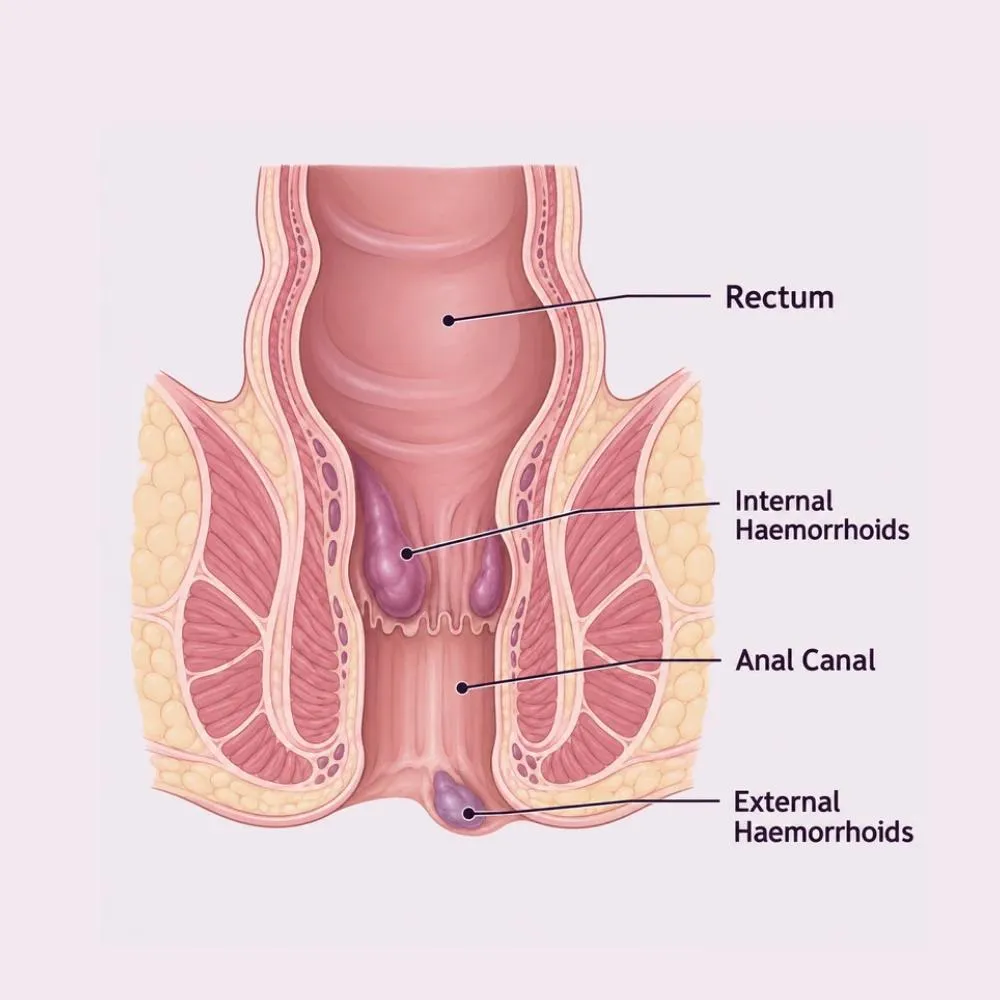
Piles, also known as haemorrhoids, are swollen and inflamed veins in the rectum or anus. They are similar to varicose veins, and can cause discomfort, itching, pain or bleeding during bowel movements.
Piles can happen because of straining during bowel movements, sitting for long periods, pregnancy, or chronic constipation. In simple terms, they are like tiny cushions or lumps in or around your bottom that have become swollen and irritated.
Piles are graded one to four by how far they protrude. Grade 1 stays inside; grade 2 comes down when you strain and goes back on its own; grade 3 needs pushing back; grade 4 stays out. The grade is what decides whether you need a cream, a clinic procedure, or an operation.
Piles happen when too much pressure is put on the veins in your bottom. These are the eight causes our proctologists see most often.
Pushing too hard while passing stool puts pressure on the veins in your bottom.
Both irritate and stress the anal area over time.
Especially on the toilet or at a desk: it increases pressure on the rectal veins.
The extra weight and pressure during pregnancy can lead to piles in women.
Doing this often, or incorrectly, strains the lower body.
Not eating enough fruit, vegetables or whole grains makes stools hard and difficult to pass.
Extra body weight puts sustained pressure on the pelvic area.
As you age, the tissues in your rectum and anus naturally weaken, making piles more likely.
In short: piles come from pressure, straining, sitting too long, or eating habits that leave stools hard to pass.
The symptoms are largely the same in men and women; the severity varies with lifestyle and with other health conditions.
Symptoms in females
Symptoms in males
Bleeding is not a symptom to wait out. It is the one piles share with conditions that need ruling out, and an examination is what tells them apart.
Diagnosis is quick, and most of it is done in the consulting room on your first visit. The point is twofold: confirm the piles, and rule out the conditions that bleed the same way.
What you are noticing, for how long, and what your bowel habits are like: this alone narrows the diagnosis considerably.
A visual check of the anal area for external piles, skin tags, swelling or a prolapsed pile.
A gloved, lubricated finger examination to feel for internal piles and check the tone of the sphincter. It takes seconds.
A short, lubricated scope that lets the surgeon see the anal canal directly and grade the piles accurately.
Advised when you are over 45, when bleeding does not fit the picture, or when there is a family history: to rule out anything higher up.
A haemoglobin check where bleeding has been heavy or prolonged, and routine pre-operative bloods if surgery is planned.
You will usually leave the first consultation knowing the grade of your piles and which treatments are open to you.
Treatment is matched to the grade of the piles and to what you would rather avoid. Most patients never reach the second list.
A small rubber band is placed around the base of the haemorrhoid to cut off its blood supply, so it shrinks and falls off.
A chemical solution is injected into the haemorrhoid to shrink it. No cut, and no hospital stay.
Infrared light coagulates the blood vessels feeding the haemorrhoid, causing it to shrink.
A high-fibre diet, more water, and not straining during bowel movements: the foundation every other treatment sits on.
A laser fibre shrinks the pile from the inside with no external cut: the least painful of the operative options, and usually a day-care procedure.
Surgical removal of large or severe haemorrhoids under anaesthesia: the definitive option for advanced grades.
A stapling device removes haemorrhoidal tissue and repositions what remains, with markedly less post-operative pain.
Ultrasound locates the arteries feeding the haemorrhoids so they can be tied off, reducing blood flow and swelling.
Which of these is right depends on the severity of the piles and on your own preference: a conversation with a colorectal surgeon, not a decision to make from a list.
The procedure most of our patients have. It takes about thirty minutes, leaves no external wound, and you go home the same day.
Laser haemorrhoidoplasty
Routine bloods, an ECG where age or history calls for one, and a fasting window of six hours before your slot.
Usually a short spinal or a brief general anaesthetic. You feel nothing during the procedure either way.
A proctoscope holds the anal canal open so the surgeon can see and reach each haemorrhoid directly. No incision is made.
A fine laser fibre is passed into the pile and energy is applied in controlled pulses, sealing the feeding vessels so the swelling collapses.
The surgeon confirms each pile has shrunk and that there is no bleeding. The sphincter is left untouched throughout, which is what protects continence.
Two to four hours in the day-care ward, a light meal, and home the same evening with medication and a follow-up date.
Because nothing is cut away and no stitches are placed externally, the pain that people most associate with piles surgery is largely absent from this one.
We offer advanced treatment options for piles in Hyderabad. Here is why patients trust us:
Led by Dr. Samhitha Reddy, one of the top proctologists in Hyderabad, our multidisciplinary team provides personalised care.
We specialise in laser piles treatment: a minimally invasive, pain-free procedure with a quick recovery time.
From the first consultation through to post-treatment follow-up, with one team throughout.
Our hospital is in HITEC CITY, near IKEA: easily reachable from across Hyderabad.
Most patients are back at a desk job inside three days. The timeline below is for laser haemorrhoidoplasty; open surgery runs roughly twice as long at every stage.
Home the same evening. Some heaviness and a mild ache, controlled with oral painkillers.
First bowel movement, usually within 24 hours and easier than expected. Light walking encouraged; desk work is realistic by day three.
Spotting on wiping is normal and settles. Sitz baths twice a day. Follow-up review at the end of the week.
Swelling resolves fully and normal activity resumes, including the gym. Driving from about day five.
Final review. The tissue has healed completely and the diet changes become the long-term prevention.
Ten minutes in warm water, twice daily for the first fortnight. It soothes and it keeps the area clean.
25–30g of fibre a day and two to three litres of water. Soft stools are what stop the piles coming back.
No phone on the toilet. Longer than five minutes on the seat undoes the point of the operation.
Nothing above ten kilos for the first three weeks: heavy lifting raises the same pressure that caused the piles.
Heavy fresh bleeding, fever, or an inability to pass urine after the procedure. Any of the three, call the ward.
Week one and week six. The second one is the one people skip, and it is the one that confirms full healing.
Recurrence after laser treatment is uncommon, and it is uncommon largely because of the diet changes: the operation fixes the pile, the fibre stops the next one.
Book a consultation if you have any of the following.
What piles treatment costs at Lux Hospitals depends on the grade, the procedure it calls for, and the room you choose. These are the ranges our patients fall into.
| Procedure | Estimated Cost |
|---|---|
| Rubber band ligation / sclerotherapy Out-patient, per session, no admission | ₹8,000 – ₹18,000 |
| Laser haemorrhoidoplasty Day care, same-day discharge | ₹45,000 – ₹75,000 |
| Stapled haemorrhoidopexy (PPH) One night’s stay | ₹55,000 – ₹90,000 |
| Open haemorrhoidectomy One to two nights’ stay | ₹40,000 – ₹70,000 |
A single grade-2 pile and three grade-4 piles are not the same operation, and the theatre time differs accordingly.
Laser costs more than a conventional haemorrhoidectomy in theatre, and less in recovery time away from work.
A shared ward, a twin-sharing room or a private suite: the largest single swing in most estimates.
We are empanelled with most major insurers, and our team files the pre-authorisation for you.
Every figure above is an indicative range, not a quote. After your consultation you are given a written, fixed-cost estimate, and that is the number you pay, with no additions once treatment begins.
What patients treated here can expect:
Relief from the pain and discomfort that brought you in.
Advanced laser procedures, most of them same-day.
An improved quality of life, with effective and lasting outcomes.
The proctologists and colorectal surgeons who treat piles at our HITEC CITY hospital.

Consultant Proctologist & Laparoscopic Surgeon
MBBS, MS, FMAS, FISCP, DMAS
8 years experience

Consultant General & Advanced Laparoscopic Surgeon
MBBS, MS, FMAS
17 years experience

Consultant Breast, Thyroid & General Surgeon
MBBS, MS (General Surgery), Fellowship in Laparoscopic Surgery
7 years experience
Reviews from patients treated for piles, fissures and fistulas at Lux Hospitals, Hyderabad.
Written by Dr. Samhitha Reddy on piles, fissures, fistulas and colorectal health.
Dr. Samhitha Reddy
Dr. Samhitha Reddy

Dr. Samhitha Reddy

Dr. Samhitha Reddy

Dr. Samhitha Reddy
Common questions about piles, its treatment, and what it costs at Lux Hospitals.
Still have questions? Call us at 079 6908 4422
Still have questions? Message us on WhatsApp at 079 6908 4444
Advanced laser and minimally invasive treatment for piles, with a fixed-cost estimate shared before treatment begins.
Plot No.116, Lumbini Avenue, HITEC CITY, Near IKEA, Hyderabad – 500032