












Partial vs Total Knee Replacement: Which Surgery Is Right for You?
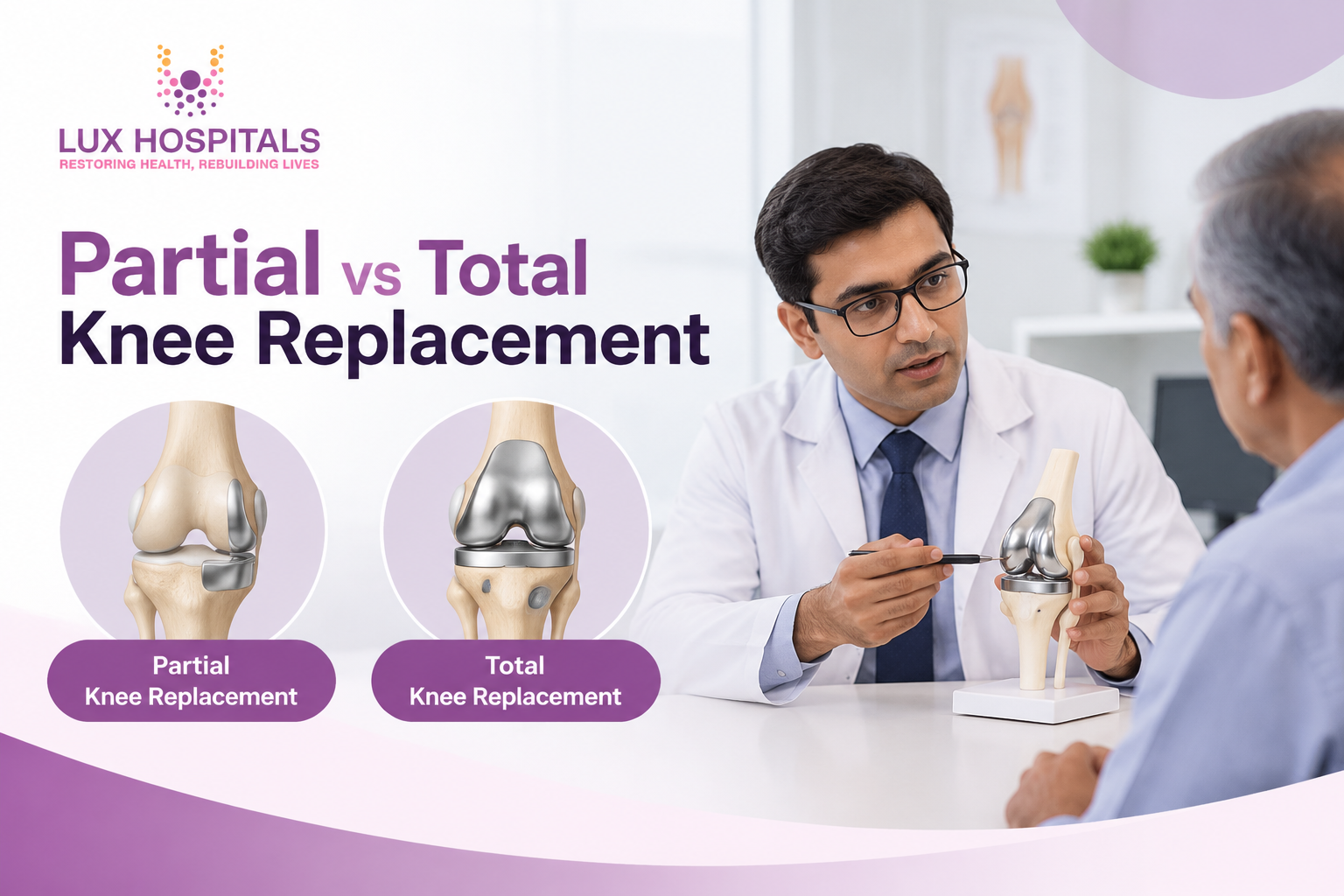
Knee pain can slowly change the way you live. Walking, climbing stairs, standing for long periods, or even getting up from a chair may become difficult. When medicines, physiotherapy, lifestyle changes, and other non-surgical treatments no longer provide enough relief, you may consider knee replacement surgery. But an important question remains Partial vs Total Knee Replacement—which one is right for you? The answer depends on the extent of joint damage, ligament health, knee alignment, symptoms, age, activity level, and overall health. A detailed orthopaedic evaluation helps determine the most suitable procedure. At Lux Hospitals, patients can discuss their symptoms, imaging results, treatment options, expected recovery, and estimated treatment costs with an orthopaedic specialist before deciding.

What Is Partial Knee Replacement?
Partial knee replacement, also called unicompartmental knee replacement, replaces only the damaged section of the knee. The knee has three main compartments, and arthritis may affect only one. When arthritis remains limited to one compartment and the rest of the knee and supporting ligaments remain healthy, partial replacement may be an option.
Potential benefits of partial replacement
- Smaller surgical area
- Preservation of more natural bone and tissue
- Usually less blood loss
- Generally quicker rehabilitation
- Potentially more natural knee movement
- Shorter hospital stay in suitable patients
Partial replacement isn’t appropriate for everyone, though. Total replacement may be more appropriate if there is significant ligament damage, considerable stiffness, inflammatory arthritis, or arthritis impacting numerous compartments.
What Is Total Knee Replacement?
Total knee replacement involves resurfacing the damaged areas of the knee joint with artificial components. It is commonly considered when arthritis affects multiple areas of the knee or when pain and disability become significant.
Total replacement may be recommended when a patient experiences:
- Severe or persistent knee pain
- Difficulty walking or climbing stairs
- Pain during rest or at night
- Persistent swelling and inflammation
- Significant knee deformity
- Reduced movement
- Poor improvement with non-surgical treatments
The goal is to reduce pain and improve everyday function, not simply treat an X-ray finding. Base the decision on symptoms, physical examination, imaging, and overall health.
Partial vs Total Knee Replacement: Key Differences
Understanding partial vs. total knee replacement can help patients have a more productive conversation with their orthopaedic surgeon.
| Feature | Partial Knee Replacement | Total Knee Replacement |
| Area treated | One damaged compartment | Multiple/all affected compartments |
| Bone preservation | More natural bone preserved | More joint surfaces resurfaced |
| Surgical extent | Smaller | More extensive |
| Recovery | Often quicker in suitable patients | Usually requires longer rehabilitation |
| Ligaments | Healthy supporting ligaments are important | May involve different ligament management |
| Best suited for | Localised arthritis | More widespread arthritis |
| Future surgery | Further replacement may sometimes be needed | Revision may be required if the implant later fails |
When carefully chosen individuals match the requirements, partial replacement can provide great results. However, if arthritis has spread throughout the knee, partial surgery is not a good option just because it is smaller.
Partial vs Total Knee Replacement: Which Is Better?
There is no universal answer to Partial vs Total Knee Replacement.
Partial replacement may be considered when:
- Arthritis is mainly confined to one compartment.
- The knee’s supporting ligaments are functioning well.
- Knee movement remains reasonably good.
- Other areas of the joint remain relatively healthy.
- Symptoms are significant despite non-surgical treatment.
Total replacement may be considered when:
- Arthritis affects multiple compartments.
- Pain significantly affects daily activities.
- There is considerable stiffness or deformity.
- Conservative treatments have not provided sufficient relief.
- The overall condition of the knee makes partial replacement unsuitable.
Your surgeon may also use X-rays and physical examination to assess joint damage, alignment, movement, and ligament stability before recommending surgery.
Partial vs Total Knee Replacement: Recovery
Everybody recovers differently. For suitable candidates, partial knee replacement may enable quicker rehabilitation because it often requires a smaller surgical site. Total knee replacement usually requires a structured rehabilitation programme involving:
- Pain management
- Early movement
- Walking exercises
- Physiotherapy
- Strengthening exercises
- Gradual return to everyday activities
Following your surgeon’s rehabilitation plan is important for improving mobility and function.
Partial vs Total Knee Replacement: Complete Cost Guide
One of the most common questions patients ask is, “How much will my knee replacement cost?” The answer varies considerably because treatment costs depend on the hospital, city, implant, room category, surgeon’s fees, investigations, hospital stay, medicines, rehabilitation, and other individual requirements. Current published Indian estimates place partial knee replacement costs in a range, depending on the treatment setting and components used. These are broad market estimates, not a quotation from Lux Hospitals.
What can influence your final bill?
- Type of knee replacement
- Implant type and specifications
- Surgeon and operating-team charges
- Hospital room category
- Anaesthesia charges
- Diagnostic investigations
- Medicines and consumables
- Length of hospital stay
- Physiotherapy and rehabilitation
- Additional medical conditions requiring management
Therefore, patients should ask for a personalised estimate after clinical assessment rather than relying only on an online cost range. At Lux Hospitals, discussing the expected procedure and treatment plan with the orthopaedic team can help patients understand what is included in their estimated treatment cost.
How Lux Hospitals Helps You Choose the Right Procedure
Choosing between Partial vs Total Knee Replacement should not be based only on cost, age, or the size of the incision.
A specialist evaluation considers:
- Location of arthritis – Is the damage confined to one compartment or more widespread?
- Ligament condition – Are the important supporting ligaments stable?
- Knee movement – Is there significant stiffness?
- Alignment – Is there a major deformity?
- Pain and function – How much does the condition affect daily life?
- Imaging findings – What do X-rays and other assessments show?
- Overall health – Can the patient safely undergo surgery and rehabilitation?
The American Academy of Orthopaedic Surgeons also notes that the choice of implant and procedure depends on factors such as knee anatomy, health, activity level, and individual needs. At Lux Hospitals, the objective is to help patients understand their options and make an informed treatment decision with their orthopaedic specialist.
Conclusion
The choice between partial and total knee replacement is highly individual. Partial replacement may suit carefully selected patients with localised arthritis, while total replacement can be appropriate when damage affects multiple areas of the knee. If knee pain is affecting your walking, sleep, work, or everyday activities, don’t decide on surgery based on online cost comparisons alone. Get your knee properly evaluated and discuss the benefits, limitations, recovery, risks, and expected costs with an experienced orthopaedic specialist at Lux Hospitals.
Frequently Asked Questions
Because the best option relies on the degree and location of knee injury, neither technique is inherently superior. When arthritis affects only one compartment, partial replacement may help; when multiple sections are affected, total replacement may be more appropriate.
Because partial knee replacement preserves more natural structures and fixes a smaller section of the joint, it typically allows for a quicker recovery. However, the patient's health, rehabilitation, surgical results, and compliance with physiotherapy all affect actual recovery.
Procedure, hospital, implant, city, room type, and other treatment requirements all affect costs. Patients should get an individual hospital estimate, although broad projections for 2026 set partial replacement at and total replacement
Lux Hospitals' orthopaedic team can assess symptoms, physical examination findings, knee movement, ligament stability, alignment, and imaging before recommending an appropriate treatment approach. The final decision should be personalised to the patient's joint condition, not based solely on cost or recovery time.
Yes, patients can consult the orthopaedic team at Lux Hospitals to discuss persistent knee pain, mobility problems, imaging findings, and possible treatment options. A specialist assessment can help determine whether continued non-surgical care, partial replacement, total replacement, or another approach may be appropriate.