












Uneven Chest Muscles: Causes, How to Improve Them and When to See a Doctor
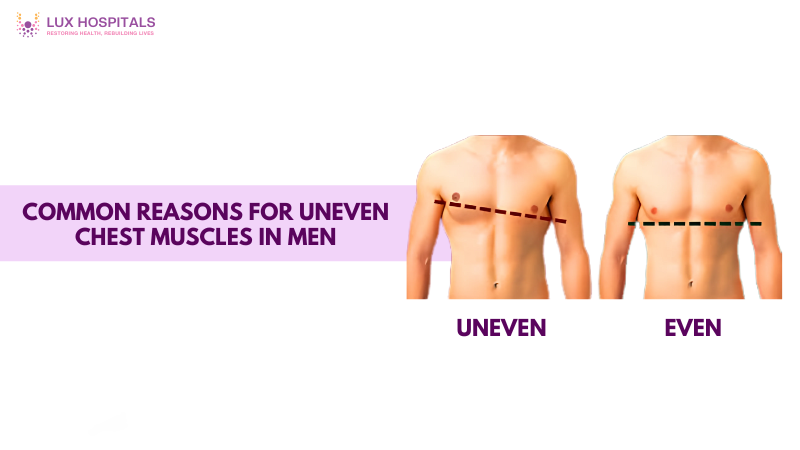
Uneven chest muscles mean that one pectoral muscle—the muscle at the front of your chest—looks larger, smaller or more defined than the other. Differences in training technique, previous injuries, posture and chest-wall structure can contribute to this appearance.
However, one side of your chest looking bigger does not always mean that your muscles are uneven. Fat distribution or gynecomastia, which is enlarged breast gland tissue in men, can also affect chest shape.
The right approach depends on the cause. Exercise adjustments may help a training-related imbalance, but a new lump, increasing swelling or nipple changes need medical assessment.
Is It Normal for One Pec to Be Bigger Than the Other?
A small difference between the two sides of your chest can occur naturally. Your muscles, ribs and shoulders may not be perfectly symmetrical.
A longstanding, slight difference without pain or other changes may simply reflect your anatomy or training habits. However, appearance alone cannot confirm this.
Arrange an assessment if the difference is new, increasing, painful or accompanied by a lump or changes around the nipple.
What Causes Uneven Chest Muscles?
Several factors can affect the size, strength or appearance of your chest muscles. More than one may contribute.
1. Unequal Loading During Exercise
During a chest exercise, one side may push more strongly or move differently from the other. This can happen without you noticing, particularly when the weight is difficult to control.
Repeated differences in loading may contribute to differences in muscle development. Being right-handed or left-handed does not, by itself, establish which pec should be larger.
2. Poor Exercise Form or Bench Press Technique
An uneven bar path, different elbow positions or one shoulder moving forward can affect how you perform a press.
If the bar consistently tilts or one arm finishes the movement first, review your technique. Reducing the weight can make it easier to control the movement.
3. Previous Injury or Surgery
A chest, shoulder or arm injury can affect strength, movement and how much you use one side. Recovery after surgery can also temporarily change your activity.
An injured side may lose muscle through reduced use, while the other side compensates. This muscle loss is different from gynecomastia.
If asymmetry follows an injury, assessment by a doctor or physiotherapist can help identify the problem before you increase training.
4. Posture and Shoulder Position
The position of your shoulders and torso can make one side of your chest look different.
For example, rotation through the upper body or one shoulder sitting farther forward may change how the chest appears, even without a major difference in muscle size.
Posture and muscle development should be assessed separately rather than assuming that every visible difference needs strengthening.
5. Differences in Chest-Wall Structure
The shape of your ribs, breastbone or spine can influence chest symmetry. Some structural differences are present from birth; others become more noticeable as the body develops.
Exercise does not change the underlying shape of the bones. An assessment can help distinguish structural asymmetry from a training-related imbalance.
6. Differences in Muscle Function
Pain, restricted movement or difficulty controlling a movement can affect how each side works.
Persistent weakness, numbness or a noticeable loss of muscle needs assessment. Simply adding more exercises to the weaker side may not address the underlying cause.
How Can You Improve Uneven Chest Muscles?
First, establish whether the difference is actually muscle-related. If there is a lump, swelling, pain or a recent change in shape, seek assessment before treating it as a gym problem.
For a training-related imbalance, the following adjustments may help.
Review Your Technique
Use a manageable weight and check whether both sides move with control. A qualified trainer or physiotherapist can assess your shoulder position, movement range and exercise technique.
Recording a set may help you notice a tilted bar or uneven movement, but it cannot diagnose the cause of asymmetry.
Consider Exercises That Let Each Side Work Independently
Dumbbells, cables or resistance bands can allow each side to work independently, depending on the exercise.
Choose movements you can perform comfortably and with control. Unilateral exercise is one possible training adjustment, rather than a guaranteed solution for every uneven chest.
Avoid Adding Excessive Work to One Side
Do not automatically add extra weight or many more repetitions to the smaller side. The appearance may reflect structure, posture or injury rather than a simple lack of training.
A balanced programme should suit your current strength, movement and recovery.
Progress Gradually
Increase exercise difficulty only when you can maintain comfortable, controlled technique. Stop an exercise if it causes pain or unusual symptoms.
Seek Guidance When Needed
Professional assessment is useful if the difference is substantial, follows an injury, affects strength or persists despite appropriate training adjustments.
How Long Does It Take to Improve Chest Muscle Asymmetry?
There is no fixed timeline.
Changes depend on whether the cause is muscle development, posture, injury, chest-wall structure or breast tissue. Training-related differences may change gradually, while structural differences may remain.
Complete symmetry is not always achievable or necessary. Comfortable movement, strength and function are more useful goals than making both sides look identical.
| Possible cause | What you may notice | Appropriate next step |
|---|---|---|
| Muscle imbalance | A difference in muscle size, strength or movement during exercise | Review technique; seek assessment if weakness or symptoms persist |
| Chest fat | Soft fullness across the chest | Assessment if the fullness is new, uneven or concerning |
| Gynecomastia | Enlargement around the breast or nipple area, sometimes with tenderness | Medical assessment to establish the cause |
| Chest-wall asymmetry | A difference in rib, breastbone or shoulder position | Assessment if pronounced, changing or affecting function |
Gynecomastia involves breast gland tissue, rather than simply an underdeveloped pec. It can affect one or both sides. Exercise does not directly remove enlarged gland tissue, although it may change muscle size and overall body composition.
Avoid diagnosing the cause by pressing around the nipple or comparing photographs. A clinician can assess whether the difference involves muscle, fat, breast tissue or chest-wall structure.
When Should You See a Doctor?
Arrange medical assessment if you notice:
- A new lump in the breast, chest or armpit
- One side becoming progressively larger
- Persistent breast or nipple pain
- Nipple discharge, including blood
- Nipple pulling inward or changes to the overlying skin
- Weakness or a change in chest shape after an injury
Do not wait for several months of exercise when these symptoms are present. Breast or nipple lumps and other changes should be checked.
How Uneven Chest Is Assessed and Treated at Lux Hospitals
Treatment depends on the cause, so the first step is finding out why your chest is uneven. At Lux Hospitals, Hyderabad, Dr. M. Ram Prabhu examines the chest to check whether the difference comes from muscle, fat, bone structure or gynecomastia, and may suggest an ultrasound if needed.
- Muscle imbalance: a corrective training plan, with physiotherapy referral if an old injury is involved
- Excess chest fat: guidance on diet and exercise for overall fat loss
- Gynecomastia: a discussion of options, which may include gynecomastia surgery when the tissue doesn’t settle on its own
You’ll get a clear explanation of what’s causing the difference and whether you need any treatment at all.
Frequently Asked Questions
Possible explanations include differences in muscle development, exercise technique, posture, chest-wall shape, fat distribution or breast gland tissue. Appearance alone cannot identify the cause.
Some training-related differences may improve with suitable exercise adjustments. Differences caused by injury or chest-wall structure may need another approach. Complete symmetry cannot be guaranteed.
Handedness does not reliably determine which pec will look bigger. Training technique, injury, shoulder position and anatomy may contribute.
Home exercises may help an established training-related imbalance, provided they are appropriate for you. Seek assessment first if you have a lump, pain, swelling, weakness or a recent change in shape.
Unequal loading during a bench press may contribute to uneven muscle development. However, bench press alone does not explain every difference in chest shape.
Yes. Gynecomastia can affect one or both sides. A new or changing breast enlargement needs assessment rather than an assumption that it is gynecomastia.
If you notice a lump, sudden swelling, pain, nipple discharge, or a change that persists despite 3 months of balanced training, consult a specialist at Lux Hospitals, Hyderabad. Book an appointment today for proper evaluation and personalised care.