











VASER Liposuction vs Traditional Liposuction: Which Is Better?
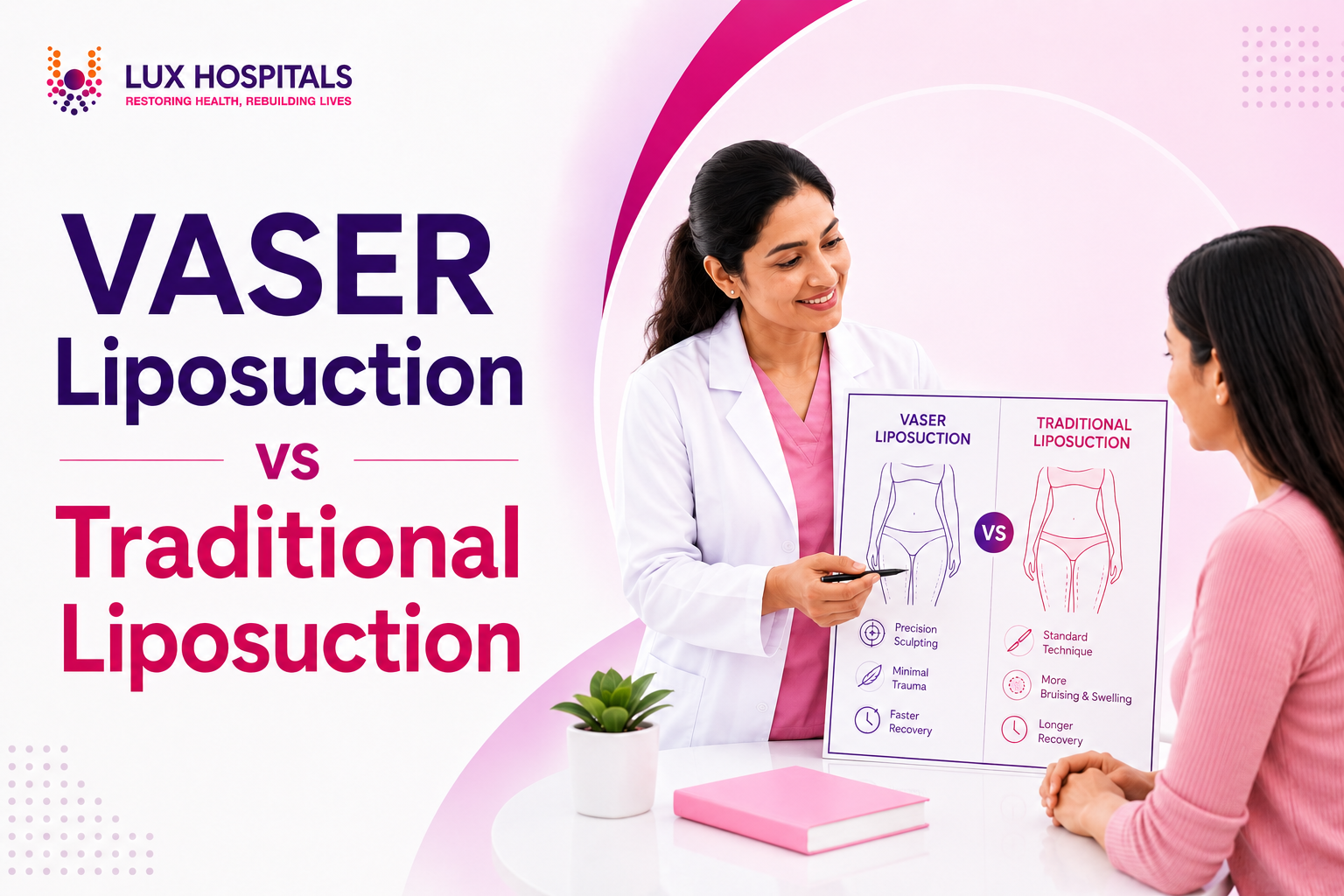
If stubborn fat remains despite regular exercise and a balanced diet, liposuction may be an option. Two commonly discussed approaches are VASER liposuction and traditional liposuction. This often leads patients to ask VASER Liposuction vs Traditional Liposuction: Which Is Better? These procedures aim to improve body shape and remove excess fat. However, they use distinct methods to separate and remove fat. If you understand the differences, you can talk to a licensed plastic surgeon at Lux Hospitals about the best choice.
What Is VASER Liposuction?
Vibration Amplification of Sound Energy at Resonance is called VASER. It uses ultrasound energy to break apart and separate fat cells before removing them. During treatment, the surgeon makes small openings and inserts a thin probe into the targeted area. Ultrasound energy helps loosen the fat, which the surgeon then removes using gentle suction.

Key Features of VASER Liposuction
- Uses ultrasound energy to assist fat separation.
- Can target specific areas of unwanted fat.
- Allows the surgeon to work around certain tissues with precision.
- May support detailed body contouring in suitable patients.
- Can sometimes be used for areas where more definition is desired.
When considering VASER Liposuction vs Traditional Liposuction, VASER may appeal to patients who want more detailed contouring rather than simply reducing overall fat volume.
What Is Traditional Liposuction?
Traditional liposuction, also known as suction-assisted liposuction, uses a cannula to loosen and remove fat. The surgeon inserts the cannula beneath the skin after making tiny incisions near the treatment area. The surgeon uses controlled movements to remove dislodged fat with suction. For many years, traditional liposuction has been a well-established method of body sculpting.
Common Areas Treated
Depending on the patient’s anatomy and treatment plan, liposuction may be performed on areas such as:
- Abdomen
- Waist
- Hips
- Thighs
- Arms
- Back
- Chin and neck
The procedure is designed for body contouring, not general weight loss.
VASER Liposuction vs Traditional Liposuction: Key Differences
The biggest difference is how the fat is prepared for removal.
VASER uses ultrasound energy to help separate fat before suction, while traditional liposuction relies mainly on mechanical cannula movement and suction.
| Feature | VASER Liposuction | Traditional Liposuction |
| Fat separation | Ultrasound-assisted | Mechanical technique |
| Main goal | Fat removal and detailed contouring | Fat removal and contouring |
| Technology | VASER ultrasound system | Suction-assisted technique |
| Precision | May support detailed contouring | Effective for established body contouring |
| Suitability | Depends on anatomy and goals | Depends on anatomy and goals |
| Recovery | Varies by treatment extent | Varies by treatment extent |
For every person, neither VASER liposuction nor traditional liposuction is intrinsically better. When selecting a course of therapy, the surgeon should consider the patient’s desired outcome, medical history, body shape, fat distribution, and skin quality.
VASER Liposuction vs Traditional Liposuction: Which Is Better?
The answer depends on what you want to achieve.
VASER may be considered when a patient wants targeted fat removal with more detailed contouring. The ultrasound-assisted approach can help separate fat before removal, which may be useful when the surgeon wants greater control over body sculpting. In many regions, traditional liposuction remains a dependable way to remove excess fat. When the primary objective is to remove localised fat without the need for extremely intricate sculpting, it might be appropriate. Therefore, you should decide between VASER liposuction and traditional liposuction through an individual assessment rather than by choosing the newest-sounding technology.
When VASER May Be Considered
VASER may be appropriate for selected patients who:
- Have localised areas of stubborn fat.
- Maintain a relatively stable weight.
- Want improved body contours.
- Have realistic expectations.
- Have sufficient skin elasticity.
- Are medically suitable for surgery.
When Traditional Liposuction May Be Considered
Traditional liposuction may be suitable when:
- Localised fat needs removal.
- The treatment area suits conventional suction-assisted liposuction.
- The patient wants body contouring rather than major weight reduction.
- The surgeon determines that traditional liposuction can achieve the desired result.
VASER Liposuction vs Traditional Liposuction: Benefits of VASER
In carefully chosen patients, VASER may provide some benefits.
1. Ultrasound-Assisted Fat Separation
The ultrasound energy helps separate fat before suction, which can assist the surgeon during fat removal.
2. Detailed Contouring
VASER can be useful when the treatment plan involves more focused sculpting of specific body areas.
3. Targeted Treatment
The surgeon can concentrate on particular fat deposits rather than treating the body as a whole.
4. Potentially Useful for Definition
In selected patients with appropriate anatomy and skin quality, VASER may be incorporated into a plan to enhance body definition. However, results depend heavily on the surgeon’s technique, patient anatomy, skin elasticity, and postoperative care.
VASER Liposuction vs Traditional Liposuction: Benefits of Traditional Liposuction
Traditional liposuction also has several advantages.
Proven Technique
It has a long history of use for removing localised fat and improving body contours.
Versatile Application
It can be used on several body areas for appropriate candidates.
Straightforward Fat Removal
For patients who primarily need localised fat reduction, traditional suction-assisted liposuction may provide an effective approach.
Established Surgical Method
Plastic surgeons have extensive experience with conventional liposuction techniques, allowing them to adapt treatment plans to individual anatomy.
Who Is a Good Candidate for Liposuction?
Liposuction is generally intended for people who are near a stable, healthy weight but have localised fat deposits that do not respond well to lifestyle measures.
A good candidate typically has:
- Stable body weight
- Realistic expectations
- Localised fat deposits
- Good general health
- Reasonable skin elasticity
- Willingness to follow postoperative instructions
Liposuction does not treat obesity and should not replace healthy eating or regular physical activity.
What About Recovery?
The amount of fat removed, the technique, the treatment region, and the patient’s health all affect recovery. Patients may have transient numbness, bruising, swelling, and discomfort following surgery. Depending on the surgeon’s protocol, compression garments are often recommended during healing.
Your surgeon may advise you to:
- Wear compression garments as instructed.
- Walk gently as recommended.
- Avoid strenuous activity initially.
- Keep follow-up appointments.
- Take prescribed medicines correctly.
- Report unusual symptoms promptly.
Remember that swelling can temporarily hide the final contour. Results become clearer as the body heals.
Is VASER Liposuction Safer Than Traditional Liposuction?
Patients often assume that newer technology automatically means greater safety. That is not necessarily true. Risks associated with both surgical procedures include bleeding, infection, fluid changes, uneven contours, changes in feeling, oedema, bruises, and anaesthesia-related problems. Adequate patient selection, surgical planning, sterile procedure, skilled medical care, and adequate postoperative monitoring are all necessary for safety. For this reason, discuss both anticipated advantages and possible hazards when comparing VASER liposuction to traditional liposuction.
How Lux Hospitals Helps You Choose the Right Procedure
At Lux Hospitals, the focus should be on choosing a treatment that matches the patient’s anatomy and aesthetic goals, not selecting a procedure simply because it is popular.
During consultation, a plastic surgeon can evaluate:
- Fat distribution
- Skin elasticity
- Body proportions
- Medical history
- Previous procedures
- Treatment expectations
- Recovery considerations
Based on this assessment, the surgeon can explain whether VASER, traditional liposuction, or another approach is appropriate.
VASER Liposuction vs Traditional Liposuction: What Should You Choose?
There is no obvious winner when comparing VASER with traditional liposuction. VASER may be a good option for people who want precise contouring and focused fat removal, while traditional liposuction still works well for many localised fat concerns. The best solution depends on your body type, goals, skin type, treatment area, and the surgeon’s assessment. See a qualified plastic surgeon at Lux Hospitals before choosing between VASER and conventional liposuction. A tailored consultation can help you understand realistic results, recovery, risks, and the best approach for you.
Conclusion
Don’t choose between VASER and traditional liposuction based only on technology. Both procedures can help improve body contours when performed on suitable patients by an appropriately trained surgeon. Understanding VASER liposuction vs. traditional liposuction can help you ask better questions and make a more informed decision. At Lux Hospitals, we can tailor your treatment plan to your body-contouring goals, health needs, and expected outcome. Decide on the right procedure after a professional evaluation, not based on technology alone. At Lux Hospitals, experienced plastic and cosmetic surgery specialists can assess your needs and recommend an approach that supports safe, natural-looking body contours.
Frequently Asked Questions
VASER may offer advantages for selected patients who want detailed body contouring because it uses ultrasound energy to help separate fat. Traditional liposuction remains effective for many patients and may be the better choice when straightforward localised fat removal is the main goal.
Pain and discomfort depend on the area treated, the amount of fat removed, the surgical technique, and the patient's recovery. Soreness, swelling, and bruising are possible side effects of both therapies, but they usually subside as the body heals.
Recovery depends on the number and size of treatment areas and the extent of the procedure. Many patients gradually return to normal activities as healing progresses, while strenuous exercise may need to wait until the surgeon confirms it is safe.
Lux Hospitals focuses on individualised treatment planning, with assessment of body shape, fat distribution, skin quality, health status, and aesthetic goals. A consultation helps determine whether VASER, traditional liposuction, or another treatment is appropriate.
Patients considering VASER liposuction can consult the plastic and cosmetic surgery team at Lux Hospitals to discuss their concerns and treatment goals. The surgeon can assess suitability and explain the available body-contouring options, expected results, risks, and recovery.