












Laser Kidney Stone Surgery vs Traditional Surgery: Which Is Better?
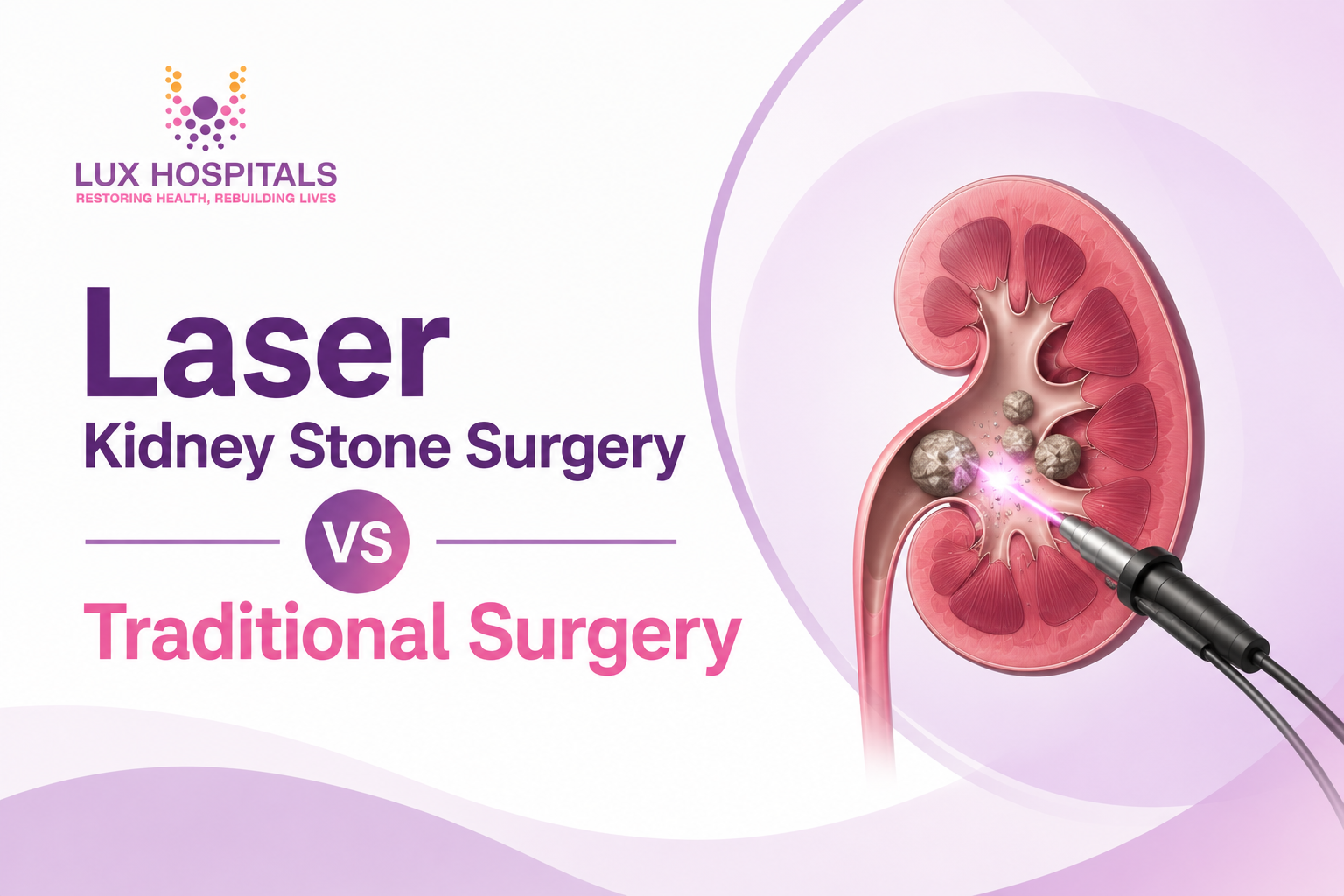
Kidney stones can cause sudden, severe pain, nausea, vomiting, blood in the urine, and difficulty passing urine. If a stone is too large to pass naturally or causes repeated symptoms, you may need treatment. But with several treatment options available today, many patients ask Laser Kidney Stone Surgery vs Traditional Surgery: Which Is Better? The size, location, quantity, hardness, urinary tract structure, and overall health all affect the outcome. For many patients, modern laser techniques have eliminated the necessity for traditional open stone surgery. Nonetheless, techniques like percutaneous nephrolithotomy (PCNL) and shock wave lithotripsy (SWL) continue to play significant roles. At Lux Hospitals, urologists evaluate the individual stone before recommending the most suitable treatment.

What Is Laser Kidney Stone Surgery?
Laser kidney stone surgery is usually performed through a minimally invasive procedure called ureteroscopy or retrograde intrarenal surgery (RIRS). A thin scope is passed through the natural urinary passage to reach the stone. A laser then breaks the stone into tiny fragments or dust. Depending on the stone, fragments may be removed with a small basket or allowed to pass naturally. When comparing Laser Kidney Stone Surgery vs Traditional Surgery, laser treatment generally offers the advantage of reaching stones without making a large incision.
How Does Laser Stone Removal Work?
The procedure usually involves these steps:
- The patient receives appropriate anaesthesia.
- The urologist guides a thin ureteroscope through the urinary tract.
- The urologist locates the stone using direct vision.
- A laser breaks the stone into smaller fragments.
- The urologist may remove larger fragments with a basket.
- A temporary ureteral stent may be placed when clinically required.
- The patient is monitored during recovery.
Modern holmium and thulium fibre lasers are established technologies for stone fragmentation during ureteroscopy.
What Is Traditional Kidney Stone Surgery?
The term “traditional surgery” can refer to different approaches. In modern practice, it may include shock wave lithotripsy, PCNL, or, much less commonly, open or laparoscopic stone surgery.
Shock Wave Lithotripsy
SWL uses externally generated shock waves to break kidney or ureteral stones into smaller pieces. The fragments can then pass through the urinary tract. It is less invasive than surgical stone removal, but some patients may require additional treatment if the stone does not break adequately or fragments do not clear.
Percutaneous Nephrolithotomy
PCNL involves creating a small access tract through the skin into the kidney. Special instruments remove or fragment larger kidney stones. PCNL remains an important treatment for large renal stones, particularly when the stone burden is substantial.
Open Surgery
Nowadays, kidney stones seldom require open surgery. Advancements in SWL, ureteroscopy, RIRS, and PCNL have greatly reduced the need for open surgery. Current standards suggest using open or laparoscopic stone surgery only in specific circumstances, when all other options have failed or are inappropriate.
Laser Kidney Stone Surgery vs Traditional Surgery: Key Differences
Patients can have a more informed conversation with their urologist if they understand the differences.
Features | Laser Surgery | Traditional/Other Procedures |
| Access | Usually through natural urinary passage | May use shock waves or a small kidney access tract |
| Incision | Usually no external incision | PCNL requires a small skin incision |
| Stone fragmentation | Laser energy | Shock waves or surgical instruments |
| Stone location | Can access many kidney and ureter locations | Effectiveness varies by technique and stone position |
| Recovery | Usually relatively quick | Depends on the procedure |
| Repeat treatment | Often effective in one session, but depends on stone | May require additional treatment |
| Best suited for | Many ureter and kidney stones | Depends on stone size, location and patient factors |
Research and guidelines indicate that ureteroscopy can provide a higher chance of achieving stone-free status in a single procedure for many ureteral stones. At the same time, SWL may have lower morbidity but can require retreatment.
Laser Kidney Stone Surgery vs Traditional Surgery: Which Is Better?
No single procedure is best for every patient.
For many patients with appropriately located kidney or ureteral stones, laser ureteroscopy can provide direct access and effective fragmentation without an external incision. It can be especially useful when a stone is difficult to target with SWL or when a patient wants a higher likelihood of stone clearance from one procedure. SWL may be appropriate for certain small kidney stones; PCNL is preferable for larger or more complicated stones. According to current standards, PCNL is still the recommended procedure for many large renal calculi. Therefore, the right question is: Which treatment is safest and most successful for my particular stone? Rather than just Laser Kidney Stone Surgery vs. Traditional Surgery.
Laser Kidney Stone Surgery vs Traditional Surgery: Advantages of Laser Treatment
Laser treatment may offer several benefits when it is clinically appropriate.
1. Minimally Invasive Approach
The ureteroscope is introduced through the natural urinary passage, so there is generally no large external surgical incision.
2. Direct Stone Access
The surgeon can see the stone immediately and apply the laser exactly where it is needed.
3. Effective Fragmentation
Laser radiation breaks stones into smaller pieces, making removal or natural passage easier.
4. Useful for Difficult Stone Locations
Because flexible ureteroscopes can reach many kidney regions, RIRS helps treat stones that can be challenging to treat externally.
5. Potentially Faster Return to Routine
Because there is usually no large external wound, recovery can be relatively convenient for suitable patients. However, recovery varies according to the procedure, stone burden, anaesthesia, and individual health.
Laser Kidney Stone Surgery vs Traditional Surgery: Are There Any Risks?
Like every medical procedure, laser stone treatment has possible risks.
These can include:
- Temporary blood in the urine
- Burning or urinary discomfort
- Urinary infection
- Stent-related discomfort
- Ureteric injury
- Residual stone fragments
- Need for another procedure in selected cases
The overall complication rate after ureteroscopy varies across studies, and most reported complications are minor, although serious complications such as infection can occur. Your urologist should assess infection risk, kidney function, medications, previous procedures, stone size, and other medical factors before treatment.
Who May Need Laser Kidney Stone Surgery?
Laser treatment may be considered when:
- The stone is unlikely to pass on its own.
- Pain continues despite medication.
- The stone causes urinary obstruction.
- The stone is difficult to target with SWL.
- Previous stone treatment has failed.
- The stone’s location makes ureteroscopy suitable.
- A patient requires active stone removal.
Not every kidney stone requires surgery. Some smaller, uncomplicated stones can be monitored or managed conservatively under medical supervision.
Laser Kidney Stone Surgery vs Traditional Surgery: How Is the Right Option Chosen?
Your urologist may consider several factors before recommending treatment:
Stone Size
Depending on their properties, larger stones may need phased treatment, PCNL, or RIRS.
Stone Location
A stone in the ureter may require a different approach from a stone deep inside the kidney.
Stone Composition
Because they are tougher, some stones may react differently to fragmentation techniques.
Urinary Tract Anatomy
Kidney and ureter anatomy can affect access and treatment success.
Previous Treatment
If SWL has already failed, ureteroscopy may be considered depending on the clinical situation.
Overall Health
Medical conditions, infection, medications, and anaesthesia considerations can influence the treatment decision. The 2026 AUA guideline emphasises individualised treatment selection based on patient considerations, urinary tract architecture, stone features, patient preferences, available resources, and medical skill.
Laser Kidney Stone Surgery vs Traditional Surgery: What Should Patients Expect?
Patients should not choose a procedure based only on the word “laser.” A minimally invasive technique can still require careful planning and follow-up.
Before treatment, your urologist may recommend imaging and urine testing to understand the stone and rule out infection.
After treatment, you may need:
- Adequate hydration as advised by your doctor
- Prescribed medicines
- Follow-up imaging
- Temporary stent removal if a stent was placed
- Stone analysis in selected cases
- Dietary and lifestyle measures to reduce recurrence
If you develop fever, severe pain, vomiting, difficulty passing urine, or worsening symptoms after treatment, contact your healthcare provider promptly.
Why Choose Lux Hospitals for Kidney Stone Treatment?
Kidney stone care at Lux Hospitals focuses on precise diagnosis, appropriate procedure selection, modern urological techniques, and personalised patient care. The goal is not simply to remove the stone but to choose an approach that considers stone characteristics, kidney health, recovery needs, and the possibility of future stones. If you are confused about Laser Kidney Stone Surgery vs Traditional Surgery, consulting an experienced urologist can help you understand which option fits your condition.
Conclusion
So, Laser Kidney Stone Surgery vs Traditional Surgery has no universal winner. Laser ureteroscopy can be an effective minimally invasive option for many suitable kidney and ureteral stones, while SWL and PCNL remain valuable treatments for carefully selected patients. The safest choice depends on your stone size, location, composition, symptoms, anatomy, kidney function, and overall health. A personalised urological evaluation is the best way to determine whether laser treatment or another approach is appropriate for you. At Lux Hospitals, patients can discuss their diagnosis and treatment options with a urology specialist and make an informed decision based on their individual needs.
Frequently Asked Questions
Although laser ureteroscopy can provide direct stone access and a good chance of clearing many eligible stones, not all patients will benefit. Stone size, placement, anatomy, health, and prior treatment all influence the decision.
Stone burden, the procedure, anaesthesia, stent use, and personal health all affect recovery. Many patients can return to their regular activities right away, but their urologist will provide specific guidelines and follow-up instructions.
Flexible ureteroscopy and laser technology can treat certain larger stones; however, PCNL may be more appropriate for particularly large or complicated renal stones. Stone size, placement, anatomy, and the possibility of successful clearance all influence the final decision.
Lux Hospitals provides evaluation and treatment planning based on the patient's stone characteristics, symptoms, kidney health, and overall medical needs. Patients can discuss minimally invasive options such as ureteroscopy and laser lithotripsy with a qualified urology team.
Patients can consult the urology team at Lux Hospitals to determine whether laser stone treatment is appropriate for their particular condition. The team recommends a procedure after evaluating imaging, stone characteristics, symptoms, and other relevant health factors.